


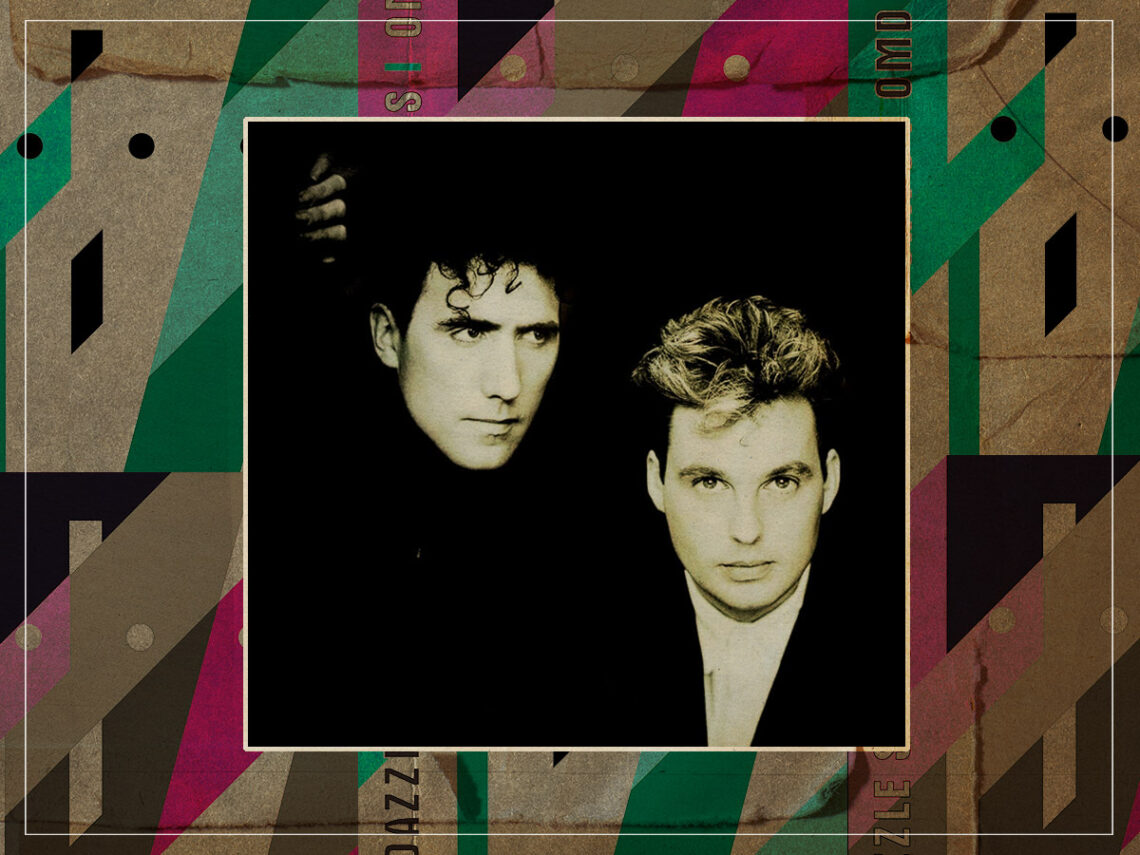
‘Dazzle Ships’: Orchestral Manoeuvres in the Dark’s confounding classic

It’s hard to overstate how important Orchestral Manoeuvres in the Dark’s debut album was to the nascent UK synthpop explosion. Having seen the neon light when first hearing Kraftwerk‘s ‘Autobahn’ in 1974, core members and old primary school friends Andy McCluskey and Paul Humphreys cut their hair, ditched the flares, and cycled through various Wirral-based local bands before blooming into a fully-fledged electronic group by ’78, adopting the OMD name and playing their first gig at Liverpool’s famous Eric’s Club in October of that year.
Along with The Human League’s early records and the John Foxx-fronted Ultravox, OMD’s self-titled ’80 debut sat in every budding synthesist’s record collection as the proliferation of accessible, portable synths such as the Moog Source and the Korg 700S finally pulled electronic tonalities away from the rock behemoths that could afford it to the bedroom musicians of the likes of Soft Cell’s Dave Ball and Depeche Mode’s original songwriter Vince Clarke, crediting ‘Almost’, the B-side to OMD’s debut single ‘Electricity’, as guiding him on a path to the synthesizer.
Success came to OMD effortlessly. Following the acclaim showered on Organisation and its lead single ‘Enola Gay’, McCluskey and Humphreys, with the recruitment of drummer Malcolm Holmes and Martin Cooper on saxophone, strode forward past the synthpop crowd’s New Romantic fashionista tendencies, donned bank clerk shirts and ties and spun a third record featuring two singles dedicated to the French patron saint Joan of Arc and soaked in the rich, choral washes of the Mellotron. It shouldn’t have worked, but ’81’s Architecture & Morality reached number three on the UK Albums chart despite its mixed critical reception, carving a sweepingly ambitious LP of evocative romanticism that still managed to mine a shining popcraft amid its lofty splendour.
It appeared OMD could have their cake and eat it. So far, their artistic radicalism was rewarded with commercial success, but the previous two years of incessant recording and touring had taken its toll, zapping any new ideas and triggering a bout of writer’s block. Resurrecting two B-sides and playing with the new E-mu Emulator sampling technology, McCluskey and Humphreys ploughed through their creative stumbling block with an unwavering belief in their King Midas’ touch and a desire to report on the global political machinations heating up as they began the sessions for their awaited fourth LP.
Dropped in March ’83 amid a febrile Cold War escalation and the alarming aggression in America’s NeoCon foreign policy, Dazzle Ships‘ melancholic collages of communist radio samples and austere blasts of musique concrète hadn’t endeared them to the pop charts and cut a chilly presence in a national mood that had swiftly veered into self-satisfied post-Falklands triumphalism coinciding with synthpop’s lurch to trite derivativity. A strain of disquieting paranoia bristles amid the documents of Czechoslovak radio announcements, speaking clocks, and news bulletins reporting on the Somoza regime’s violence during the Nicaraguan Civil War, OMD’s world reportage capturing the pivot of mass communication and all the confusing media noise and geopolitical disarray that followed.
Dazzle Ships‘ industrial disquiet is countered with McCluskey and Humphrey’s fiercely inventive pop chops. Lead single ‘Genetic Engineering’ manages to wield typewriter clangour and Speak & Spell toy vocal synthesis to score their fascination with DNA tampering, and the pair conjure one of their most joyously buoyant pieces with second single ‘Telegraph’, a satirical puncture against America’s queasy mulch of imperial overreach and religious mythos surging with giddy bombast despite its latent political bite. Elegiac soar is conjured again, ‘The Romance of the Telescope’ and ‘Of All the Things We’ve Made’ that waver on pompous but are held back from falling into grandiosity by their sincerely affecting introspective beauty.
While initially peaking at number five on the UK Albums chart, Dazzle Ships quickly plummeted and sold a paltry 300,000 compared to Architecture & Morality‘s 3million. Critical reception was savage too, accusing OMD of contrarian indulgence and tedious pretension. With pressure to reclaim a commercial footing, coupled with a financially ruinous dodgy contract with Virgin Records, ’84’s Junk Culture marked the turning point toward a glossier pop terrain bereft of any of the pair’s sonic adventurism, taking from calypso and reggae over Eastern Bloc radio intermissions and automaton car factories.
Dazzle Ships has enjoyed a retrospective reappraisal however, its haunted exorcism of Cold War ghosts and subterranean ballads left a spectral legacy that would be namechecked by Moby and Radiohead years later. Bold, audacious, and sounding unlike anything that surrounded it in ’83 or today, OMD’s creative gamble proved to be a commercial failure but an enduring knockout, still possessed with fascinating and confounding ingenuity.
