


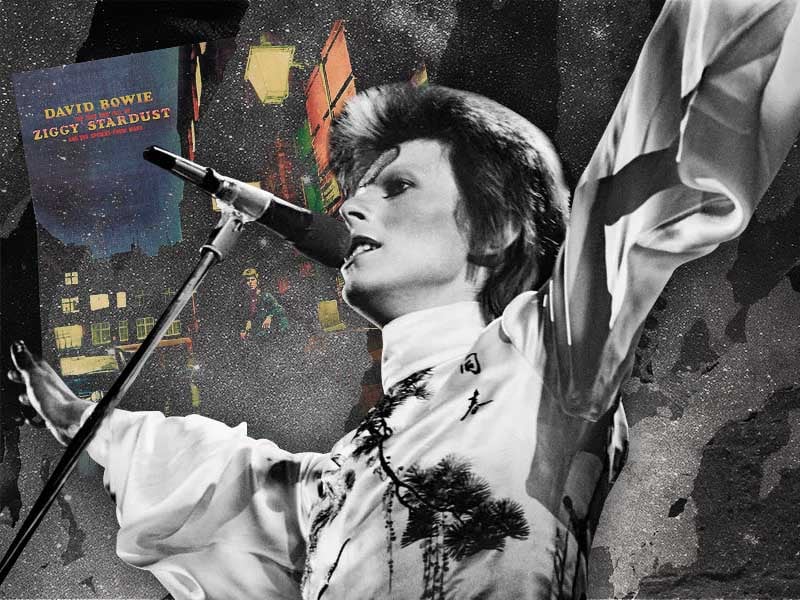
Did David Bowie’s ‘Ziggy Stardust’ prefigure the environmentalist movement?

When David Bowie released The Rise and Fall of Ziggy Stardust and The Spiders From Mars, scientists and world leaders met in Sweden for the final day of The Stockholm Conference, the first United Nations conference concerning humanity’s impact on the health of the planet.
Although these two landmark moments might well seem utterly unrelated, it’s possible they were both inspired by the same burgeoning eco-anxiety we’re all so well acquainted with today. Indeed Ziggy offered the public sphere the same wake-up call thrown at world leaders in Stockholm: a vision of a polluted world in need of salvation.
It would be a mistake to argue that any of this was intentional. I highly doubt Bowie sat down to write an environmentalist album. However, he was an artist who came of age when the Western world was fascinated and terrified by the future. That’s why he would undoubtedly have absorbed the various fears that fed into the birth of the environmentalist movement.
The 1967 moon landings provide a good example: in the spring of that year, billions of people worldwide tuned in to watch a group of American astronauts walk on the moon’s surface. Thanks to new satellite technology, viewers could see their planet from the perspective of a barren lump of orbiting rock. Those first images of Earth generated what some scholars have labelled the “overview effect”.
After seeing their planet floating in space, many people became acutely aware of how fragile and precious it was. Considering all-out nuclear annihilation was a genuine threat at the time, you can’t blame them.
The speaker of Bowie’s breakthrough track ‘Space Oddity’ clearly experiences something similar to the overview effect: “For here am I sitting in a tin can,” he sings in the opening verse, “Far above the world / Planet Earth is blue / And there’s nothing I can do”. That sense of mourning, that feeling of utter helplessness, is what motivated the environmentalists of the 1960s.
In 1968, before Bowie released ‘Space Oddity’, the American writer Cliff Humphrey founded Ecology Action. He invited 60 people in Berkeley, California, to smash his 1958 Dodge Ramber while shouting, “these things pollute the earth”. A year later, inspired by Rachel Carson’s book Silent Spring and the writings of Nan Shepard, a group of activists close to Humphrey founded a little ecological activism organisation called Greenpeace.
By the time Bowie released Ziggy in 1972, environmentalism had gained mainstream traction and was a vital aspect of the countercultural movement. In 1970, Joni Mitchell penned ‘Big Yellow Taxi’, in which she bemoaned humanity’s desire to pave over and castigate the natural world.
That same year, the first-ever Earth Day was observed in San Francisco, during which Secretary-General U Thant spoke of ‘spaceship Earth,’, thereby framing the planet as a resource of essential supplies that it was humanity’s duty to protect. It was a reassuring image. All over the world, there was a fringe sense that the world was on the edge of environmental catastrophe.
That apocalyptic anxiety is given life in ‘Five Years Time’, the opening track of The Rise and Fall of Ziggy Stardust, in which Bowie paints a grim portrait of a world almost indistinguishable from the one we now inhabit. “News had just come over / We had five years left to cry in (cry in) / News guy wept and told us / Earth was really dying (dying)”. It is a startling vision: a world in which climate breakdown is no longer a looming threat but an inescapable fact of life.
Those fearful of environmental collapse in the 1970s reacted in various ways. Some used eco-terrorism to get their message across; others chose to return to the land and live outside normal society on shared farms. Many of these experiments with communal living resulted in more radical environmental philosophies such as Deep Ecology.
Bowie’s Ziggy Stardust character is a similar kind of outlier. As an alien, he is detached from the human world and carries greater knowledge of how to save it from the imminent destruction outlined in ‘Five Years’. He is precisely the radical visionary the world needs, as Bowie observes in ‘Starman’: “There’s a Starman waiting in the sky / He’s told us not to blow it /’Cause he knows it’s all worthwhile”.
But it goes deeper than that. The overall narrative of The Rise and Fall of Ziggy Stardust can be seen to reflect the popular environmentalist narrative that humanity’s desire for dominion over the natural world, its exploitation of natural resources and its hubris, will eventually lead to its destruction. At the start of Ziggy, the titular martian is fearful of disturbing our fragile planet. He’s scared “he’ll blow our minds,” as Bowie observes.
However, by ‘Moonage Daydream’, that nervousness has given way to blooming confidence. Guitar in hand, Ziggy spreads technologically-enhanced optimism worldwide, instilling humanity with the belief that things can only get better. Sadly, by ‘Ziggy Stardust’, he’s forgotten about his original mission and stopped caring about the world he came to save.
His ego has been “sucked up into his mind”, and he spends his time thinking only about himself and his “god-given ass”. He has, Bowie observes, “taken it too far”. And while assuring his fans “they are not alone” in ”Rock ‘n’ Roll Suicide,’ he dies by his own hand”. It’s the same story we’ve heard countless times. It’s there in Genesis, it’s there in Doctor Faustus, and as Bowie makes blisteringly apparent, it’s there in our own history too.
