


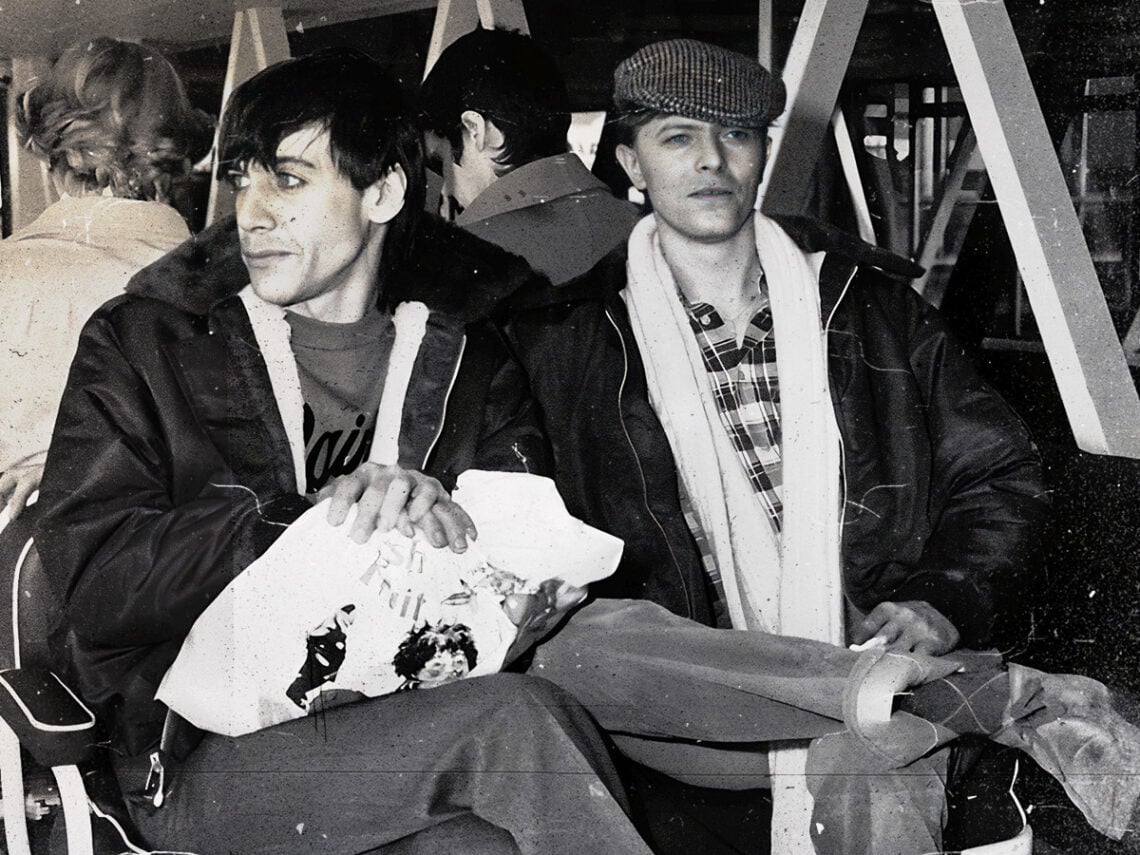
David Bowie’s surprising advice to Iggy Pop: “More accessible”

When they first crossed paths at Max’s Kansas City in New York in the early 1970s, David Bowie and Iggy Pop were perhaps too entrenched in their own theatrics to co-exist pleasantly.
“[It was] me, Iggy, and Lou Reed at one table, with absolutely nothing to say to each other—just looking at each other’s eye makeup,” Bowie recalled during a US press junket in 1987. “Lou dropped out of my life because I got too busy to do any more for him. Iggy wasn’t getting as much work. He would end up in my hotel, having broken in through the window, and I’d find him sleeping on the floor, surrounded by an army of girls. I used to dread going back to my hotel room.”
Over time, of course, Bowie warmed to Iggy, and the two became increasingly important in one another’s lives, leaning on each other not just as artists, but as friends dealing with similar addiction issues in the 1970s. Pop was and has remained, by some accounts, a man prone to solitude for much of his life, but he found in Bowie a person he could put his trust in, both personally and professionally.
Bowie benefited a great deal from the friendship, as well, as years of collaborations with Pop surprisingly led to very few fractured egos or fallouts. “We think very differently,” Bowie explained. “There isn’t that boredom you often get if you’re too close together in your ideas. That’s probably why our relationship has lasted so long.”
Even during the 1980s, as Bowie somehow ascended to an even higher level of mainstream superstardom, Pop’s comparatively low profile only inspired Bowie to work with his old friend more, believing that Iggy’s best days could still be ahead of them as both men approached their 40s.
David Bowie’s role in reinventing Iggy Pop’s sound
After producing and co-writing much of Pop’s 1986 record Blah Blah Blah, ‘The Starman’ boldly identified Iggy as “my favourite contemporary songwriter”, according to a 1987 interview published in the St Louis Post-Dispatch. “[He is] still terribly underrated…there’s a fabulous maturity about what he’s doing right now,” Bowie continued, noting that he had long advised Pop to push past the more dramatic, shock-oriented persona of his youth, i.e. all the violent blood letting and such.
“He always thought that he had to rely on a certain amount of histrionics, both visually and verbally, to get his message across. I’ve always been on at him that he didn’t need to do that, that he’s substantially good without all that. That maybe he could make himself more accessible to people if he lessened the histrionic aspect, which he undoubtedly has.”
It might seem unusual to imagine Bowie, an artist known almost first and foremost for his own over-the-top stage presence, to suggest that a fellow performer ought to essentially “tone it down”. By the late ‘80s, though, Bowie had arguably followed that path already in his own career, shedding the character work and outrageous costumes of the ‘70s in favour of a more straightforward version of himself, letting the songs speak for themselves a bit more. Bowie, however, also looked more suited to a short haircut and a suit-and-tie than Iggy Pop ever did.
In the end, the MTV-ready, straightforward, and “mature” version of Iggy was short-lived but fairly successful, as Blah Blah Blah proved to be the best-selling album of his solo career, spurred by the single ‘Real Wild Child (Wild One)’. Pop supposedly soured to the album swiftly after its release, however, with Bowie biographer David Buckley later writing that Iggy considered Blah Blah Blah “a Bowie album in all but name”.
Further proof that it’s not always the best choice to follow a friend’s advice, even if the friend is effectively correct and his name is David Bowie.
