


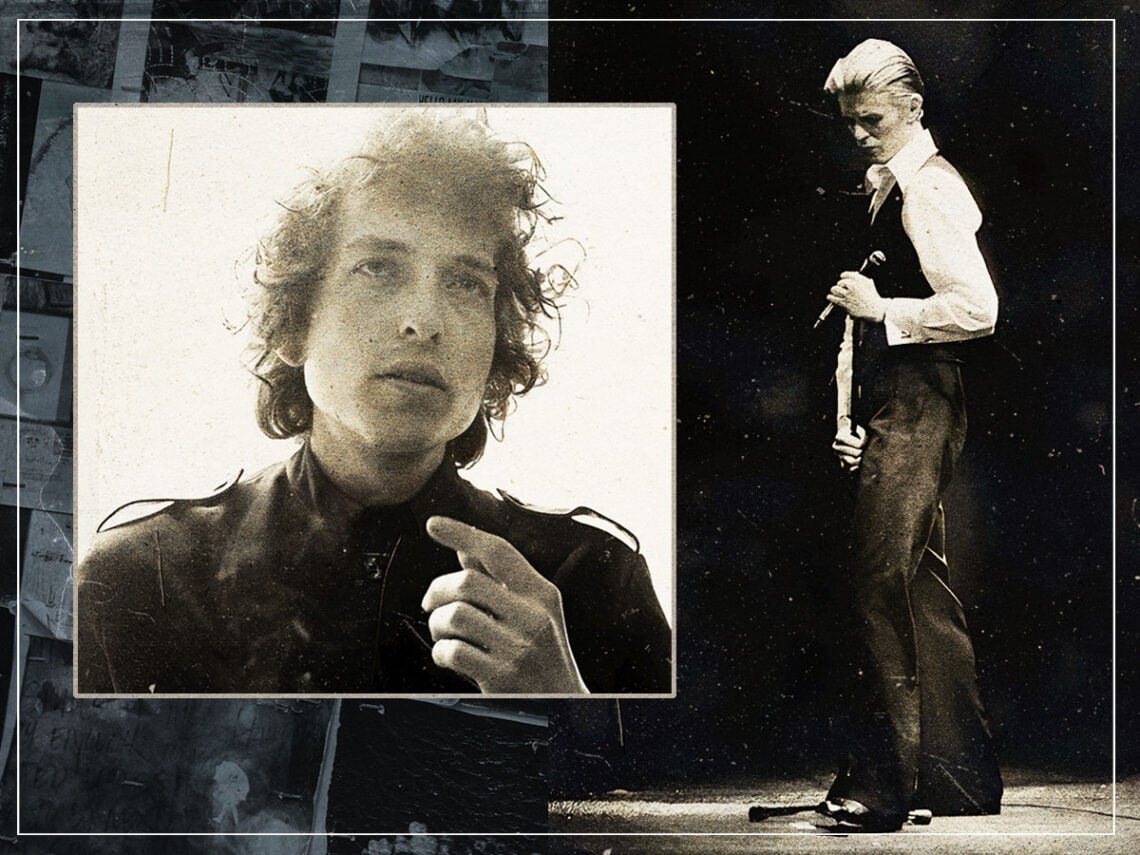
The one reason David Bowie was jealous of Bob Dylan: “I was green with envy”

David Bowie was always a unique figure. He strived ahead in the 20th century and became one of the leading lights of pop music, reinventing himself time and time again to be rightly revered as a saviour of rock music. He transcended the genre and turned the art of being an icon into a way of life. His wholly singular position in the sphere of music means that very few times was Bowie ever starstruck or, worse, jealous of another artist. All except in the case of Mr Bob Dylan, of course.
Despite their very different approaches to writing, recording and performing music, Bob Dylan and David Bowie have occupied similar spaces for longer than one might guess. The duo both found their foothold in the business through acoustic-led folk music before transitioning into a more power-driven sound, then gently floating around the genre ocean, casually shipwrecking and regaining their course from time to time, all while sailing across the globe and making millions of fans along the way.
While Bowie certainly blew up in the 1970s and found pop stardom in the decade that followed, he and the freewheelin’ troubadour are more closely connected than many assume. Dylan only has about half a decade in the limelight ahead of Bowie, and, therefore, a myriad of comparisons between the two have been made throughout the subsequent years. While those are relatively inconsequential, there is one aspect that Bowie admitted he was always jealous of: Dylan’s sturdy back catalogue.
It’s well known that David Bowie didn’t like to rest on his laurels. The singer was always striving forward and remained determined to advance and evolve artistically all the way up until his sad passing in 2016 when he released the landmark LP Blackstar, an album which fundamentally dealt with his own mortality in a way no artist ever has before. It was a facet of his career that saw him reject many of the ‘greatest hits’ of the ‘90s and see Bowie pursue purer aspects of artistry.
Rather than turn up for his mammoth shows with a setlist jam-packed with newly considered classics, Bowie championed the avant-garde and freshly adapted versions of his tracks. Considering he was still making his way toward the legendary status with which he would leave his mortal coil, this bold move spoke highly of his devotion to making art.
Likewise, for a time at least, Bob Dylan was never a fan of languidly paddling around in his own stream of huge songs. Even now, when visiting a Bob Dylan concert, do not be surprised to see massive hits like ‘Don’t Think Twice’, ‘Hurricane’, or even ‘Like A Rolling Stone’ left off the setlist without so much as a raised eyebrow.
However, at the time Bowie was interviewed in the clip below, Dylan had changed tact and was still making his way around the globe as part of the Never-Ending Tour. For such an extensive run with constantly changing setlists, Dylan would need to rely on his hefty canon of work, which he claimed to be in the region of 100 songs, to help him get through the more boring nights on stage. With this assertion, Bowie’s jealousy began to pique.

“50 songs isn’t enough, I’ve realised,” Bowie told the interviewer as they discussed his setlist and how he kept himself interested on stage all these years. “I heard, and I was green with envy, Dylan’s got like 140 songs he chooses from [to make a setlist]. I can see that you’ve got to build up to that because even when you’ve got 50, there are some that you’re gone get a bit fed up with faster than others.” It certainly fits in with Bowie’s output over these years, ditching the approach of simply churning out the hits and instead focusing on his new music whenever he took the stage.
It’s not the only connection the pair have had, either. Featuring on Bowie’s 1971 album Hunky Dory, the chameleon of rock paid homage to the folk singer but in a curious way. Bowie, never really happy to do things the ordinary way, used the spot on his album to make a point—that point was ‘I’m the leader now’.
It’s hard to consider the track one of the best on the record, but Bowie himself once highlighted the song’s significance in a 1976 piece in Melody Maker. He once recalled: “There’s even a song—‘Song for Bob Dylan’—that laid out what I wanted to do in rock. It was at that period that I said, ‘Okay (Dylan), if you don’t want to do it, I will.’ I saw that leadership void.”
He added: “Even though the song isn’t one of the most important on the album, it represented for me what the album was all about. If there wasn’t someone who was going to use rock ‘n’ roll, then I’d do it.” You can’t argue with determination like that, and Bowie repeatedly proved himself right.
However, for a time, Bowie believed the song and his actions might have sent Dylan on a downer and caused the two to endure a fractious relationship. “I saw Dylan in New York seven, eight months ago,” Bowie told Playboy in 1976. “We don’t have a lot to talk about. We’re not great friends. Actually, I think he hates me.”
“We went back to somebody’s house after some gig at a club,” Bowie continued. “We had all gone to see someone, I can’t remember who, and Dylan was there. I was in a very, sort of … verbose frame of mind. And I just talked at him for hours and hours, and whether I amused him or scared him or repulsed him, I really don’t know. I didn’t wait for any answers. I just went on and on about everything. And then I said good night. He never phoned me.”
The reality was likely that, seeing Bowie, Dylan recognised an artist who trod a similar path toward a different goal. A notably disdainful conversationalist, Dylan’s quietened behaviour is an aspect of his character that many rock stars have faced. Thankfully, the duo didn’t fall out and, instead, would end up covering each other songs many times over the ensuing decades.

Never Miss A Tale
The Far Out Bob Dylan Newsletter
All the latest stories about Bob Dylan from the independent voice of culture.
Straight to your inbox.