


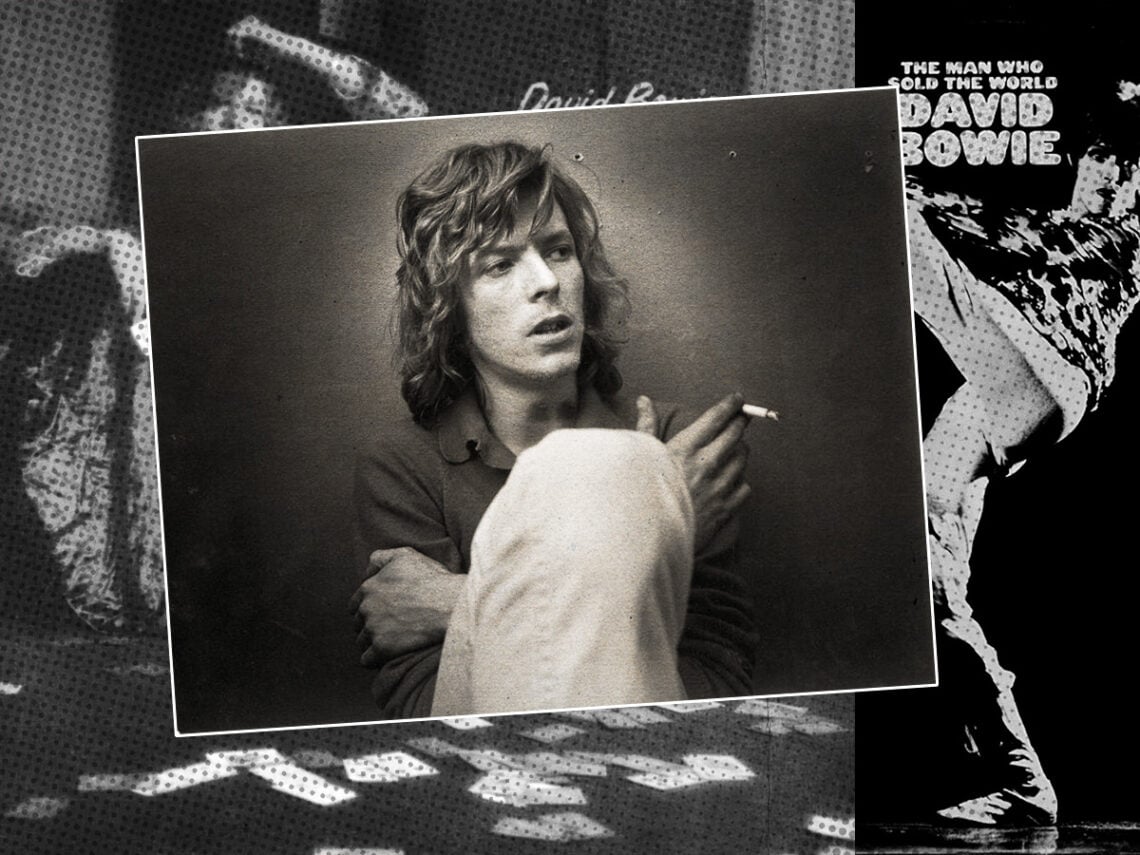
David Bowie – ‘The Man Who Sold the World’

After ‘Space Oddity’, David Bowie was shot up to superstardom. He had spent years cutting his teeth in the artsy side of rock ‘n’ roll, and now his ode to space travel and metaphysical search for new lands brought him into a new land of his own: the mainstream. Though his otherworldly song may have been his calling card at the time, Bowie spends most of The Man Who Sold the World trying to subvert our expectations.
Working with Tony Visconti for the second time, this is the first record of Bowie’s where every song feels like a separate journey. From the start of ‘The Width of a Circle’, Bowie wants you to know that he has changed drastically, taking the old sounds of songs like ‘Unwashed and Somewhat Slightly Dazed’ and adding a lot more grit into the delivery.
While Bowie is still sitting firmly in his art rock style, the backing band behind him pulls from genres like heavy metal and blues rock as Bowie tries his best Black Sabbath impression. The heaviness continues on ‘All the Madmen’, which has a similar hard rock style while adding a touch of psychedelia into the mix thanks to the spaced-out production. The lyrics are also a darker turn for Bowie, referencing his brother Terry Burns and his ongoing struggles with his mental health. After reaching new heights with ‘Space Oddity’, Bowie was perhaps wondering whether he was also going slightly mad.
The dark slant of these songs wasn’t by accident, either. When Bowie was first putting together the music for The Man Who Sold the World, he moved out to a Gothic villa in England to get inspiration. This sense of the creeky past imbues the songs with a spooky feel – a feeling that paganism was more than a mere trend in the zeitgeist.
The Gothic tone of Bowie’s travels is best felt on ‘Black Country Rock’. Compared to the hard rock extravaganza of the first tracks, ‘Black Country Rock’ is a blues-focused number, as Bowie takes cues from the glam rock rising to the fore in England. It was a emerging style that appealed to everything he loved; in essence, doing away with anything drab. While Bowie has admitted that he thought the song sounded like The Move, the final product has much more in common with Marc Bolan of T. Rex, who was working on his own masterpieces simultaneously.
The biggest strength of this album is the backing band that Bowie put behind him. While Visconti provides the bass on several tracks, bringing Mick Ronson and Mick Woodmansy into the mix gives the songs much more weight than listeners were used to from Space Oddity. Compared to the folksy sound of his debut, Ronson’s heavy riffs are on par with other rock legends like Tony Iommi, setting the stage for every one of Bowie’s dark tales. Bowie hasn’t just gone metal here, either. Every now and again, a Moog synthesizer is added to the mix, bringing a psychedelic edge to proceedings. It’s as if Bowie knew how far he was stretching himself, so this synthesizer was a reminder of his space-themed beginnings.
Throughout the rest of the album, Bowie is looking to defy expectations. After being known as the man Major Tom spoke to half a world away, Bowie takes the typical tropes of hard rock and makes something completely different. As much as his debut relied on folk influences, half of this album is indebted to the hard rock coming up around the same time. Both ‘Running Gun Blues’ and ‘Saviour Machine’ have a morbid slant, the latter depicting a scenario where artificial intelligence has dictated modern life.
If the album cover is any indication, Bowie was subverting every single trend in his way. Much like the dress he sports on the cover, Bowie is taking the hard rock sounds that were being heard in the blues scene and channelling them into glamorous rock ‘n’ roll. Naturally, the result is something that refuses to be boxed and ironically both benefits and suffers because of this in the same breath.
He is flirting with both the rising era and his own wild individualism. This can be seen by the fact that Bowie also had a few targets in mind when recording the album. During the recording session for ‘She Shook Me Cold’, the idea was to make something that could outdo Led Zeppelin, the name of the song being a play on the Zeppelin blues belter ‘You Shook Me’.
Across every song, Bowie inhabits new characters to see how the other side of life feels. These characters are all lost and looking for relief from what life has to offer. ‘The Width of a Circle’ talks about a man going down to Hell and having a sexual experience in the afterlife, while ‘Running Gun Blues’ depicts a soldier in Vietnam trying to find some way to end the fighting happening all around him.
Though the lyrics sound obtuse, Bowie’s Gothic slant creates a unique world for these songs. From one line to the next, Bowie pulls from writers like Friedrich Nietzche and H.P. Lovecraft to build an environment in the listener’s mind. That being said, the messages behind these songs aren’t for the faint of heart. Bowie’s questions in a song like ‘The Supermen’ don’t have clear answers, but he isn’t afraid to let them hang in the air and let you make your own conclusions.
This is the crux of the record: it offers a look into Bowie’s psyche. The title track is where everything comes together on this front. Starting with a simple guitar lick, Bowie paints an existential picture of meeting the man who sold the world, projecting a thousand-yard stare right back at him as he shakes his hand and waxes poetic about what the world has come to. The world in question is open to interpretation, such is the mystic depth of Bowie.
By the end of this record, Bowie establishes himself as far more than just the fluke artist who had an extraterrestrial hit. Bowie becomes an artist to be reckoned with, and The Man Who Sold the World takes all of the trends in rock ‘n’ roll and spits them back out into a musical cornucopia. And going forward, Bowie was about to show us the limits of where rock ‘n’ roll could go.
