


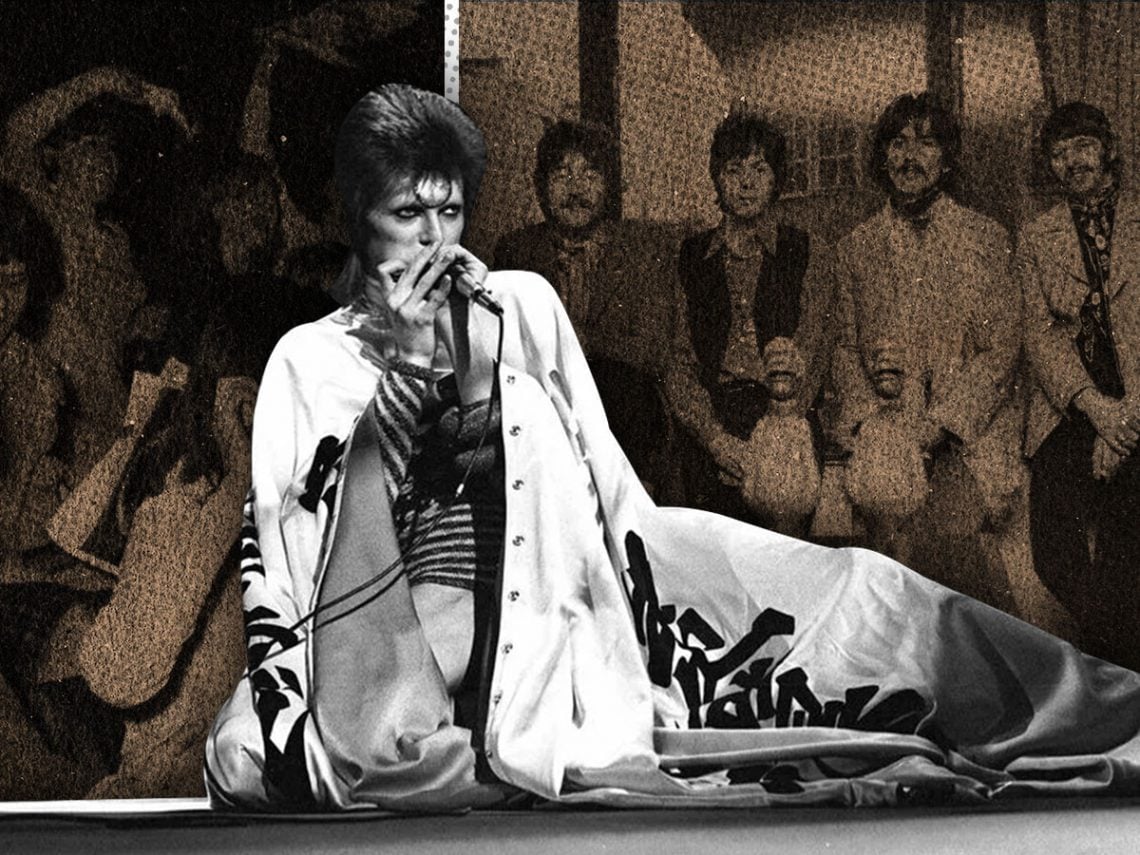
David Bowie & The Beatles: From an Apple Records rejection to the brink of a supergroup

When David Bowie worked with John Lennon at the height of his own career, he commented candidly on the hero-meeting experience. “Hell, I mean, he was one of the major major influences on my musical life,” Bowie declared. “I just thought he was the very best of what could be done with rock ‘n’ roll.” But it was the specific element that he highlighted next that had the biggest bearing on his own back catalogue. “I felt such kin to him as much as he would rifle the avant-garde and look for ideas that were so on the outside on the periphery of what was the mainstream and then make them apply in a functional manner to something that was considered populist and make it work,” the ‘Starman’ happily shared.
Although, Bowie would also later opine that in the rippled reverberations of influence that over the years the cult act The Velvet Underground, in fact, went on to be more influential than The Beatles, he forever admired the ‘Fab Four’. His own career almost mimicked their vast expansive mission to refute every box ever constructed for them while remaining at the forefront of society taking “the most odd idea and [making] it work for the masses.” In turn, expanding culture. Yes, it can be said for both acts, that they achieved the rarified of ensuring the world would be a different place after their work remoulded it.
However, there was an early point where clearly The Beatles didn’t quite think that this strange lad from Bromley could match them on that front. When they returned from India in 1968 and announced their own new liberated label for “creatives”, it seemed like the perfect oddball place for a drifting Bowie to find success. So, when he heard the news, Bowie raced to the nearest telephone and immediately urged his then-manager Kenneth Pitt to submit an audition tape for the nearly yoga-fied Beatles. Sadly, Bowie was one of about a million artists who had this plan, and Apple Records was possibly the most ill-equipped label in the world to deal with such a surge.
The endlessly bickering Beatles had to reach a four-way agreement on all signed acts. Which effectively meant that no act was signed unless they were friends or close enough to one of them to allow them to strong-arm the others into submission. As Nicholas Pegg writes in his memoir: “I know that Apple was a new, small label initially besieged by numerous musicians, managers, agents, artists, and hucksters, and that the individual members of the Beatles were directly involved with many acts signed to the label, as examples, McCartney with Mary Hopkins and Badfinger, and George Harrison with Jackie Lomax, but who in the Apple hierarchy actually listened to the submissions and presentations? Who rejected Bowie? Neil Aspinal, Alistair Taylor? Did one of the Beatles pass judgment on the youthful Bowie’s Decca recordings?”
Pitt was enraged by the slovenly new giant “creative” company he was met with. He later proclaimed: “Had David not been keen on recording for Apple I would not have tolerated the deplorable organisation, sheer amateurism and downright rudeness that confronted us during the next three months, the time it took Apple to give us a decision.” All the same, the rejection came bluntly and Bowie was sent looking for his avenue to success once more.
Perhaps it was for the best. In the beginning, Bowie wanted more than anything to be an architect of change in some way and everything else was secondary. He merely wanted to be an influential figure. He once stated: “I suppose for me as an artist it wasn’t always just about expressing my work; I really wanted, more than anything else, to contribute in some way to the culture I was living in.”

Whether through music, his understandably short-lived multimedia mime act or some other means, Bowie was more concerned with “becoming” rather than “being” in his early efforts. The constant rejections he faced in this period allowed him to fortify his weird identity enough so that when he was ready to foist his own “odd ideas” on the masses in a populist way, he was proficient enough at both camps to unleash his influence on the world in the most incontrovertible fashion seen since The Beatles and Bob Dylan before him, and perhaps the dumbfoundingly singular and irrevocable since.
This kinship, of course, caught the attention of the disbanded Beatles when he did eventually find fame, and it inspired them enough that he almost brought the bloody band back together. It was amid New York’s decadent decline towards a dilapidated dystopia in 1974 when Bowie had absconded himself to a Pierre Hotel room, escaping the exorcised devil in his swimming pool over in Los Angeles. He spent most of his evenings shovelling enough cocaine up his nose to cause a Wall Street crash. This peculiar existence rendered him the complexion of an Alaskan Vampire but a creative force to contend with.
One night, as he busied himself with some obscure personal art project, there was a knock on his door. For anyone else anywhere in the world, that could only mean that reception or security had come calling, but for a bohemian holed up in Manhattan, there’s a chance it could be your boyhood hero. “It was about three in the morning and John was there and he had Paul with him!” Bowie recalled with astonishment in an interview on BBC 6 Music with Marc Riley.
Adding: “The two of them had been out on the town for the evening. And John says, ‘you won’t believe who I’ve got here’ and I said, ‘wow I thought you two had…’ and he said, ‘oh no, all that’s going to change’. It was great! We just spent the evening talking. That must’ve been the first evening they were back together since the big bust-ups. They actually asked me if I’d join the two of them and become a trio with them, and we’d change the name to something like David Bowie and The Beatles because they liked the idea of it being DBB.”
Sadly, however, the dawn brought about the same old problem that H.G. Wells wrote about in his Time Machine back in 1895, proving that the death of drunk patter in the sober morning sun is eternal – “It sounds plausible enough tonight but wait until tomorrow. Wait for the common sense of the morning.” As Bowie wearily concludes: “But, you know, the next morning it just never came to anything.” Nevertheless, I’m sure it came as a confidence boost to his wayward psyche that Lennon and McCartney were trying to recruit him as their own spiritual Ziggy Stardust. The question remains: Would it have worked?

Never Miss A Beat
The Far Out Beatles Newsletter
All the latest stories about The Beatles from the independent voice of culture.
Straight to your inbox.