


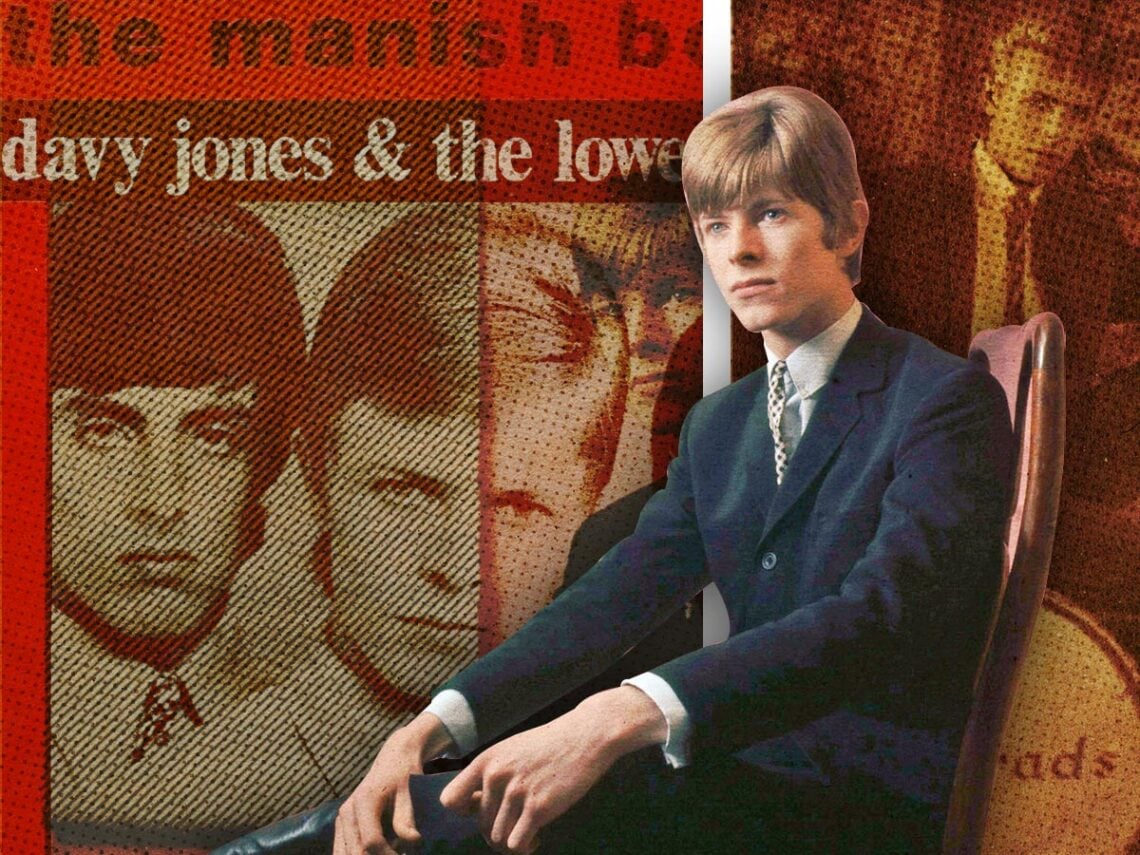
Get to know David Bowie’s pre-fame bands

Even the David Bowie that we know and love today is a complex figure to look back and reflect on, given that his six-decade-spanning career saw the artistic icon constantly shift in terms of genre, appearance and creative direction. Yet every great artist must begin somewhere; in that light, David Bowie (born David Jones) was no different. Here, we are taking a walk through the early (and often frustrating) part of Bowie’s career and his early bands.
During his time at Burnt Ash Junior School, Bowie’s singing voice was considered “adequate” for the school choir, although he demonstrated better ability at playing the recorder. It was around this time that Bowie claimed he had “heard God” upon listening to the likes of Little Richards, Elvis Presley and Fats Domino.
It was Bowie’s maternal half-brother, Terry Burns, that introduced him to jazz music, though, which subsequently led to him starting to play the saxophone. Bowie loved the sax style of Charles Mingus and John Coltrane, and when his mother bought him his first saxophone in 1961, Bowie started taking lessons from Ronnie Ross.
A year later, Bowie formed his first band at age 15, still going by the name David (or Davy) Jones. The Konrads played rock and roll music at weddings and local events, with Bowie’s childhood friend George Underwood also a group member. Bowie’s first experience playing with other musicians led to his desire to make it big as a pop star.
Bowie’s deep wish led him to leave the Konrads, though, as he had become frustrated with their lack of musical abilities, clearly believing in his talent. The budding musician then joined a new band called The King Bees and asked the washing machine mogul John Bloom to “do what Brian Epstein had done for The Beatles”. Bloom, however, did not respond.
Still, Bowie released his debut single ‘Liza Jane’ under Davie Jones and The King Bees, but it still ended in commercial disappointment. Following this growing frustration with The King Bees and their reliance on Howlin’ Wolf covers, Bowie quit the group to join another, The Manish Boys. However, their single, a cover of ‘I Pity The Fool’ by Bobby Bland, was equally disappointing, and Bowie jumped ship again, this time to Lower Third. His time with Lower Third was considerably longer than his previous groups, even though their single, the aptly named ‘You’ve Got a Habit of Leaving’, fared no better than Bowie’s efforts with The Konrads and The King Bees.
When Ralph Horton began managing Bowie, he played a vital part in his transition into a proper solo artist. Around this time – around the mid-1960s – Bowie grew tired of his name Davy Jones and adopted the moniker by which we all know and love him today: David Bowie. He took the name from the American inventor of a famous knife, James Bowie.
Bowie was still with Lower Third in 1966 when their single ‘Can’t Help Thinking About Me’, although once again, it was a chart flop. That was the final straw for Bowie with the band, and he briefly joined a group called The Buzz to release two singles called ‘Do Anything You Say’ and ‘I Dig Everything’. Bowie also played with an outfit called The Riot Squad around this time.
1967 came, and Bowie released his first single as a solo artist, a momentous occasion in his career. However, once again, the single (this time ‘The Laughing Gnome’) failed to chart. Surely at this point, Bowie must have been frustrated with the entire music industry and likely considered going into a different line of work.
Still, he managed to record and release his self-titled debut album later that year, which marked his last release for two years. Towards the end of 1968, Bowie began playing in a group called Feather, in which the trio combined folk music, poetry and mime. But it was in 1969 that all the hard work of the 1960s paid off, as on July 11th of that year, he released the single ‘Space Oddity’, which would mark the beginning of his incredible career as we know it today.
Whilst Bowie must have been close to calling it quits throughout his early career, it invariably taught him two pertinent lessons. The first was never to give up nor to let others get in the way of your desire and vision. The second was to throw yourself into whatever opportunity presents itself to you, whether it be with personnel or genre. These lessons proved pivotal in the future career of Bowie; ever-changing and eternally visionary.
