


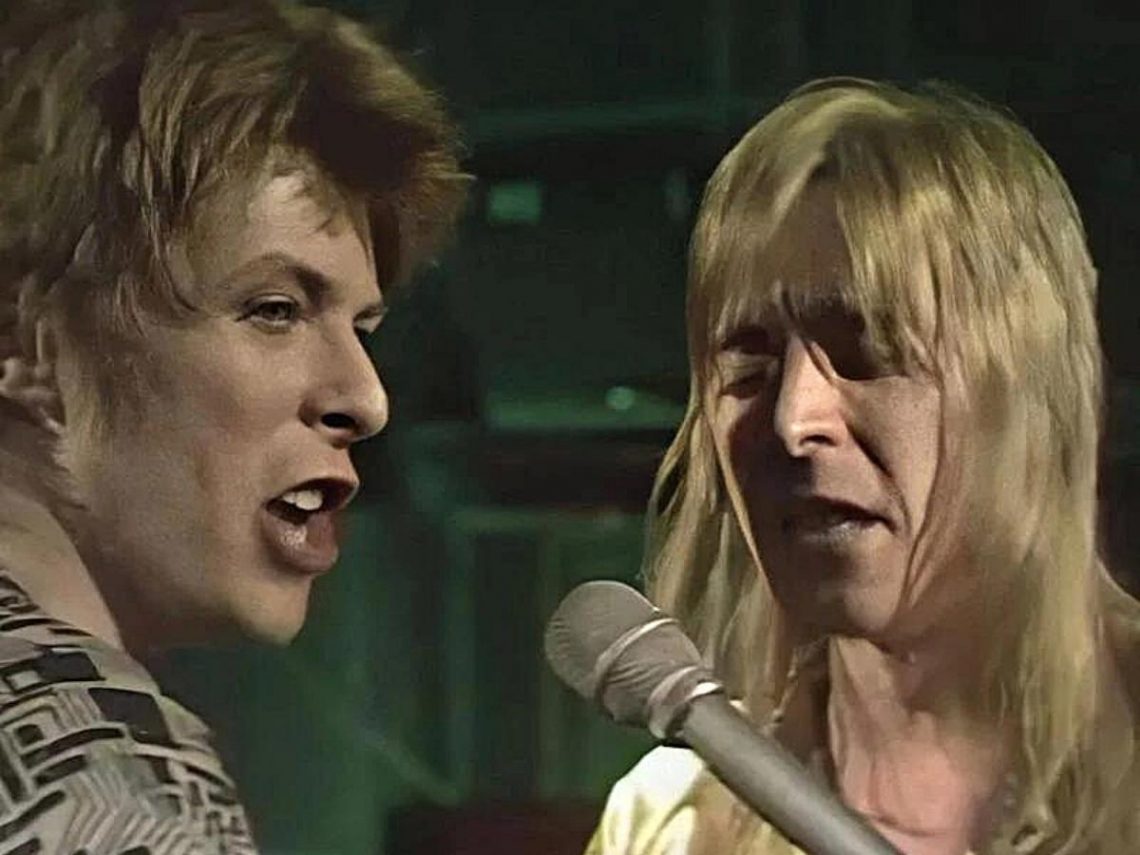
How David Bowie and Mick Ronson became the “yin-yang” of glam rock

Between 1971 and 1973, David Bowie was backed by The Spiders from Mars, a group comprised of Mick Ronson on guitar, Trevor Bolder on bass and Mick Woodmansey on drums. They had, of course, taken their name from Bowie’s 1972 concept album, The Rise and Fall of Ziggy Stardust and The Spiders from Mars.
The band had previously played together in Bowie’s former backing band, The Hype, although Tony Visconti had been on bass then rather than Bolder. With Bolder in the mix, the group were signed in their own right under the name Ronno. Under Bowie, however, the group glammed themselves up a la Ziggy and became glam rock’s best-known outfit.
Photographer Mick Rock said of the group: “The Spiders. The stuff of legend, rock n roll style. Nothing as worldly as The Crickets or The Beatles. These insects were from Mars. After recording the Ziggy Stardust album, it was decided that to promote the record, these three should be dubbed The Spiders From Mars. Thus they were restyled from head to toe, and the illusion was complete. Not as noticeable as the multi-talented Ronno, but an essential part of the drama. And they knew how to play. The Spiders were a hot band. The hard thing for Trevor and Woody was all the attention devoted to Bowie and Ronno, of which they got to share little. The Spiders From Mars. What would Ziggy have done without them?”
Bowie himself said that The Spiders were the key men for the job: “They played the part perfectly. I actually sort of picked them for that. They were, at the time, the number one spacey punk rock band. They were absolutely archetypes. All of them. Everyone was absolutely right – right out of a cartoon book. They were great musicians.”
As Rock noted, however, during Bowie’s early 1970s tours, it was Bowie and Ronson who seemed to steal the show. Bowie stated that Ronson’s demeanour was the perfect counterbalance to Ziggy’s flamboyance. He said: “Mick was the perfect foil for the Ziggy character. He was very much a salt-of-the-earth type, the blunt northerner with a defiantly masculine personality, so what you got was the old-fashioned Yin and Yang thing. He provided this strong, earthy, simply-focused idea of what a song was all about. And I would simply flutter all around him on the edges and decorate. I was sort of the interior decorator. Ziggy and Mick were the personification of that rock n roll dualism.”
So Ronson was the yin to Ziggy/Bowie’s yang, the macho to Bowie’s sexuality. Still, in his early 20s, Ronson was living the stuff of dreams, out on tour all throughout the year. He claimed them to be the best times of his life: “They were probably the best times, the Ziggy period, everything was different and, when it started to happen, it happened so fast, there was no time to think or worry about anything. I think it was probably the best time for Dave, too, before it all got to be a lot of internal hang-ups.”
Despite the fame, however, Ronson always felt a draw to his humble Yorkshire roots and never really delved into stardom like his friend Bowie. “All that star bit never got through to me in the same kind of way. I liked pretty straightforward kinds of people,” he said. “I mean, I like to look good, but I don’t need to surround myself with a lot of weird people. But then we were always into different things except when it came to the music.”
Both Bowie and Ronson would produce Lou Reed’s excellent 1972 album Transformer, and Reed himself was amazed by the results: “Transformer is easily my best-produced album. That has a lot to do with Mick Ronson. His influence was stronger than David’s, but together as a team, they are terrific.”
