


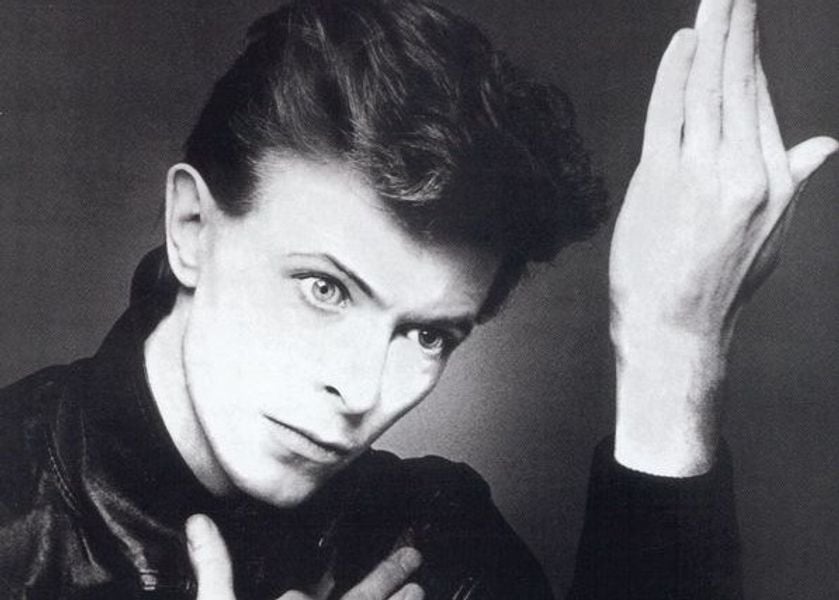
David Bowie’s ‘Heroes’: The greatest kiss in music history

“And we kissed, as though nothing could fall,” (David Bowie 1947-2016)
The ‘Mona Lisa’ is a load of Todd, and the ‘Sistine Chapel’ is a pain in the neck, but David Bowie’s ‘Heroes’, on the other hand, is one of the greatest artistic creations in history and it ought to be lauded as such. It is a love bomb of euphoria, and if catches you in the right mood, in the right moment, with the right lightning, it can increase the wattage in your life to such an extent that your brain cells start to flicker. Contained within this masterpiece is a kiss. It is the pinnacle of a zenith, the tip of an edifice proclaiming profound humanity. As such, this kiss is undoubtedly one of the greatest recorded meetings of lips in human history. And this is the remarkable story behind it.
To begin with, there is an edifice of hate and division. The Berlin Wall stands as a bleak reminder of the darkest days in human history. That is a matter of fact that comes without any of the subjective hyperbole that you might opine renderers the above highfalutin. Nevertheless, this wall was forever breached with reassurances of humanity. Folks like Mark Reeder risked it all to smuggle the subversive force of punk into the staunchly conservative East. Art was etched upon it, proclaiming defiance and togetherness. And letters of love were thrown over.
This, however, was not why Bowie moved to Berlin. His own life was in turmoil. He described Los Angeles as an “insidious” hell hole, and his drug habit was threatening to throw him overboard. As guitarist Carlos Alomar states: “David went to Berlin with Iggy [Pop] for isolation. It was to humanise his condition, to say, ‘I’d like to forget my world, go to a café, have a coffee and read the newspaper.’ They couldn’t do that in America. Sometimes you just need to be by yourself with your problems. Sometimes you just wanna shut up.”
By the time he got around to recording ‘Heroes’, the newspapers and coffee had got him back on track. He entered the studio jubilant, sobering, and in the midst of a creative purple patch. This confidence was brought into the studio, where Bowie set about simply jamming out an epic. As producer Tony Visconti recalled: “One day David announced that he had the lyrics written for ‘Heroes’ but he had to write a few more verses. And that day Antonia Maass, who sang backing vocals on ‘Beauty and the Beast’, was in the studio,” he said.
Adding: “David couldn’t concentrate with us in the studio so he said [to Visconti and Maas] ‘would you two mind taking a walk?’ but it wasn’t a great place to walk around. So, we walked around the back of the studio and we could see the control room and I guess we were visible too because Antonia and I shared a little kiss by the wall. We go back to the studio and David is smiling. He had a sort of cat who ate the cream sort of smile and I said, ‘what’s up?’ and he said well we saw you kiss by the wall and it made it into the song.”

There is perhaps no more befitting lyrical tableau in music than: “I, I can remember / Standing by the wall / And the guns shot above our heads / and we kissed as though nothing could fall.” Whilst the verse may have been crafted from the comfort of the studio, it is a vignette with the humanised weight of realism and history. Ultimately, it speaks of a truth that even stiffed-lipped historians would not besmirch: that although art might not literally topple regimes, it has a way of permeating circumstance with the transcendence of human experiences. The Wall was a literal symbol of division and oppression, and Bowie helped to illuminate this fact with an assegai of unity elucidated in one simple verse.
It may be born from a kiss that played out for real, but in the minds of millions, it brought up the image of folks leaning through railings to catch a loving lip—it conjured up every adversity that romance overcomes. The iron curtain was peppered with a salvo of pure poetry that could’ve rattled the foundations of a lead mine.
However, the song runs both ways. It doesn’t just delve back into history, but in true transcendent fashion, it also went on to affect the future. Ten years later, in 1987, the song would land in its blooming summer and deal a more exacting blow. Bowie played a concert in East Berlin near the Reichstag. A crowd of 70,000 gathered. As Bowie rallied through a triumphant set, an amassment of revellers began to build in the west. From the far side of the wall, a crowd was heard.
“It was like a double concert where the wall was the division,” Bowie recalled in an interview with The Atlantic. “And we would hear them cheering and singing along from the other side. God, even now I get choked up. It was breaking my heart. I’d never done anything like that in my life, and I guess I never will again. When we did ‘Heroes’ it really felt anthemic, almost like a prayer.”
As the concert gloriously sprinted towards a fever-pitched crescendo, a chant of “THE WALL MUST FALL” rang out and momentarily, Berlin was united in a harmonious symphony of song. And at the moment that Bowie sang “…and we kissed,” the sound of thousand mouths meeting for the sort of smooch where teeth collide rang out too. In a panicked frenzy, the authorities trying to police the orgiastic melee began to brandish bully clubs against the revellers and, in an ironic twist, landed the blow that would quash the regime. Suddenly, the great wall seemed ridiculous, and from naïve beginnings, the red tape of politics was eviscerated in a declaration of togetherness. There aren’t many pieces of art in history that can do that.
Bowie returned to Berlin in 1989 and basked in the sanguine glory of a united city in a wave of eudemonia that ‘Heroes’ and his ’87 concerts foretold. When he died in 2016, the German government officially thanked Bowie for his contribution, commenting: “Good-bye, David Bowie. You are now among Heroes. Thank you for helping bring down the wall.” Not bad for a jam and an impromptu kiss to help a recovering junkie concentrate. Fate is a funny old thing, and the kiss of ‘Heroes’ is full of it. “We saw you kiss by the wall,” are the fateful words Bowie’s great friend Visconti recalls hearing from a delighted Bowie when he trudged back to the studio. So, kiss often, folks.
