


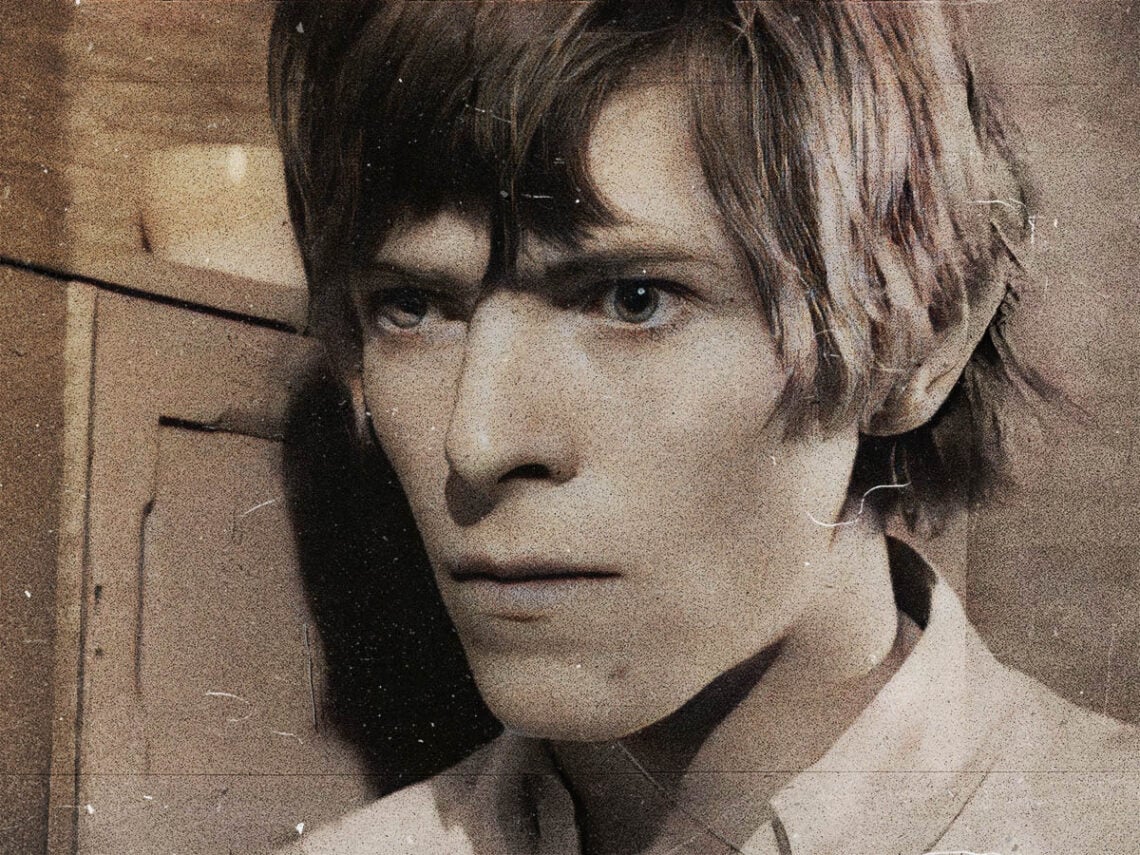
‘The Image’: Looking back at David Bowie’s first acting role

Rising from the ashes of a failed musical career as David Jones, David Bowie became one of the most electrifying figures the industry had ever seen. Known for his pioneering approach to music, fashion, persona and performance, Bowie was an artist that constantly reinvented himself as different characters, from the glamorous Ziggy Stardust to the suave Thin White Duke.
Bowie’s career as a performer saw him attempt various outlandish acts, such as trying to fly on stage or walk on the hands of the audience. Inspired by the bizarre drug-fuelled antics of Iggy Pop, whom he soon became great friends with, Bowie saw his opportunities to perform in front of a crowd as a chance to portray someone other than himself – a form of acting. He once told Cameron Crowe for Rolling Stone, “I always had a repulsive sort of need to be something more than human. I felt very, very puny as a human. I thought, ‘Fuck that. I want to be a superman.'”
The musician took it upon himself to become more than a man standing in front of a crowd, simply reciting songs and playing instruments. Instead, he draped himself in colourful fabrics, or sometimes very few pieces of clothing at all, adorned his face with bright makeup, and put on a theatrical show.
He fashioned personas as a form of protection and a means to express his multifaceted nature, embodying characters that looked like they could’ve swooped down from another planet. Therefore, it was only natural for Bowie to embark on an acting career alongside his music, starring in several cult classics, such as The Man Who Fell To Earth, where he fittingly played the alien protagonist. Released in 1976 and directed by Nicolas Roeg, the movie further cemented Bowie as an iconic figure, closely associating him with his otherworldly image.
The artist subsequently starred in many movies over the 1980s and 1990s, such as Tony Scott’s The Hunger, Martin Scorsese’s The Last Temptation of Christ, David Lynch’s Twin Peaks: Fire Walk With Me and Jim Henson’s Labyrinth, in which he starred as a Goblin King. However, Bowie’s acting career actually dates back further than his successful music career.
Bowie began playing music as a teenager, releasing his debut single, ‘Liza Jane’, as David Jones with the King Bees when he was 17. Under the management of Leslie Conn, Bowie found no success, leading him to depart from the contract. He failed to find acclaim with the release of his following singles and self-titled debut album, leading him to begin studying mime under the instruction of Lindsay Kemp, who later went on to train Kate Bush.
As a student of the dramatic arts, Bowie became well-versed in theatre and the idea of creating different personas, preparing him for his future as an actor and performer. During this period, Bowie went on tour with T. Rex, opening their shows with his bizarre mime act. In the book Ziggyology: A Brief History of Ziggy Stardust by Simon Goddard, he explained that the mime performance was “ruined by heckles of left-wing students and hippies irate over his damning portrayal of China’s Red Guard.”
After starring in Kemp’s theatre production Pierrot in Turquoise in 1967, Bowie landed a role in a short horror film, The Image, two years later. His performance in the Michael Armstrong-directed piece marked his first on-screen acting role. The black-and-white movie, which comes in at 14 minutes, features Michael Byrne as a painter who creates a portrait of a man that resembles Bowie. Soon enough, the man himself appears in a ghostlike manner, haunting the artist as he steps through the window.
On Armstrong’s website, a synopsis reads, “a study of the illusionary reality world within the schizophrenic mind of the artist at his point of creativity.” Although Byrne’s character repeatedly attempts to kill Bowie’s apparition, he continues to haunt him.
Speaking to the Wall Street Journal, Armstrong explained how the film was initially screened between two pornos at a cinema in Piccadilly Circus. He said: “Whether David had gone in on his own, I don’t know, but he said he felt really strange sitting there on his own, in this cinema with all these guys in their raincoats.”
The Image became one of the first and only short films to receive an X-rating. “For its violence, which in itself was extraordinary,” claimed Armstrong. The director, who described Bowie as “very pretty” and “flirtatious”, chose the young musician to star in his film because he was a fan of his early work. Recalling anecdotes from shooting, Armstrong explained that his assistant used a hose pipe to replicate rain in one scene, although they accidentally “point[ed] the hose at David and hit him square in the back with hose-pipe water. And he’s moving it around. So David is drenched.”
According to the director, “We’d actually said, ‘David, come in, come in, get warm,’ and he’d said, ‘No, no, I’m fine.’ I think he was terrified of moving. By the time we got the shot, he came in, and he was literally blue. He was bright blue. We had to strip him down and stand him in front of the lights to warm him up.” Apparently, Bowie and Byrne couldn’t hide their laughter while filming the scenes where the former was being killed. “It was the whole awkwardness of it – the two of them trying to keep a straight face during this dramatic moment was just too much.”
The film remains a fascinating capsule into the early career of David Bowie, who would soon become an international superstar and rock and roll icon. Watch the film below.
