


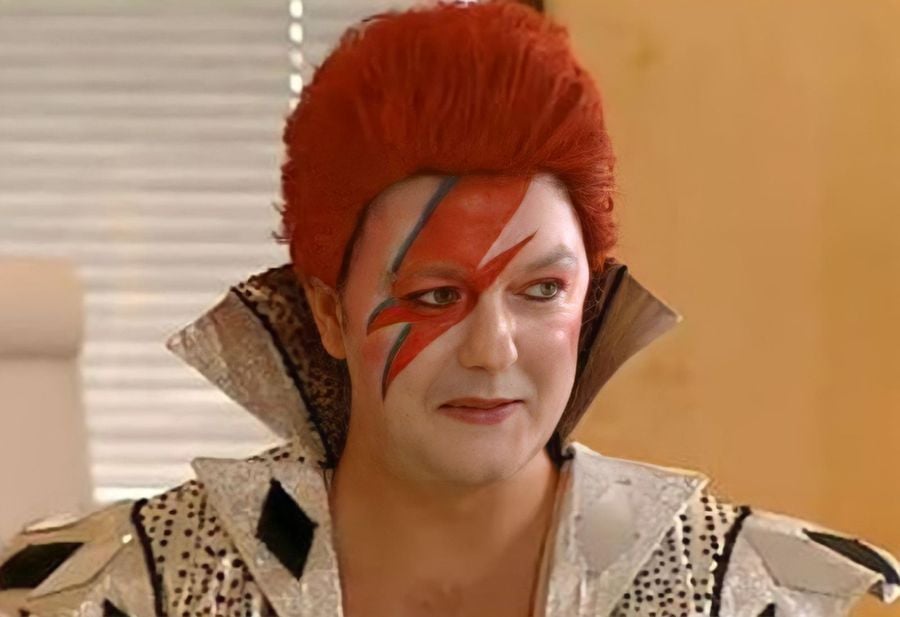
How David Bowie convinced Ricky Gervais he could “do anything”

On countless occasions, comedian Ricky Gervais has discussed his heroes and remained consistent in his inspiration. The name that never fails to crop up is David Bowie. From a young age, Gervais wanted to become a rockstar, just like his beloved Starman, but who wouldn’t? In fact, Gervais’ early ambitions were so strong that, in the early 1980s, he made serious efforts as a singer and songwriter in his New Romantic duo, Seona Dancing.
Oddly, pictures from this period show a relatively lean Gervais striking an uncanny resemblance to Bowie himself. Though it must be said, the comedian’s fashion sense was perhaps more akin to Japan’s David Sylvian – such were the times. With Seona Dancing, Gervais recorded a couple of mostly-forgotten singles and boasts an appearance on the ITV show Razzmatazz in 1983.
As with most childhood aspirations, Gervais’ withered under the pressure of adulthood responsibilities. Some two decades later, Gervais found global fame through comedy as the tragic manager, David Brent, in The Office.
Having worked in radio with co-writer Stephen Merchant through the 1990s and 2000s, Gervais never severed his ties with the music world. He later became well acquainted with Bowie in the mid-2000s through celebrity links and a hefty dose of mutual appreciation. When it came to picking out celebrities to star in the duo’s second creation, Extras, Gervais could think of nobody he’d like to invite more than David Bowie.
“I wrote the Extras scene about meeting your hero and him not being what you thought,” Gervais wrote of his hero in The Hollywood Reporter. “I wrote the lyrics and called him, and he said, ‘Sorry, I was eating a banana’. I thought that was funny. I asked if he could do something retro, something like ‘Life on Mars?’ He said [sarcastically], ‘Sure, I’ll just knock off a quick little ‘Life on Mars?’ for you.’ We laughed. And then he came and did the show and gave us exactly what Bowie was.”
In Gervais’ Hollywood Reporter eulogy, he continued to explain how Bowie’s management of fame and natural wit set an admirable example. “I was looking at an email he sent me a few weeks ago,” he wrote. “It was as funny and fresh and smart as any in the last ten years I knew him. That’s integrity. That’s fucking privacy. All this about being one of the most worshipped artists in the world — he never fell for it. I remember the first time I went to see him, I didn’t know what to say. ‘You’re here for Mr. Jones?’ I smiled — of course, I was. Right then, David Bowie didn’t exist. His apartment was as amazing as you’d imagine. There was a 3D Picasso-esque sculpture in the middle — beautiful. He said, ‘My daughter likes to hit that with a hammer.’”
“Our relationship was bizarre and surreal, and I felt so privileged to know him,” Gervais added in the eulogy. “I never forgot he was my hero, even when he became my friend. I somehow divorced the two concepts in my head. When I talked to people, I talked about this rock star who changed my whole outlook. He put my life in colour. He made me believe: You can do anything; you’re a working-class kid in Reading; creativity is freedom. Ability is a poor man’s wealth. I loved everything he did. He never let me down, even at the end. I’ve never seen a more dignified ending.”
Speaking to GQ in 2019, Gervais defined the word “hero” by describing his, who incidentally brought us the timeless classic, ‘Heroes’. “[David Bowie] sort of put my life in colour in many ways. A working-class teenager, in a council house, in a rough estate in Reading, and I’m eating my beans on toast and I see ‘Heroes’ – I think it was on the TV show, Marc… Marc Bolan Show – and I thought, ‘Of course, you can do anything!’”
