


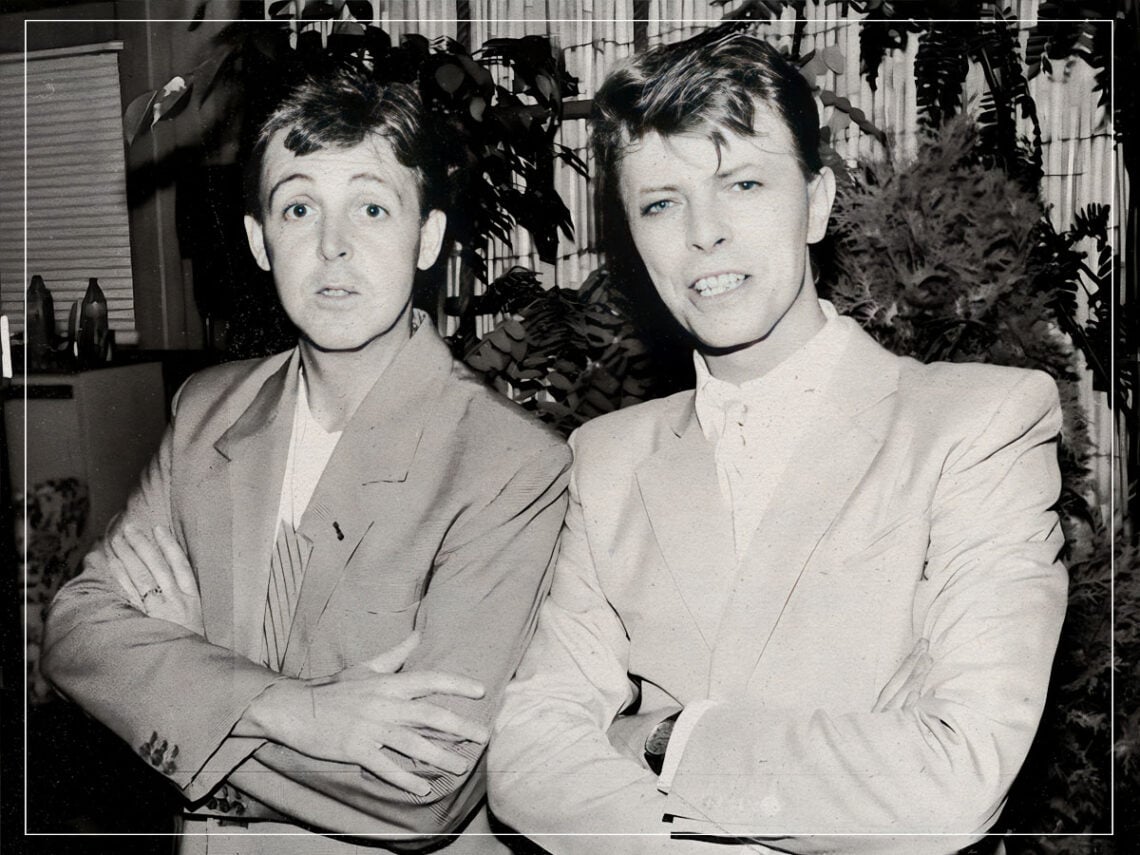
The World’s Greatest Supergroup: The night David Bowie almost reunited The Beatles

It was 1974, amid New York’s decadent decline towards a delipidated dystopia, and David Bowie had absconded himself to a Pierre Hotel room. The ‘Do Not Disturb’ had been prominently facing outward for weeks. He had disturbed himself enough. He was in the Big Apple, escaping the now-exorcised devil in his swimming pool in Los Angeles. He had felt a nefarious force haunting him on the West Coast, and he wanted to get away from it all.
But in Manhattan, he had also spent most of his evenings shovelling enough cocaine up his nose to cause a Wall Street crash. His lock-in lifestyle rendered him the complexion of an Alaskan Vampire. His thoughts were fevered. Things didn’t seem all that hopeful for the Third Reich-obsessed star. The magnificent David Bowie was in a decidedly dreadful spot.
One night, as he busied himself with some obscure personal art project, there was a knock on his door. For anyone else anywhere in the world, that could only mean that reception or security had come calling, but for an artistic bohemian holed up in Manhattan, with enough drugs stowed away to get the Terracotta Army dancing, there’s a chance it could be your boyhood hero.
Bowie once said of John Lennon: “He was one of the major influences on my music life. I just thought he was the very best of what could be done with rock ‘n’ roll, and also ideas. I felt such akin to him in that he would rifle the avant-garde and look for ideas that were so on the outside of, on the periphery of what was the mainstream and then apply them in a functional manner to something that was considered popularist and make it work.”
This is precisely what Bowie was looking to channel as he pored over the darkened psychology of dictators. “He would make it work for the masses and I thought that was so admirable,” the Starman continued. “That was making artwork for the people and not making it elitist.” Essentially Bowie’s appraisal of Lennon is exactly how many would describe the ‘Heroes’ singer himself, but aside from that, the other element that shines through in his critique is the light of adoration in which he holds the bespectacled Beatle.

Thus, surely even for Bowie himself, it served-up a hefty mind-wallop to open the door and see him standing there: John bloody Lennon—and the bastard wasn’t even alone. Far from it. As Bowie explained in an interview on BBC 6 Music with Marc Riley: “It was New York, around 1974, and I think it was around the first time they had gotten back together again. And I got a knock at the door at the Pierre Hotel where I had taken over a suite for months and months. It was about three in the morning and John was there and he had Paul with him,” Bowie recalled with astonishment.
He added: “The two of them had been out on the town for the evening. And John says, ‘You won’t believe who I’ve got here’ and I said, ‘Wow I thought you two had…’ and he said, ‘Oh no, all that’s going to change’.” Pause the tape there for a moment and consider that presentiment unfolding before our beloved Bowie. Here he is, in a hovel few come back from, on the run from no less than a paddling Beelzebub who has been plaguing his LA pool, struggling in every which way. When, out of nowhere, Lennon appears like an apparition and McCartney pops out from behind his shoulder. And they’re not just after a sniff of your stash—if all indications have been read correctly, there’s a chance that The Beatles – the motherfucking Beatles – might be getting back together. And somehow, it would appear that you might have a part to play?
“It was great,” Bowie continued in a statement of the bleeding obvious. “We just spent the evening talking. That must’ve been the first evening they were back together since the big bust-ups. They actually asked me if I’d join the two of them and become a trio with them, and we’d change the name to something like David Bowie and The Beatles because they liked the idea of it being DBB.”
Sadly, however, the dawn brought about the same old problem that HG Wells wrote about in Time Machine back in 1895, proving that the death of drunk patter in the morning sun is an eternal paradigm: “It sounds plausible enough tonight but wait until tomorrow. Wait for the common sense of the morning.” As Bowie wearily concludes: “But, you know… it just never came to anything.”
But it if had happened, if only it had, it just might have worked. Supergroups so seldom exceed the sum of their parts because they’re conceited from the start. As The Beatles proved with their subsequent solo work, the beauty of the biggest band in history was all in the mix. Put simply, conversation will tend to flow better among old friends rather than among those who’ve just met.
However, one thing that The Beatles have never gotten enough credit for – perhaps the only thing they haven’t gotten enough credit for, at that – is how utterly insane their world-changing conversation proved to be. We might hold up Bowie and his wacky ways alongside ‘Yesterday’ in retrospect and colour the Fab Four as a little more commercial. But there is no way the world would’ve accepted the Thin White Duke quite so quickly had it not been for a certain mystic Eggman before him.

There is no way such beasts should have been charting hits quite so quickly after the hand holding birth of rock ‘n’ roll. However, The Beatles somehow strongarmed the world towards making the avant-garde marketable. ‘I Am the Walrus’ is a song millions of us know from primary school despite being born decades after its release.
There is no way that a song inspired by the sexual kinks of Eric Burdon, a working-class Geordie singer, transmuted in the drug-addled mind of Lennon, run through a ringer of a Promethean collision of rock and classical orchestration, taking on the ground-breaking compositional structure of a harmonic Moebius strip, should reasonably expect to be a hit that lives on for centuries. It is mind-bendingly experimental and innovative, a million miles from the typical mainstream, and yet, mutter to any given eight-year-old in 2024, “I am the walrus,” and at least some will likely reply, “goo-goo-ga-chu” – whatever that means.
Bowie was next in the line of that lineage. And he would’ve slotted right in and brought the avant-gardist element of The Beatles to fore, changing the world once more, and forming a fitting second chapter. Why would it have worked so seamlessly? Well, it was, without doubt, one of Bowie’s greatest attributes as an artist that he wasn’t unhinged by his own sense of individualism and was happy to celebrate the artistic vision of others. Sadly, the vision of the others was overridden by sobriety on this occasion.
Did The Beatles ever think of reuniting?
While that may have been the end of a supergroup beyond comprehension, a similar incident would occur a year later in 1975 after the Grammy Awards whereby Art Garfunkel was present for plenty of talk about getting back with songwriters called Paul. The story goes that John had been on stage alongside Simon and Garfunkel at the awards ceremony. Afterwards, John invited Arty and Bowie back to his Dakota Building apartment in what surely represents one of the kookiest smorgasbords of counterculture talent ever assembled in a single abode.
In an interview for the Beatles Stories documentary, Art Garfunkel regaled another tale of an after-party for the ages and one of music’s great what-if’s. “I have my great memory of John Lennon when I met him that one night with Yoko Ono and David Bowie,” Art explains, “It was the mid-70s, and we were coming back from some show we mutually did. So, we go back to the Dakota [John’s apartment], Bowie was with us. And John pulls me to the bedroom.”
Presumably, this call for privacy between the two former Paul co-opters left a coked-up Thin White Duke in the living room fervently discussing fascism with a spun-out Yoko gazing at the stars. All while the straight-laced Arty was mind-numbingly confounded by wonderment at finding himself coaxed into the intimate setting of his hero’s boudoir.

Art continues with his tale revealing a rather more tender and personable side to Lennon than we are used to hearing about during this period, as he adds, “Incredibly disarmingly he said to me ‘Arty you worked with your Paul recently, I’m getting calls from New Orleans [which was where Paul McCartney recorded part of his Venus And Mars record at Sea-Saint studios] that my Paul wants to work with me and I’m thinking about it and I don’t know. How did it go when you worked with Paul [Simon]?’”
As if Garfunkel wasn’t flummoxed enough, he now had to contend with advising upon what would have been the biggest reunion in history since the continental plate of India collided with Asia. “He [was] measuring his situation – the great John Lennon with Paul McCartney – with Paul and Arty, as if to make sure that my ego is fully established as a colleague of his!”
Under the burgeoning pressure of the situation, no doubt feeling the weight of a large nation’s worth of Beatles fans bearing down on his subconscious, Arty had to advise astutely. He wisely told him, “Remember that there was a music blend that was a great kick if you can return to the fun of that sound and the musical happenings with your old buddy and ignore the strands of the complications and history. What I found with my Paul was the harmony and the sounds happening on a full agenda, they’ll keep you busy, and you’ll have fun.”
So, what of the great what-if moments that remain. Was it just some dreamy fantasy for the world to enjoy in a post-party haze only to be forgotten the morning after, once again? When asked about whether he thought Lennon was seriously considering it, Garfunkel replied, “I thought he [wanted to get back] the subject seemed very straightforward and uncomplicated. It really was a musical question and not a heavy personal question.”
So there we have it, reunion was certainly in the air, but sadly we’ll never know what a 1970’s Beatles would’ve sounded like, and it’s beyond even the greatest minds in human history to imagine throwing the otherworldly brilliance of Bowie in the kaleidoscopic mix!

Never Miss A Beat
The Far Out Beatles Newsletter
All the latest stories about The Beatles from the independent voice of culture.
Straight to your inbox.