


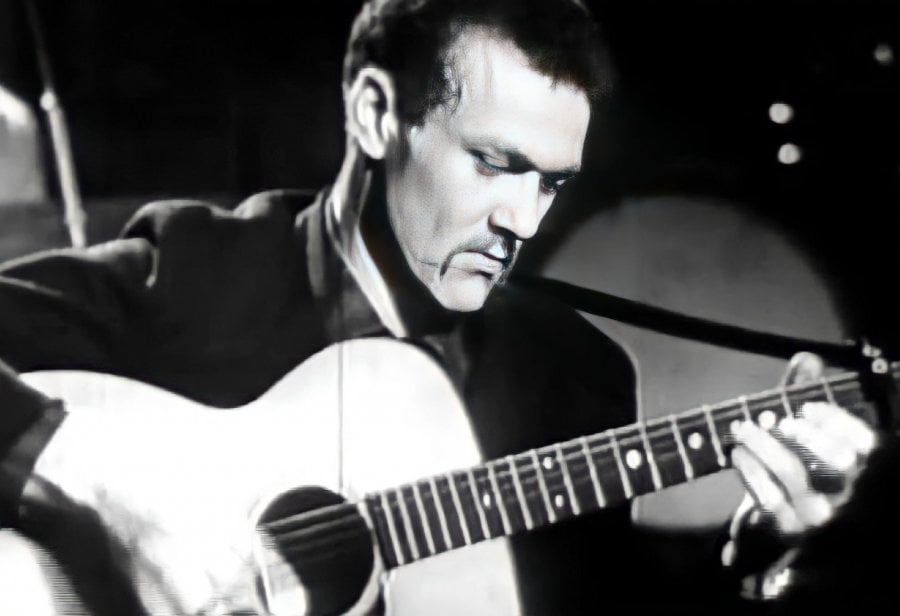
Davey Graham: The most influential guitarist you’ve never heard of

The 1960s folk revival has no shortage of pioneers. Pete Seeger, Bert Jansch, Bob Dylan, Joan Baez, Alen Lomax: the list goes on. These singer-songwriters are today regarded as laying the foundations for an entire era of stirring, politically-minded and unexpectedly countercultural music-making. Though, as it turns out, one of the most influential among them also happens to be the least-known. I’m talking about Davey Graham.
One of the most respected players of the British folk-revival scene, Davey Graham (who also recorded as Davy Graham, just to make things more confusing) was born in Leicestershire to a Guyanese mother called Amanda, and a Scottish Father called Hamish, who taught Gaelic in the local school and was blessed with a remarkable voice. One wonders if the presence of both traditional Celtic music and calypso in the Graham household might have influenced young Davey’s famously eclectic taste.
Most of Graham’s young life was spent in Westbourne Grove in London’s now-affluent but then-dilapidated Notting Hill Gate. As an adolescent, he became fascinated by the guitar, though he’d have to wait until his 16th birthday to get his hands on one. He quickly set about learning skiffle hits by the great Lonnie Donegan and early rock ‘n’ roll tunes by Elvis. After leaving school – where he’d suffered an accident that left him visually impaired – Graham packed his bags and set off to Paris, Greece and North Arica, where he earned his keep busking in the streets.
Around this time, he started honing his guitar skills, taking inspiration from Jack Elliot and Steve Benbow. The finger-stye technique he developed during this period would go on to inspire everyone from John Martyn and Paul Simon to Bert Jansch and Jimmy Page. Martin Carthy, would later describe him as an “extraordinary, dedicated player, the one everyone followed and watched.” For Ray Davies of The Kinks, he was an “awesome influence.” Simon and Garfunkel even covered his most famous song ‘Anji’ on their 1966 album Sound of Silence.
Graham himself was more inspired by John Coltrane and Miles Davis than his folk contemporaries. He was also instrumental in kicking off the British R&B scene that led to the formation of British Invasion bands like The Rolling Stones, having played with Alexis Korner’s Blues Incorporated, who helped set up the famous Ealing Club where everyone from The Who to Elton John had early performances.
Sadly, his own recording career, which kicked off in 1961, wasn’t quite as successful – though his first two albums are now regarded as British folk classics. Graham’s delayed success may have had something to do with his fascination with the murkier side of the music business. As Carthy would later tell The Guardian: “He was a lovely man, but he was in thrall to jazz players like Charlie Parker, and the whole drug culture. And though there was very little heroin on the British folk scene, he deliberately became a junkie. I remember Alexis Korner’s fury when he found out.”
Davey continued to record albums throughout the 1960s, many of which are fabulously experimental. By 1969 and the release of his raga-infused Large As Life and Twice As Natural, however, he was becoming increasingly reclusive. He spent the next ten years writing music in private, learning languages and teaching himself new instruments like the oud and the sarod, the latter of which he played on his 1979 venture Dance For Two People. By this time his influence was everywhere, but he was content to write, perform the odd show and record the odd single. He carried on in this vein as late as 2006 when he performed a rare concert at the London Spitz. Davey Graham passed away in 2008, leaving a towering legacy in his wake.

Never Miss A Tale
The Far Out Bob Dylan Newsletter
All the latest stories about Bob Dylan from the independent voice of culture.
Straight to your inbox.