


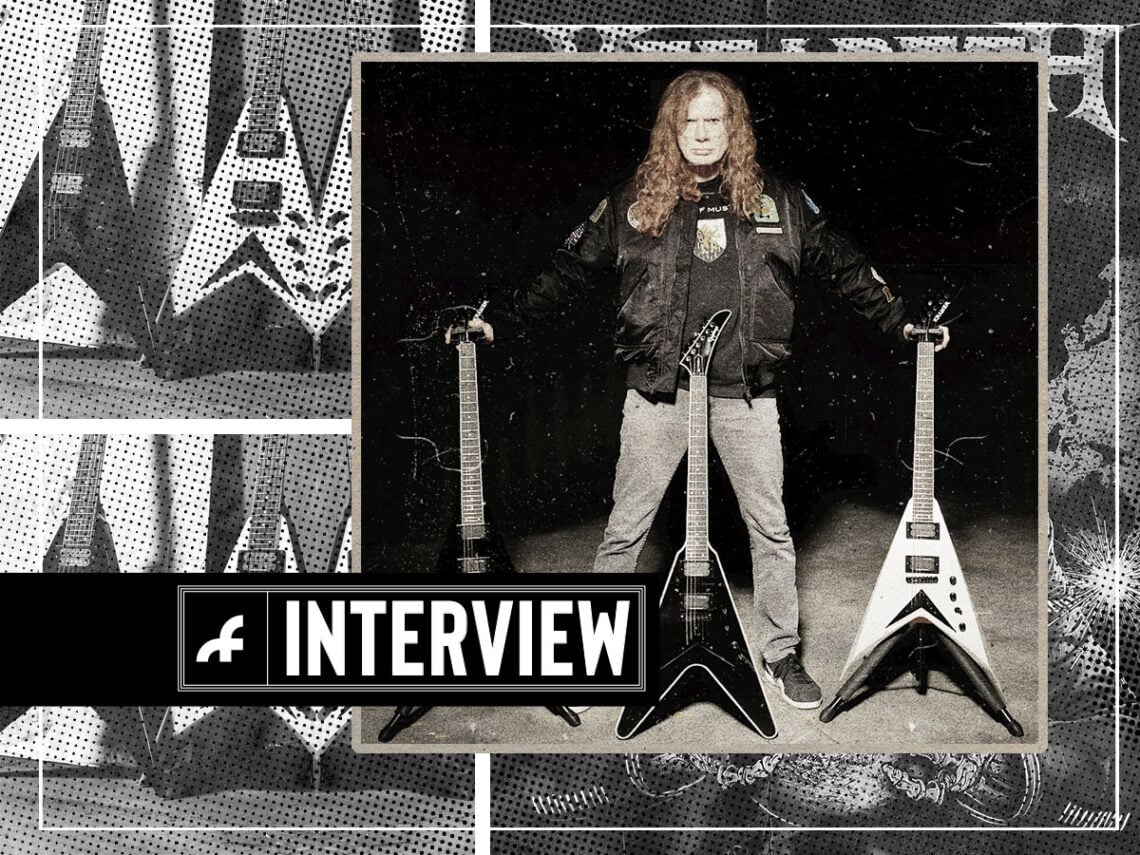
Dave Mustaine discusses his new guitars and a life in music

It’s the question I’m always asked: “How do you say your name?” I’ve been fending that remark for the last 30 years, so I reply, “You say it like Owen”. OK,” replies Dave Mustaine, chuckling as he does so. “I used to sign my name as Owen Money, as a bit of fun”. Now it’s my turn to ask the question: “Money as in ‘dinero’?” – “Si,” he replies.
Mustaine is used to speaking in different languages, largely because he’s spent the last 40-something years talking to journalists from all over the world. He’s something of a legend among rock fans, having harnessed his craft in Metallica before creating Megadeth, the vehicle he has acted as songwriter, singer and custodian for. But the man ringing from the other end of the line isn’t presenting himself as royalty but as a musician who has merely done well for himself. “When I’m over in the Emerald Isle,” he tells me, “I want you to come backstage. I’m going to hold you to that promise.”
Mustaine is calling to promote the Kramer Dave Mustaine Vanguard, a powerful, turbo-charged instrument, as well as the equally thunderous new limited edition Epiphone Dave Mustaine Flying V Custom and Flying V Prophecy. Mustaine’s trajectory has been predominantly linked to the hook, which explains his eagerness to talk about the instrument. “If you saw me just before I go onstage, you might think I have ants in my pants,” he cackles. “You will see me putting up and down my guitar strap, or straightening my shirt. The one thing I’m not worried about is the guitar.”
Mustaine’s confidence in his guitar tech allows him to enjoy the spotlight, and it’s a focus that takes over everything, from engaging with the audience to the songs that emanate from his mouth. “So, it’s only after I get off stage that the tech will say to me, ‘Do you know what the first guitar I gave you was?’ And I’m like, ‘Who cares?’ [laughs uproariously]. And then it turns out it was the Kramer, and I’m like, ‘What? I genuinely could not tell?!”
Mustaine is aware of his vocal deficiencies – his excellent 2010 book Mustaine: A Heavy Metal Memoir elaborates on this sentiment – but there’s no denying that his guitar playing bristles with energy, flair and swagger. “It was honouring and really flattering when I found out I was number one in [Joel McIlver’s] The 100 Greatest Metal Guitarists book,” Mustaine beams. “There’s a lot of guitarists and bands out there that don’t get the big break that they definitely deserve.”
Aware of the trappings that are found in the industry, Mustaine says he provides advice to aspiring bands he feels need guidance. “The industry is all about whether or not a band sells records,” he sighs. “I don’t agree with that, so I try to be a loving uncle when I can. You treat people as you wish to be treated.”
His voice changes: “Are you aware of the Oriental saying, ‘A smart man learns from his mistakes, but a wise man learns from the mistakes of others’?” I’m familiar with it. “Well, no disrespect Eoghan, but I’d rather you put your hand on a hot stove instead of me doing it.” And with that, he laughs, no mean feat for a man who has carried himself as one of the most precocious songwriters in metal.
It’s at this moment I decide to ask him about my favourite Megadeth number, ‘A Tout Le Monde’. Was it challenging to sing in French? “Well, we wrote it in 1994,” he explains, “And we re-recorded it with Cristina Scabbia during the millennium. I contacted a guy from Hard Rock magazine, and he looked over what I had written in French, and he said it was fine. I went in to record the vocal, and I asked how it sounded? [affects a voice] ‘Really bad!'”
“But I wanted to sing in French,” Mustaine continues. “I wanted to have a song with a French chorus. The Beatles used a French chorus with ‘Michelle’.” It can’t have escaped Mustaine that metal was growing in popularity across continental Europe, too; the mots francais must have gone down a treat at festivals. “I decided to do another one in Spanish,” he says. “When you look at the world’s most popular languages, well English is number one. And then, I think, it’s Mandarin; definitely one of the Chinese dialects. And then it’s Spanish.” ‘Trust’, the finished result of this endeavour, stands as one of the band’s more interesting experiments in sound and theme. “‘Trust’ definitely goes down well in the Spanish-speaking countries,” Mustaine agrees.
His memoir is impressively confessional, delving into the rigours of managing a band as successful as Megadeth, to the difficulties he experienced with bassist Dave Ellefson, who departed the band in 2002 (Ellefson re-joined in 2010, performing beside Mustaine for the next decade, although it looks like his second departure will be a more permanent one.) “It was so much fun co-authoring that book,” Mustaine notes. “I had so much fun doing it, and then I became a New York Times best-selling author.” In the interview, he notes that the band sounded more focused in Arizona, sensing it was a “curse for a metal band to be in L.A.”
It’s at this point I move from my favourite Megadeth number to the song they are best known for, ‘Peace Sells’, a pulsating rocker guided by Ellefson’s galloping bass work. “I think that song captured a feeling,” he says. “There was a sentiment and a topic that people could understand. A lot of it is going to church, paying bills…But don’t mess with me. That was the feeling.”
It’s time to bring it back to the subject that inspired this interview in the first place: guitars. “Gibson guitars are number one for a reason. When I’m performing, I have a Kramer, an Epiphone, and a Gibson. There was a time I went through a B.C. Rich phase, but otherwise I’ve been a Gibson fanatic all my life. I’m pretty sure Led Zeppelin used one. The body, the neck: It all feels out of this world. And it’s affordable.”
Kramer guitars are available worldwide on www.kramerguitars.com / Flying V Prophecy (Limited Edition), available at www.epiphone.com.
