


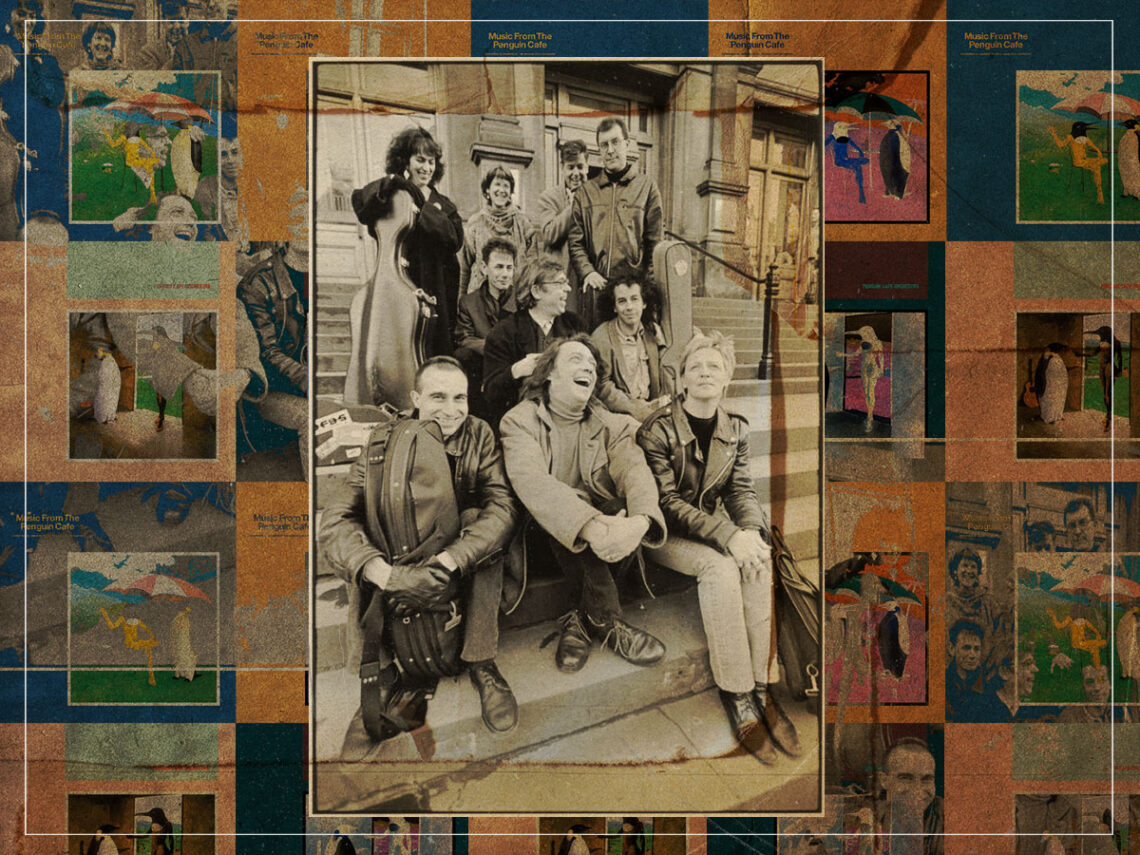
Dystopian Hallucinations: the dark vision that founded the Penguin Cafe Orchestra

In 1972, the once lingering vision of the 1960s was steadily being laid to rest. The world suddenly seemed too brutalist to sustain such dreamy thinking. Everything from art and architecture to lifestyle choices and floundering livelihoods began to reflect this.
So, it perhaps comes as no surprise that while suffering from a bad bout of food poisoning in the South of France, the feverish thoughts of Simon Jeffes turned towards the dystopian. When he pulled around and the slim semblances of beautiful nature reawakened after his terrible illness, this mixture of glimmering hope and looming damnation gave birth to a new type of avant-pop, presented under the quirky moniker of the Penguin Cafe Orchestra.
If anything, this odd part of history seemed creatively liberated. It offered Jeffes a chance to dance between light and dark, between the expansive nature of music in a genre-less generalisation and the minutia that can be unearthed in its various niches, all of which seemed possible as technology arose. However, perhaps he mightn’t have seen the new horizons possible had it not been for some bad cooking while holidaying in the la Riviera.
“As I lay in bed, I had a strange recurring vision,” Jeffes wrote in the band’s official bio. “There, before me, was a concrete building like a hotel or council block. I could see into the rooms, each of which was continually scanned by an electronic eye. In the rooms were people, everyone of them preoccupied. In one room a person was looking into a mirror and in another a couple were making love but lovelessly, in a third a composer was listening to music through earphones. Around him, there were banks of electronic equipment. But all was silence”.
At the time, he could’ve been accused of reading 1984 a little too veraciously, but now this vision comes with a bleak, eerie prescience. In that composer, he saw the future of music and commented: “Like everyone in his place, he had been neutralised, made grey and anonymous. The scene was, for me, one of ordered desolation. It was as if I were looking into a place which had no heart”.
So, he decided to be the heartbeat of disordered hope, a dream undoubtedly realised in beautiful songs like ‘The Sound of Someone You Love Who’s Going Away And It Doesn’t Matter’ that make a mockery of the term avant-garde, instead making its dramatic sudden movements from perfectly tranquil folk guitar giving way to the howl of a wailing mono-tonal viola seem like music simply dancing to deeply human whims rather than pre-ordained constraints of genre.
As Jeffes said once, his vision subsided: “Next day, when I felt better, I was on the beach sunbathing, and suddenly a poem popped into my head. It started out ‘I am the proprietor of the Penguin Cafe, I will tell you things at random’ and it went on about how the quality of randomness, spontaneity, surprise, unexpectedness and irrationality in our lives is a very precious thing”. This would become somewhat of a mantra for the collective that he founded shortly after his trip to France, a disaster and blessing in equal measure.
“If you suppress that to have a nice orderly life,” Jeffes says, “You kill off what’s most important. Whereas in the Penguin Cafe, your unconscious can just be. It’s acceptable there, and that’s how everybody is. There is an acceptance there that has to do with living the present with no fear in ourselves”.
So, there may be times when you listen to the timeless music of the Penguin Cafe Orchestra where blissful dalliance suddenly erupts into dissonant chaos, obliterating your reverie like a seagull shitting upon your coastal walk, and you think, ‘What have they gone and done that far’, but in those moments I’d implore you to bear in mind the vision and mantra that the band were borne from.
After all, it is one that not only liberated Jeffes to dive headfirst into the music that makes up the segments of honeyed belle, and hopeful brilliance like ‘Perpetuum Mobile’, but one that seems more and more like an encapsulation of the times with each passing, disorderly day.
