


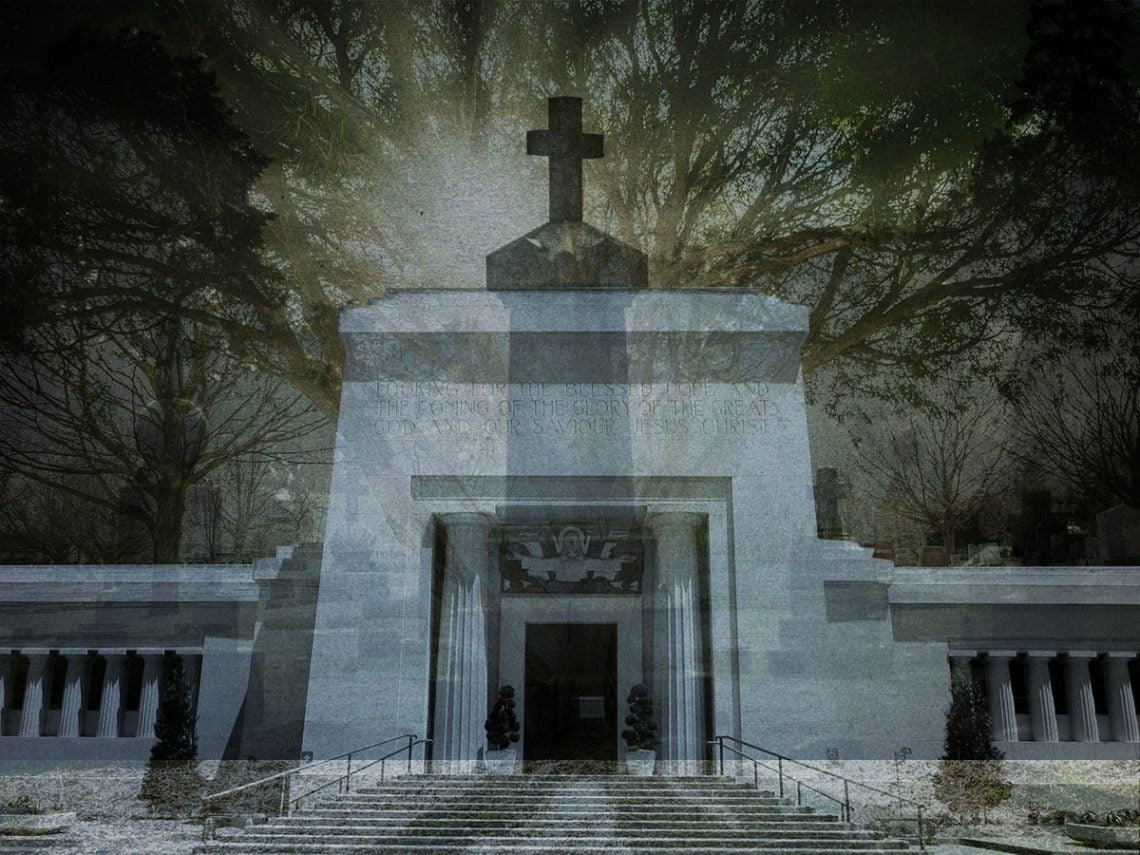
Dark Tourism: Colma, City of The Dead

In Colma, life is a rare commodity. Drivers passing through this sun-dappled suburban enclave tend to note the welcome sign declaring, “It’s great to be alive in Colma!” Indeed it must be. Nestled in San Mateo County, some ten miles from the foggy swirl of San Francisco, this two-and-a-half square mile stretch must be the only town in America where the dead outnumber the living. Home to about 1,400 people and nearly two million corpses, the bulk of the population resides a few feet below the surface, occupying seventeen cemeteries and 73 per cent of the town.
Colma started out as a farming community. Founded in the first half of the 19th century, it was home to prospectors, Spanish missionaries, frontiermen and homesteaders. They had heard of gold in California and been drawn west, only to give up and settle down to more reliable work. Many wound up in San Francisco, which, by the 1880s, had seen a huge influx of immigrants from all over Europe and the Americas. Overpopulation bred disease, and it wasn’t long before San Fransico found itself in the grip of a pandemic.
Writing in the San Francisco Newsletter and Advertiser in May 1887, one particularly anxious commentator objected to being forced to live next to so many cemeteries. “Half a million pounds of putridity are manually boxed up and covered with a few feet of earth,” they wrote. “The scientist knows that all the evils of this decomposition are but disguised by stone vaults and costly cerements. The germs of disease grow and are diffused in spite of them. They rise to the surface from the deepest grave to poison both the earth and the air.”
Land was in high demand, and most of it was being used to bury the mounting dead. The same year the San Fransisco Newsletter published its damning article, the city’s catholic archbishop Patrick Riordan bought 283 acres for burial use. The congregation of the city’s Jewish Temple bought up more land the following year. In an effort to stop San Francisco from being turned into one big cemetery, all burials within the city limits were banned, making nearby Colma the only place where San Franciscans could be laid to rest.
Colma expanded its cemeteries, but, In 1912, more bodies arrived after the San Francisco Board of Supervisors ordered that all corpses be disinterred and reburied outside the city. For thirty years, horse-drawn bone wagons carried thousands upon thousands of remains from San Francisco to Colma, with the Catholic Holy Cross Cemetary founded by Archbishop Riordan receiving over 39,000 bodies. Many corpses were so old they could not be identified and were piled into mass graves.
If you go to Colma’s Japanese cemetery today, you’ll find one plot home to 107 bodies moved from cemeteries on Laurel Hill. You’ll also find the graves of Joe DiMaggio, baseball star and husband to Marilyn Monroe; Levis Strauss, the jeans manufacturer; William Randolph Hearst, the enormously rich newspaper baron; and Bill Graham, the 1960s music promoter famed for his work with Bay Area bands like The Grateful Dead and Jefferson Airplane.
