


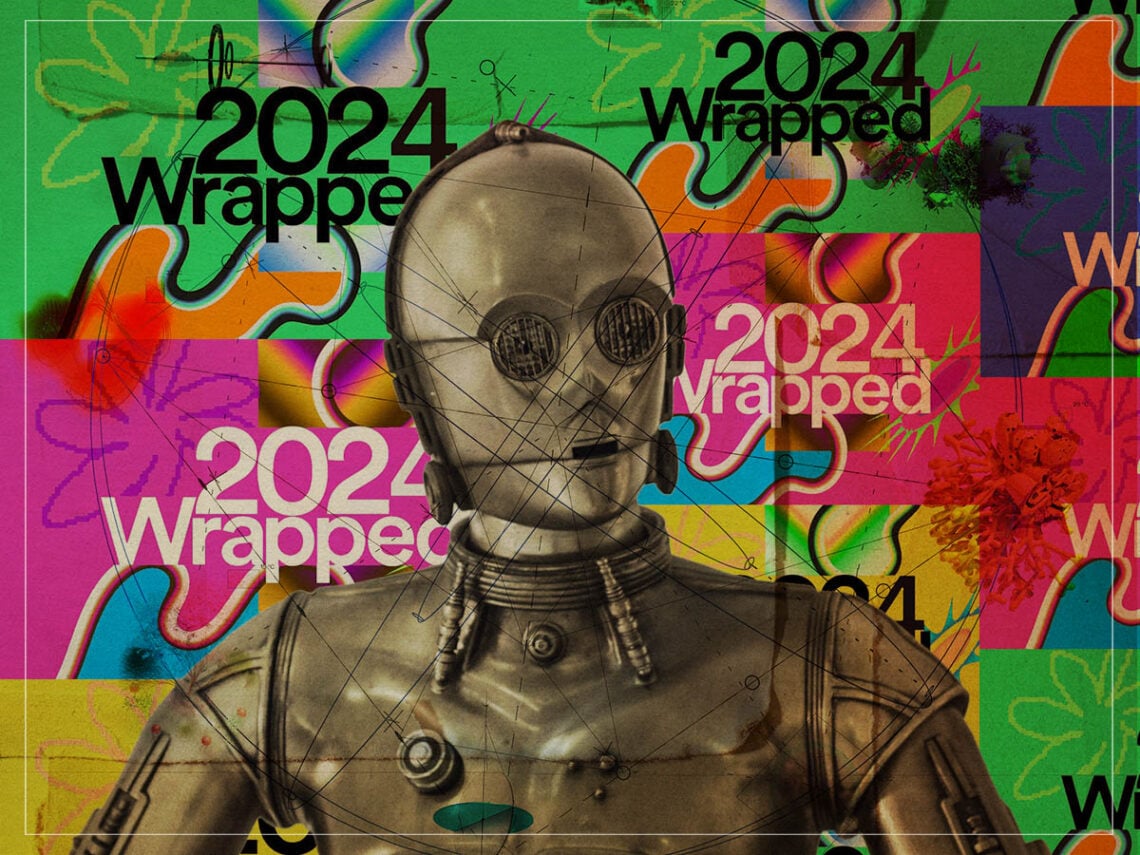
Culture as a data farm: How AI entered Spotify Wrapped

With battle lines firmly drawn between the arts and artificial intelligence in recent years and musicians refusing to be benched for their computer-generated counterparts, AI has instead filled a vacuum of participation—that of the culture commentator.
For the first time in its history, the highly anticipated Spotify Wrapped feature has introduced an AI-generated podcast—Your Wrapped AI Podcast—with two artificial hosts ‘personally’ walking you through your data set and, in effect, identifying your personality tropes. In other words, your marketable properties.
When the annual Spotify Wrapped results are published, AI’s role in music flourishes and provides listeners with the sort of short-term, relevant personal experience that’s appropriate in papering over the cracks of modern music’s moral misconduct. But when the dust settles on this highly anticipated and socially shared event, controversy usually appears not long after, be it conversations around artist royalties or perhaps the origins of Wrapped’s creation.
However, this latest pivot of expanding Spotify’s use of AI seems to drive the platform further into the heart of controversy. While Spotify Wrapped may be an early Christmas gift to some, to others, it’s another play from major tech conglomerates to collect our data at will and track our listening habits, which are an inextricably linked part of our personal lives.
Powered by Google Notebook, Your Wrapped AI Podcast comprises two voices who run you through much of the data the traditional Wrapped segment provides you with, but with an added element of artificial familiarity. While something remains innately artificial about the delivery of the podcast, the voices of the two podcast ‘hosts‘ are undoubtedly personal and with the consistent address of your name throughout the episode, there is certainly an element of intimacy within. In addition to that, the presentation of your otherwise commonplace data is seasoned with adulation and awe, with my hosts telling me they can picture me driving my car, with the windows down listening, to Babe Rainbow.
What was striking throughout was the validation of what subgenre each of my picks fell into, which ranged from “lounging escape room soul” to ”psychedelic permanent wave indie” and “van life beach psychedelic beach”. On a platform where curated playlists are the lifeblood of up-and-coming artists, the doubling down of these over-described subgenres from two faceless voices puts the entire question of where artistry exists within music at odds. Would Bowie have shifted between ‘Space Oddity’ and Ziggy Stardust’ so freely if his royalty livelihood depended on his songs being featured in a playlist titled “Space Infused Psychedelic Folk Rock” that was artificially celebrated at the end of a yearly cycle?
Not only does this development strike fear in the hearts of artists, but it must certainly feel like a stab in the back to a handful of podcast creators who have joined the Spotify community in recent years. End-of-year lists are a tried and tested editorial strategy for many journalists and provide key conversational signposts when it comes to providing the context of artistic culture shifts. Understandably, no human-powered podcast can create the same level of mass individualism in their content, which to some consumers could be considered a more appealing proposition and therefore put their position of relevancy at risk.
While Spotify introduced this AI functionality to their platform in the previous Wrapped year, with their resident AI DJ who remained on the platform thereafter playing you both songs from your library and recommendations based on your listening, this latest introduction feels like a reinforcement of a wider strategy to unify music fans with AI capabilities. Albeit impressive as part of a personalised data package, it undoubtedly feels like a step closer to a more singular approach that leaves only the music created as the human contribution.
While the outright replacement of artistry feels too close to the bone just yet, Spotify’s control of the curator role feels like a more palatable strategy. Artists may not be replaced by AI for the immediate foreseeable, but with the voices being the orators of many music fans’ most beloved recaps, it becomes a question of not if but when we will start seeing artists thank Spotify AI for featuring them. Therein lies a dangerous dystopia where the gatekeepers of the arts are faceless machines subject to any manner of unknown manipulation, no accountability, and untold data harvesting.
