


‘Bhaji on the Beach’: a cultural phenomenon for British Asians

At a time when British Asian stories weren’t exactly well-represented in cinema, Bhaji on the Beach blew through the country like a gust of wind along the seaside, serving as a calling card for two key creatives who went on to enjoy stellar careers.
The feature-length directorial debut of Gurinder Chadha – who’d go on to helm Bend It Like Beckham, Bride and Prejudice, and Angus, Thongs and Perfect Snogging – the idea originated from screenwriter Meera Syal, inspired by her own experiences of childhood trips to Blackpool.
Of course, Syal would continue gaining prominence through her work on stage, screen, and television, but it was Bhaji at the Beach which served as an impressive breakthrough for both. Reflecting cultural and societal attitudes that were rarely spotlighted on the big screen, the dramatic comedy deftly balanced heart and humour with important and resonant messages that spoke to the British Asian community.
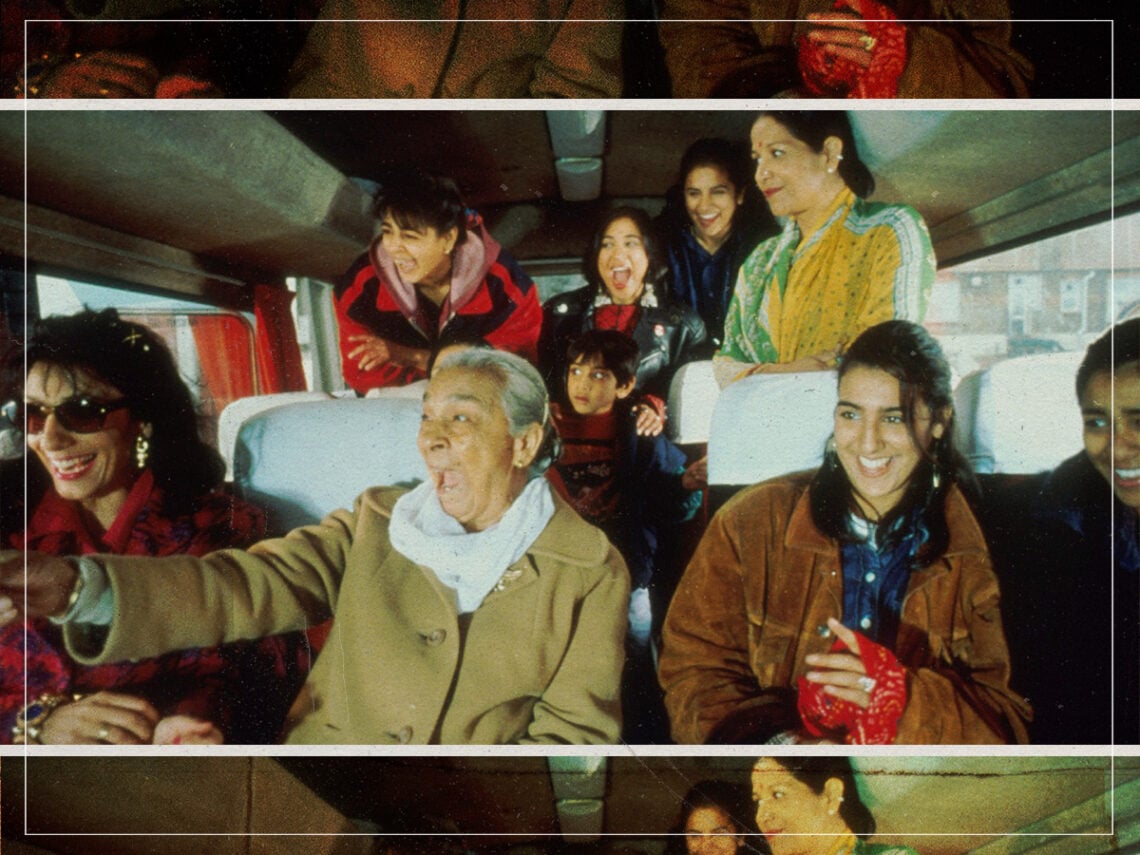
A group of women of Indian descent from multiple backgrounds and age groups ventures off from their community centre in Birmingham to take a trip to Blackpool. With a principal cast comprised largely of South Asian female actors, Bhaji at the Beach instantly gives a voice and perspective to a demographic that was rarely served well on celluloid in the early 1990s.
Before they even set off, Shaheen Khan’s Simi gives the busload of passengers a rousing pep talk, underlining the restrictions and burdens placed upon them by racism and sexism and urging everyone to have a good time. Of course, it’s never as straightforward as that, with each of the main characters having a unique experience that’s rooted in both their view of modern British society and their place within it.
Although it’s a British Asian story at heart, Chadha didn’t approach Bhaji on the Beach as a filmmaker determined to keep the focus narrowed to a particular cross-section of the culture. “What I am saying is that there is no such thing as ours and theirs. There is no part of Britain or England that I can’t lay claim to,” she told the British Film Institute. “The look of England, as I’ve experienced it in things like A Taste of Honey, Up the Junction and the Carry On films, which have a very constructed sense of Englishness. I think of Bhaji as a very English film.”
Embracing themes of single parenthood, teenage pregnancy, prejudice, cultural and generational divides, the fractious political landscape, and the notion of Britishness and how it’s perceived by anyone who calls themselves a citizen are intrinsic to the tapestry woven together by not only Syal’s words and Chadha’s direction but also the moving performances of the cast.
Bhaji on the Beach was a movie that simply didn’t come around all that often for the British Asian community when it was released in 1993, but more than 30 years later, it’s still remembered as one of the most important.
