


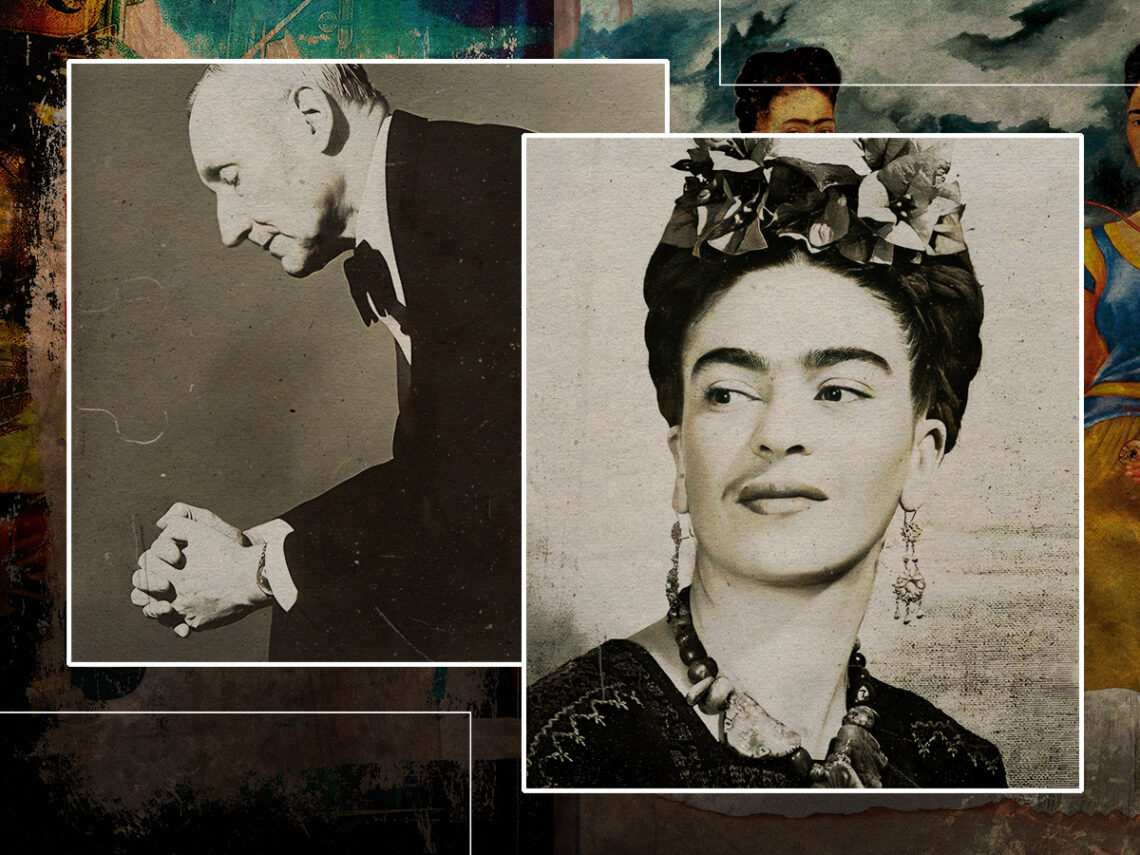
Cultural Connections: William S. Burroughs, Frida Kahlo and the art of the world’s sickness

The wonderful thing about art, regardless of medium, is that it can explore any range of the many facets that comprise the human condition, interrogate them, hold them at arm’s length, find the beauty in the hideous, the strange in the seemingly perfect and examine just what it is that makes our terrifically flawed species so special and unique.
There’s no doubt that humankind has a certain sense of sickness, whether from a physical or ecological perspective or through disorders of the mind. The pain and anguish of merely being alive as an individual or as part of a broader collective society is often the central point of many of the most remarkable pieces of art, and two figures who use this theme as a focus in their works are William S. Burroughs and Frida Kahlo.
Burroughs’ pain largely came through his heroin addiction, which developed after he was turned away from the Office of Strategic Services and the Navy, and his 1953 novel Junkie, a confessional piece of work in every sense, explores the nature of what it is like to be addicted to a severe substance like heroin.
Junky is utterly up-front about its subject matter and doesn’t pull any painful punches or hide the sickening nature of addiction from its readers. Bathed in the light of brutal realism, Burroughs was a provocative figure in the literary world of the mid-20th century and found himself a place in the earnestness of the Beat Generation.
Will Self once wrote in The Guardian of Junky, “It is Burroughs’ own denial of the nature of his addiction that makes this book capable of being read as a fiendish parable of modern alienation. For, in describing addiction as ‘a way of life’, Burroughs makes of the hypodermic a microscope, through which he can examine the soul of man under late 20th-century capitalism. His descriptions of the ‘junk territories’ his alter ego inhabits are, in fact, depictions of urban alienation itself.”
There’s a sense in Burroughs’ work, particularly in Junky, that he was airing the drug’s dirty laundry. The disgusting parts of going through withdrawal, the hallucinations, the excrement, the robberies, the weight loss, the end of relationships, the paranoia and prison stints are all given the gruesome spotlight. Everything that comprises the true sickness of being a heroin addict is laid bare by Burroughs with unflinching honesty.
The suffering that Burroughs experienced as a heroin addict was matched, if not superseded, in terms of its physical pain by the Mexican painter Frida Kahlo. Kahlo’s work had often been inspired by the folklore and nature of her native country and explored the notions of identity, gender, race and class in Central American society.

But it was Kahlo’s depictions of her chronic pain that stands out, at least when we compare her work to that of William S Burroughs. Take, for instance, her 1945 painting Without Hope, in which she depicts herself being force-fed from a strange and rather horrific mass of flesh and animal parts whilst lying in bed in a natural vista.
Kahlo’s sickness had largely arisen after being injured in a bus accident at 18, and her 1929 work The Bus depicts the moments before the accident happened. As with Burroughs, there is a sense of bearing all as it was, refusing to be ashamed of what one is but using art to accept the events and occurrences that make us what we are, regardless of how painful that might be.
Elsewhere, in paintings like 1944’s The Broken Column and 1946’s The Wounded Deer, we again see Kahlo depicted in moments of pain, whether in the former, where she is shown with a metal surgical pillar in the centre of her body or in the latter, where she is transformed into a beautiful deer that has been stuck with several arrows. Both paintings suggest that Kahlo seemed destined to be something perfect, but fate looked to take that life away from her, leaving her to live in pain and misery.
But perhaps the very act of painting such tormenting scenes with herself as their central focus meant that Kahlo was able to achieve some sense of catharsis, and not only that, but she was able to show others who are/were afflicted with similar ailments that there is a way to live a beneficial life, even if only through creating art.
Both Kahlo and Burroughs have a sense of unashamed confrontation of the darker and more painful sides of the human condition in their respective works that have had both artists receive widespread acclaim. Art possesses the power to address the sickness and afflictions of humankind, and perhaps the American writer and the Mexican painter did it the most justice.
