


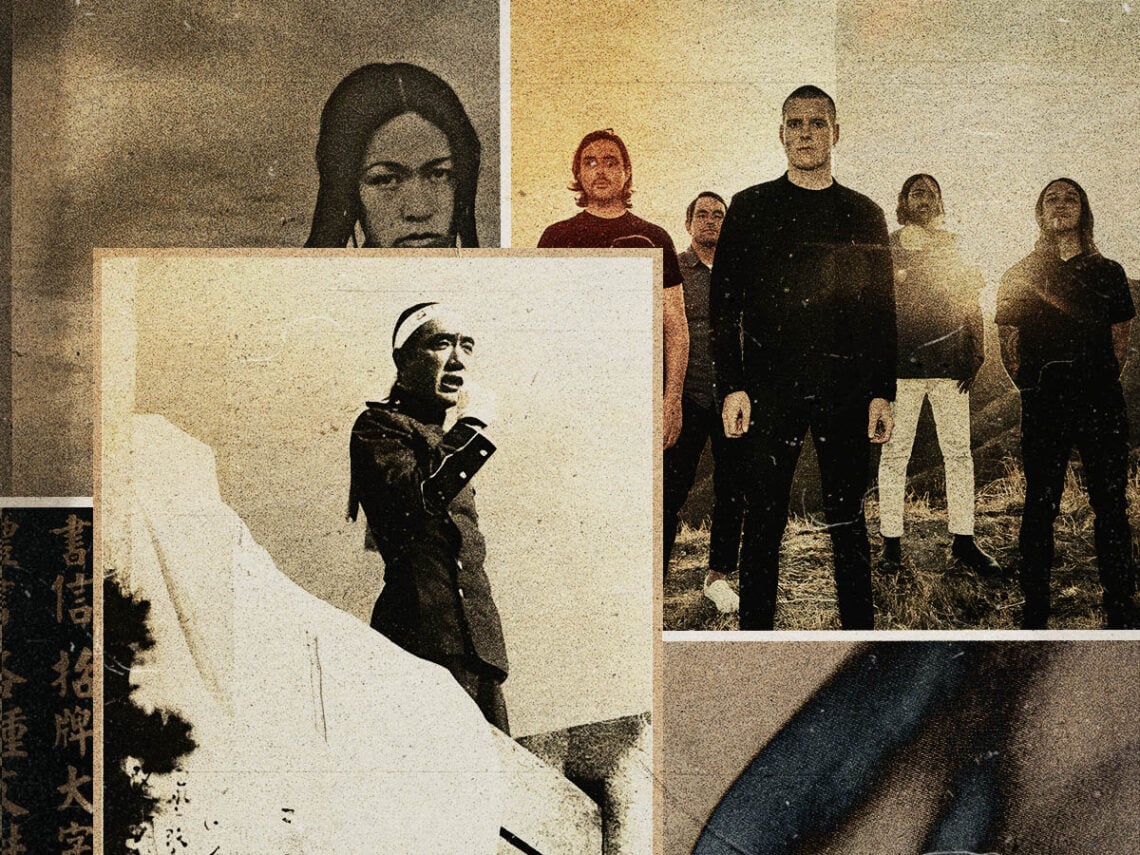
Cultural Connections: Action, beauty and death in the works of Yukio Mishima and Deafheaven

It’s fair to say that the best kind of art is the most powerful, that which rouses the emotions deep within us. Art for art’s sake is often the kind of art that falls flat; it has no human meaning, and therefore, we cannot relate to it. By contrast, art which stirs something in us we did not know was there; visceral art, even art which borders on the violent, can provide a profound catharsis, cleansing us of our inner concerns and allowing us to move on in our lives with a deeper sense of clarity.
One of the clearest examples of an artist who explores truly visceral and powerful conceptions in their work is the Japanese writer Yukio Mishima. Many of Mishima’s novels concern the themes of beauty, death, action and even art itself, and, in several ways, we can draw a relation between Mishima’s work and the American ‘blackgaze’ band Deafheaven, who have delivered some of the most powerful and moving pieces of music ever committed to record.
Yukio Mishima’s most significant treatment of beauty came in his 1956 novel The Temple of the Golden Pavilion. It told of a young stammering acolyte, Mizoguchi, at a Zen Buddhist Temple in Kyoto who is struck by the beauty of its titular Golden Pavilion. Mishima argues through his writing that beauty itself is volatile, so much so that Mizoguchi feels compelled to burn the Temple down to the ground.
Where most people simply appreciate beauty and admire its aesthetic qualities, the beauty of the Golden Pavilion stirs something in Mizoguchi and causes him to act. So rather than beauty being solely a visual appreciation of colour, of symmetry – for Mishima – it is one of the central and vital influences on our human agency, especially in those who are sensitively attuned to beauty’s captivation, as young Mizoguchi certainly is. Furthering this idea, Mishima had once written, “True beauty is something that attacks, overpowers, robs and finally destroys.”
This leads us to Mishima’s second notion of vital importance, action. As a true patriot of Japan, coming from a Samurai lineage, Mishima felt that post-war Japanese society had become lazy and overly concerned with material gain. The once central ideal of honour had departed Japan as the country began to make the transition into a Capitalist mode of living.
Mishima ardently desired that Japan would return to its former glory, and he explored this notion in his 1969 novel Runaway Horses. It focused on the story of a right-wing reactionary, Isao Iinuma, who plots to overthrow the powerful and greedy businessmen at the top of Japanese society in the 1930s. Isao, like Mishima himself, has been versed in the honorific ways of the Samurai by his father and seeks to return glory and power to the Japanese Emperor.
In many ways, this also mirrors Mishima’s own efforts to return power to the Emperor. In 1970, Mishima and four of his political and military disciples took hostage the Commander of the Camp Ichigaya military base in Tokyo. He delivered what he hoped would be a rousing speech to the camp’s soldiers and urged them to follow the Emperor rather than the Japanese capitalist government. However, the soldiers mocked Mishima’s speech and, humiliated, he committed ritual suicide in the Commander’s office.
This historical fact only reinforces Mishima’s belief that one’s personal values can only be realised if one is to act upon them, even to the point of one’s death. Tying together Mishima’s dual imperative of beauty and action, we can point to the fact that he was also a keen bodybuilder and a master of the pen. Mishima felt that the most profound beauty came from the human body, and his autobiographical text Sun and Steel: Art, Action and Ritual Death detailed his quest for personal human corporeal perfection.
If Mishima was to die, as he knew he inevitably would, then he felt he owed it to the shell that housed his human spirit for it to die in beauty and in strength as a work of art itself. Reflecting on his early days as a puny youth, Mishima wrote, “I lacked, in short, the muscles suitable for a dramatic death. And it deeply offended my romantic pride that it should be this unsuitability that had permitted me to survive the war.”
Then, “Any confrontation between weak, flabby flesh and death seemed to me absurdly inappropriate”. So Mishima was essentially able to face up to the inevitable death of his body by preparing it for that very same death. The words, “[We] must be open to death — which means, of course, that [we] must be a community of warriors,” is perhaps Mishima urging to his acolytes and readers to join him in a strengthening of the human body, so that they too may become works of art in their own right.
Moving some 40 years on from Mishima’s glorious death by his own hand, we find the California “blackgaze” band Deafheaven. The term “blackgaze” comes from the black metal and shoegaze genres, and even there, immediately, we see that within Deafheaven’s genre classification, there is an appeal to Mishima’s values in the solace and beauty of shoegaze and the violent and urgent action of black metal.
Deafheaven’s masterpiece album Sunbather contains some of the most visceral sonic moments ever committed to record. Guitarist Kerry McCoy’s wall of sound, as inspired by My Bloody Valentine’s Kevin Shields, is propelled by Daniel Tracy’s persistent blast-beat percussion, and the effect is a sound that just persistently stabs you to the core with all the power of a jet engine.
This power is then elevated into something even more glorious when singer George Clarke’s high-pitched screamed vocals come in with genuine ferocity, almost banshee-like, or as something beyond the realms of prior human understanding. So on the surface of it, Deafheaven’s sound is aggressive, violent even, and stirs a hidden something in those who are able to bear its visceral energy.
However, underneath all the screaming and blast-beats and heavily distorted guitars, there lies a genuine sonic beauty to Deafheaven. We have moments of still and quiet on Sunbather’s ‘Dream House’, ‘Vertigo’ and ‘The Pecan Tree’, as well as the sombre, touching instrumental ‘Irresistible’. It’s these moments of Deafheaven that give the harder parts all the more weight and purpose, chiaroscuro perhaps, a light contrast to the undoubted dark.
Discussing the sound of Deafheaven and its inner beauty, George Clarke told The Guardian in 2015, “The chord progressions are very orchestral; there’s a lot of grandiose beauty. And what drew us initially to black metal was the constant blastbeat which can be really hypnotic – you can write a 10-minute song to it, and it feels like no time has passed.”
Yet, if we dive deeper still, we find that there is far more to the beauty of Deafheaven than we had first anticipated. As Clarke’s vocals are nigh-impossible to understand by merely listening to them, it is only upon reading them written down that we see how akin to true artistry they really are.
There is a certain appeal to Yukio Mishima’s notion of beauty in death in Clarke’s lyrics in ‘Dream House’, “I’m dying/ Is it blissful?/ It’s like a dream/ I want to dream.” They suggest that there is something to be taken from the inevitability of death; it needn’t be something we ought to be afraid of, but rather something that we should confront and that can inspire us into action, into an authentic mode living.
The non-album release ‘From The Kettle Onto The Coil’ explores the notion of beauty and simultaneously its inherent futility. “The reflection on the sill/ Giving the cheekbones their due/ Praising the worth of porcelain skin/ My shades of blonde dancing in the high,” Clarke sings. Then, “I gave labour to the grief/ To the squinting spectator who drank in the despair/ As I tiptoed off the plane of existence and drifted listlessly/ Through the velvet blackness of oblivion.” Beauty is there to be admired when it peers in through our window to the external world, but at the very same time, we are a speck in the universe, and true beauty might lie beyond our usual human perception.
And yet there are moments of just straight-up poetic beauty in Clarke’s writing, which like Mizoguchi in The Temple of the Golden Pavilion, we are completely and utterly captivated by. In ‘Vertigo’: “Hunched over in apathetic grief with a disregard for steps except the one taken back / Perched up on a rope crafted in smoke, a sword-wielding death that buried your hope.” But again, a la Mishima, the urgency of death and the disregard for action other than those taken in moments of regret.
Of his lyrical method, Clarke said, “We discussed the lyrical approach early on. I told Kerry, ‘It’s great to have this powerful music, but I want to bring something further to it, and I want it to be autobiographical, to be extremely personal.’ I might as well give all of myself to the listener; otherwise, they might feel cheated, and I might, too.”
He added, admitted to the fact that his lyrics require closer analysis, “I like that people need to investigate it; it makes the experience more immersive. There’s a humanity to our lyrics; people can see through to the bigger picture. Deafheaven isn’t about fitting some narrow definition of what black metal should be, it’s emotional, giving music for anyone willing to open their ears to it, and that’s our only agenda.”
So there is an urgent action within Deafheaven with their ferocious sound, but there is also an underlying beauty and even an appeal to death. However, we can’t access that beauty without doing work of our own, whether like Mizoguchi, we act in our own violent way to the songs or delve deeper into our own beliefs when reading George Clarke’s lyrics. So in that light, Deafheaven certainly appear to continue the artistic mission of Yukio Mishima through their undoubtedly unique approach to creativity.
Through art, we face up to the things that we deep down believe we should act upon but never seem to, and great art inspires us to take that very same action once and for all. It reveals to us the beauty of the human soul and the world in which it lives out its short existence. The works of Yukio Mishima and Deafheaven are some of the most intense and vital pieces of art ever made, and they stir moments of beauty deep within us and make our lives ones with agency, force and meaning. Though the two are starkly different artists, they both essentially contribute to the same thing, and the words of Mishima and Clarke will undoubtedly whisper through the trees for ages to come.
