


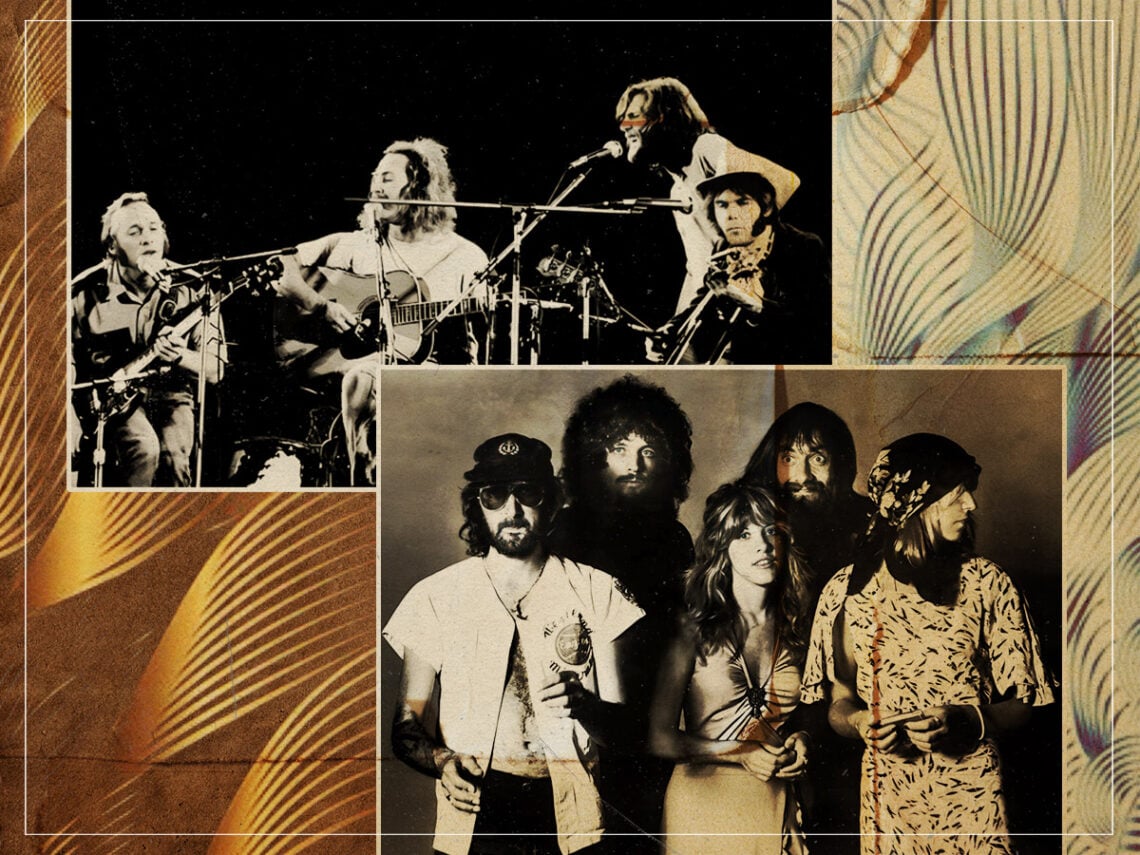
CSNY vs Fleetwood Mac: Who were the best dysfunctional harmonisers?

As pioneers of folk rock and critical forces in the visionary nature of the countercultural era, CSNY and Fleetwood Mac share several spiritual similarities. However, the most tangible connection is that they were both two of the most dysfunctional outfits of their time and the groups that weaponised vocal harmonies better than anybody else.
The stories of both groups parallel each other in their tumultuous journeys, marked by the prominence of sex, drugs, and alcohol. Yet, it’s the depth of their vocal harmonies that most closely unites them, beyond their shared hippie vibe and earthy folk inclinations. While blending multiple voices to create powerful harmonies is impressive on its own, achieving this amid clashing personalities and the debilitating effects of hard partying is truly remarkable, as they defied all odds to create something enduring.
To be fair to Fleetwood Mac, defying the odds is what they do. After all, they’ve welcomed many different members over the years and kept pushing on. Their often chaotic career includes successfully navigating the psychological decline of their founding member Peter Green, as well as original slide guitarist Jeremy Spencer randomly taking off to join a cult. Even their world-famous masterpiece, Rumours, was born out of the most fractious time in the band’s history, with romantic relationships breaking down and drugs creating a miserable personal time for all. It remains one of music’s greatest success stories.
That said, CSNY’s history has been far more fragmented. Initially formed as CSN, consisting of David Crosby, Stephen Stills, and Graham Nash, the group added Neil Young following the success of their 1969 self-titled debut. A year later, with the release of Déjà Vu, their first album as a quartet, CSNY crafted what many consider the ultimate farewell to the countercultural era. The record is filled with their collective talent and captures the sentiment of an idealistic period that was swiftly giving way to something much bleaker.
Since then, CSNY have released two more albums, 1988’s American Dream and 1999’s Looking Forward. CSN, as a trio, released five studio LPs altogether. Offering a taste of their deeply fractious inner workings, personal and creative disputes—and the ever-present spectre of drugs—they even carry around an unfinished album in Human Highway, which the individual members have perplexingly touted as their best. Still, it’s never been released.
As a testament to CSNY, though, despite the heated stupor of bringing together four of their generation’s brightest and most unrelenting musical minds, they found a way to unite their respective talents and weaponise vocal melodies with a transformative effect on music going forward.
…but who had the best harmonies in dysfunction?
The question of which band conceived the best and most full-bodied harmonies out of such notorious dysfunction is a genuine head-scratcher. After all, both outfits are brilliant and widely influential. Yet, there can only be one winner: CSNY.
In addition to defining the essence of the counterculture with their vocals on Déjà Vu—a pivotal moment in time—CSNY’s harmonies were more dynamic than those of Fleetwood Mac, exploring a wider range of delivery styles within a much smaller body of work. Take the title track of their 1970 album, for instance; it is more expressive and refined than many of Fleetwood Mac’s songs, some of which, like the Rumours opener ‘Second Hand News’, can come across as somewhat cheesy by comparison.
Not only is it a question of ability, profundity, and execution, but CSNY weaponised vocal harmonies first out of the two. Three years before Fleetwood Mac formed in London in 1967, Crosby was crafting some of the most potent vocal harmonies ever heard in The Byrds, who understood their power in bolstering their decisive melodic inclinations on the guitar.
After the formation of Fleetwood Mac, they initially operated within an expressive, blues-rock realm, heavily reliant on Peter Green and Danny Kirwan’s evocative guitar work and Green’s powerful voice. It wasn’t until Green’s departure in 1970 and the arrival of bassist John McVie’s wife, Christine, that the band began to more fully explore vocal harmonies. Even then, it would take the arrival of Stevie Nicks and Lindsey Buckingham in 1975 for the band to truly harness and showcase their collective vocal power, marking a significant evolution in their sound.
Although Fleetwood Mac’s vocal harmonies on classics like ‘The Chain’ and ‘Go Your Own Way’ are more widely recognised beyond their era—despite being born out of significant dysfunction—there’s no surpassing the impact of CSNY’s classics such as ‘Our House’, ‘Helpless’, and ‘Teach Your Children’. The blend of their four remarkable voices creates an enveloping, almost ethereal effect, floating atop music that effortlessly penetrates our most guarded, innermost emotions.
