


‘Crocus’: Suzan Pitt’s surreal feminist animation

The history of surrealism, especially in cinema, primarily focuses on the contributions of male artists such as Luis Buñuel, David Lynch, and Alejandro Jodorowsky. But what about the female filmmakers who injected surrealist cinema with well-needed doses of femininity, like Suzan Pitt? She was a talented animator and artist, creating movies that dealt with female sexuality, identity, and motherhood by using gorgeous illustrations that illuminated her glorious and colourful world.
As a teacher at Minneapolis College of Art and Design, Pitt was given access to a wide range of art supplies and cameras, leading her to try her hand at animation. Crocus was her second short film, yet it proved that Pitt already had a real knack for blending paper cutouts with an animation style that allowed itself to be slightly messy and artificial.
The characters in Crocus move awkwardly, and their limbs don’t have much fluidity, but as a result, there’s a charm to this stiffness. It’s a clear reflection of the fact that these are hand-drawn creations, emphasising the importance of honing an individual artistic style that doesn’t conform to anything but one’s own creative impulses.
Still, just because Pitt’s visual style dealt with the surreal and uncanny, this doesn’t mean that the narratives of her work were detached from reality. Crocus begins with a naked woman in her bedroom, who walks over to her mirror and analyses her face. She then touches her breasts and makes an inquisitive noise. It’s strange – while we feel as though we’re intruding on an intimate moment, we’re then hit with the reminder that we’re watching an animated drawing.
Pitt then introduces us to the woman’s husband, a naked figure emerging from the dark hallway. The drawing’s lack of ability to move properly creates comedic effect, establishing a tone of lightheartedness. In the bedroom, he giggles before his ridiculously large penis emerges, comically erecting to the sound of a slide whistle. The woman then looks at us, bringing the viewer into the intimate bedroom scene. In doing so, she involves us in the narrative, asking us to pay attention beyond the humorous sound effects and naked figures.
After kissing and getting into bed, their baby calls from the other room for a drink of water, interrupting their attempts to have sex. Of course, it is she who must tend to the baby. Once she’s back in her bed, the woman continues to have sex with her husband while the camera spins to emphasise the dizzying nature of love and pleasure. Pitt inserts various bizarre images over the top of the scene, with a giant phallic pickle journeying through the door frame and out the window, followed by the likes of a Christmas tree, a rose, a bird, and a butterfly.
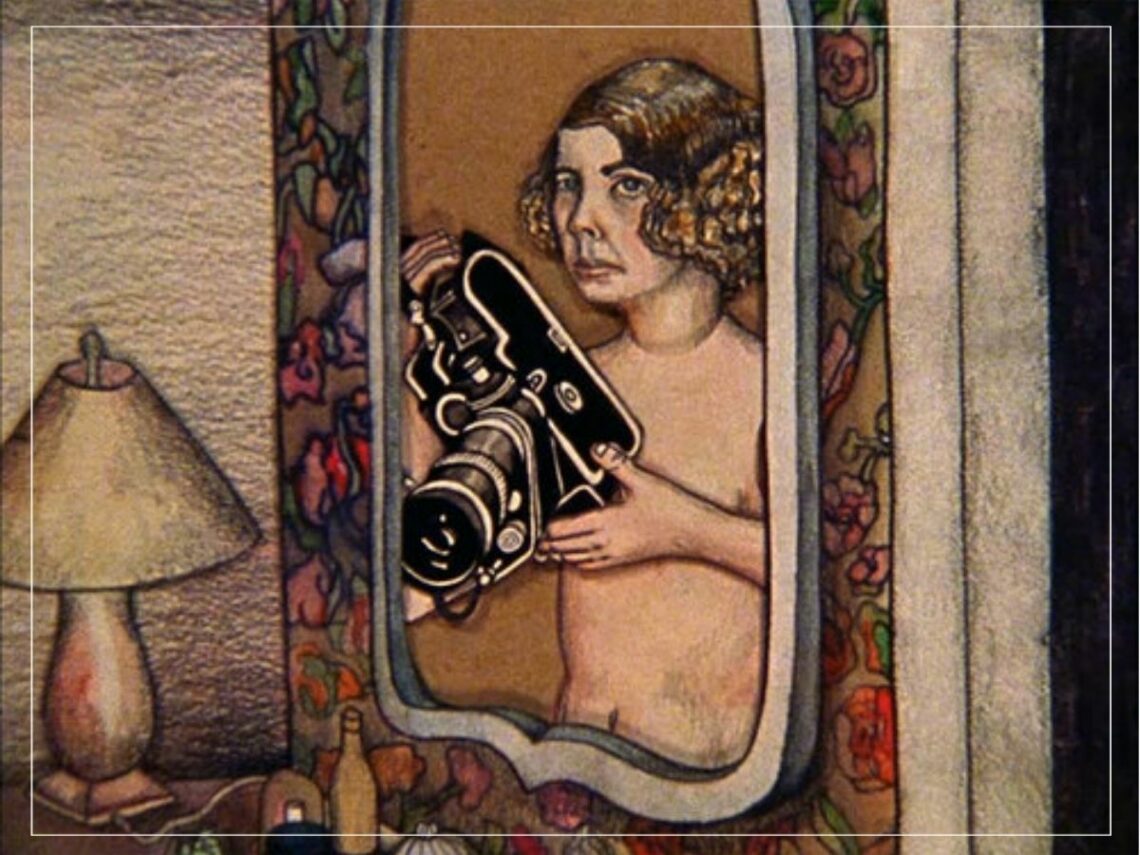
Acting as symbols of fertility, beauty, and enjoyment, Pitt links female sexuality with the natural world, a motif she continued to use throughout the rest of her career. Then we see the woman holding a camera in the mirror, looking over at herself having sex before winking at us. This continues the theme of voyeurism and the gaze that is established at the start of the film. The woman studies herself at various points throughout the film, with and without the camera, and it appears as though she is reflecting on her own female identity (emphasised by her admiration of her own breasts).
She is caught between identities, and while the film offers up a lighthearted tone, under the phallic imagery and rather garish-looking baby, it is a poignant exploration of what it means to be a woman. The woman is trapped between roles, such as being a sexual wife who frequently makes love to her husband, a good mother (who seems to have more responsibility than the father, who remains in bed when the baby cries out), a filmmaker (as demonstrated by the version of her watching over with a camera), and a participant in the female experience under the patriarchy.
The emphasis on the gaze not only serves to explore Pitt’s self-reflection but also highlights the ever-present expectations and demands placed on women, who must juggle various identities at once. A shot framed from outside of the window closes the film, with the woman pulling the blinds down so that we can’t see her having sex. Here, she seems to shut out the watchful eyes of others so she can simply do what she wants, which, at this moment, is to have sex.
The film offers a playful insight into a woman’s evening, where she is caught between demands and expectations. Can you be in every role that you are expected to fulfil? Do these roles leave enough room for other personal and artistic pursuits? Pitt doesn’t give us an answer, instead taking us on a surreal trip through giant pickles and cheeky self-referential nods.
