


The creative duo who have long fascinated Patti Smith: “Could not be copied”

Patti Smith was every bit the trailblazing punk poet figure that the 1970s needed, who music needed, who women needed. Tearing onto the scene with wild dark hair and an androgynous look that suggested ambiguity and mystery – where had she emerged from with these rapturous words? – Smith asserted herself as an artist in every sense of the word.
Composing poems, prose, and eventually setting her reflections – her reckoning with faith, nature, love, and pain – to music, Smith soon dominated New York’s underground scene, taking up residency at CBGB alongside Television for seven weeks in 1975 and lighting a fuse that could never be put out, and while she might have arrived in New York alone, having recently given up a child for adoption that she felt too young and too unprepared for, once she was there, she found various people with whom she shared a unique kinship. One of those was Robert Mapplethorpe.
She describes their first meetings so eloquently in her memoir Just Kids – and that’s what they were, just two kids who had nothing much but the desire to be something more. Smith and Mapplethorpe became best friends, lovers, muses, and guides to one another, leading them to move into the artistic hub that was the Chelsea Hotel together. It was here that Mapplethorpe developed his interest in photography, eventually taking the iconic image of Smith that adorns the cover of her debut album, Horses, while Smith would continue to write, forming a band which would carry her words from the page into the realm of performance.
You can’t think of Smith roaming about New York’s artistically-fuelled yet seedy streets back in the 1970s without seeing the image of Mapplethorpe, too, camera in hand with an eye increasingly fixated on leather and BDSM, his practice expanding as he explored his sexuality – the pair were creative soulmates, even if their romantic relationship ultimately failed, with Smith claiming that he was “the artist of my life,” and that she’ll never forget the importance of such a nourishing and artistically fulfilling partnership.
It seems like Smith has long been fascinated by complicated creative partnerships, those whose members continually come back to each other despite the chaos, and sometimes, there’s just this force that occupies a space between two people, and it’s too strong to ignore – that’s how the artist feels about the ultimate French New Wave pairing, Jean-Luc Godard and Anna Karina.
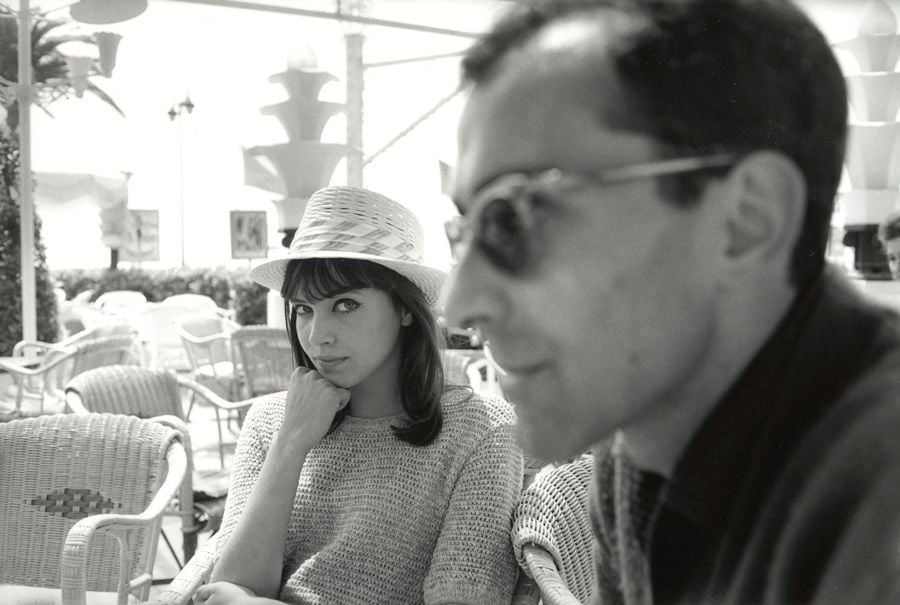
Their relationship was intense from the start, but it was this intensity which spawned various collaborations between the two, which remain some of French cinema’s greatest artefacts. “We had something very special that you couldn’t get away from. It was magnetic. It all started in that film,” Karina once said, reflecting on their first movie with each other, Le Petit Soldat. Godard, who was ten years older than Karina, had asked her to star in his first film, Breathless, after seeing her in a Palmolive advert, but the requirement of nude scenes turned her off the project.
He was luckier the second time around, and once she was 19, the pair were wed. Godard subsequently cast her in films like Une femme est une femme, Vivre sa vie, Bande à part, and Pierrot Le Fou, and she astonishes in each – Karina was so charming, so great at comedic flourishes, yet she could also rein it in and give a sympathetic, emotionally-charged performance, with Vivre sa vie perhaps standing as her most accomplished on-screen turn.
The relationship soon turned abusive, and Karina was often left alone without any money for food while Godard was off working… There were miscarriages, suicide attempts, and jealousy, and by 1965, they were divorced, but even then, they still worked with each other afterwards, clearly inspiring one another enough to retain that sense of artistic kinship after their relationship had broken down.
Smith loves Godard’s films, and in Just Kids, she reflects on Karina inspiring her style when she began working at a bookstore after moving to New York. “My uniform for Scribner’s was taken from Anna Karina in Bande à part: dark sweater, plaid skirt, black tights, and flats.” Beyond that, she has always found their pairing to contain a certain poetic magic which she can never get enough of.
“I’ve loved Godard for as long as I can remember. I really loved the films he made with Anna Karina. And I love Pierrot le Fou. They had an aspect of poetry that could not be copied,” Smith told MacLean’s. “The [structures] of the films were revolutionary, but they had a sense of romance to them. Visually, they were beautiful, they were intelligent.”
Godard and Karina’s relationship had a similar tumultuousness to that of Smith and Mapplethorpe’s (without the abuse, of course), and it seems like both pairings possessed a certain magnetism, endlessly fuelling the other’s creative impulses, even when emotions were strained. Karina and Godard defined French cinema together, while Smith and Mapplethorpe defined the New York underground a decade later. Sometimes, it takes another person to bring those ideas out of you; unfortunately, the circumstances are rarely plain-sailing.
