


‘Corsage’ Review: Vicky Krieps stars in Austrian period piece

Austrian filmmaker Marie Kreutzer’s latest release is a fictionalised but fact-based portrayal of a year in the life of Empress Elisabeth of Austria (1837-1898). The film is this year’s Oscar submission for Austria. Corsage is certainly not a straightforward biopic, but a character study of the popular royal figure, seen partly from a modern, feminist perspective and taking her point of view entirely. It combines historical facts with present-day sensibilities in a retelling that reaches back to the beleaguered empress with sympathy and understanding her contemporaries were unable to provide. Despite her privileged life, in this film, Elisabeth is used in order to represent the pressures, dilemmas, and absurdities experienced by countless women, in one form or another, from her own time to the present day.
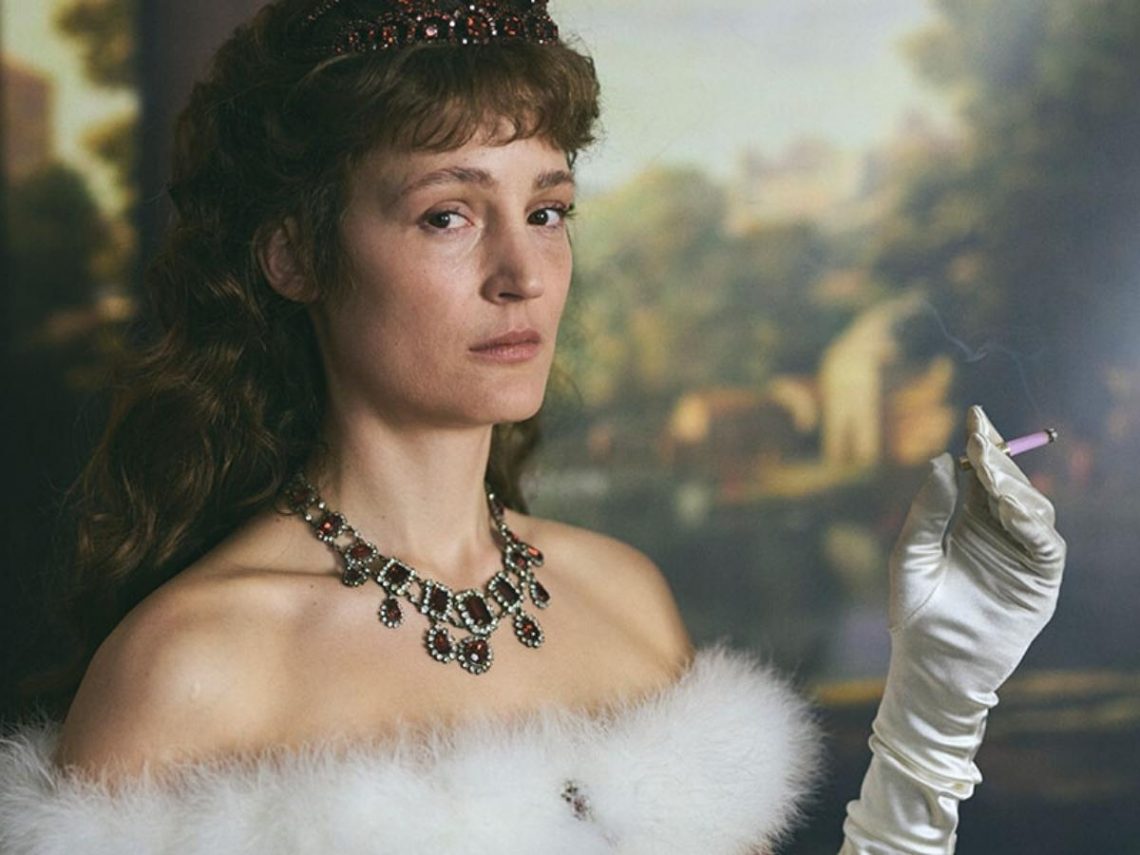
The success of Corsage rests partly on the remarkable performance of Vicky Krieps, who took the acting award at Cannes for her intense, sensitive portrayal of Empress Elisabeth. Krieps’ famously understated acting in Phantom Thread is replaced by a much more comprehensive range, as the actress reveals a woman impatient with the court etiquette and ceremonial duties that govern her life; and desperately struggling, at the age of forty, to maintain the fashionable and youthful image that had both defined her and given her a nominal influence. Krieps runs the gamut from depression to fury, rebelliousness to grief, displaying every facet of her character’s complex personality as she portrays the empress’ public and private battles.
The idea for the film came from Krieps herself. She suggested the concept to director Kreutzer, with whom she’d worked previously on the 2016 comedy We Used To Be Cool. Empress Elisabeth had been the subject of biographical films before, most notably in a popular trilogy from the 1950s known as the ‘Sissi films’ (Empress Elisabeth’s nickname was Sisi), starring Romy Schneider as the empress. These were, however, sentimental and romanticised versions of her life at court and her marriage to Emperor Franz Josef. During the film’s release, Krieps discussed the questions that occurred to her after reading the empress’ biography concerning Elisabeth’s eccentricities, beginning with a highly stringent diet and the stifling corseting referenced in the film’s title, experimenting with narcotics, and veiling her face in public, which were glossed over by earlier accounts. Director Kreutzer’s own research found a subject full of fascinating possibilities, and she partnered with Krieps to put the film together.
Empress Elisabeth had her marriage to the emperor arranged when she was 16. She quickly became a favourite among the Austrian aristocracy, admired for her tall, slender figure and natural beauty. However, she found life in court restrictive and limiting, especially for women. Worse, as she grew older, she felt a tremendous pressure to preserve her youthful appearance; she followed a virtual starvation diet, exercised to excess, and for public appearances, used sturdy leather corsets to force her mature body into the girlish silhouette that had been associated with her from years before, and which was virtually the only trait for which she was valued.
The film captures this situation and Elisabeth’s dissatisfaction. Still, it also goes further, following the empress as she searches for means of escape and finds ways around the unwinnable situation in which she’s found herself – some helpful, others self-destructive. The story includes her inner journey, as well as a series of actual adventures, travel and encounters with new people and new situations, as Elisabeth explores her seemingly inflexible boundaries and looks for ways to find freedom and purpose. Director Marie Kreutzer described her discoveries while researching Elisabeth’s life, explaining that her early forties, the period dealt with in the film, “was the phase in Elisabeth’s life when, on the one hand, she began to rebel against all the ceremony and, on the other hand, started to withdraw and isolate herself; a time when it had quite obviously become impossible for her to squeeze herself into a predetermined template.” She describes Elisabeth as “always having to live up to an outsized image” of herself; “I found that both extremely interesting and universal.”
The director found this a story worth retelling because, in her view, Elisabeth’s problems were not exclusive to her or to her time but something experienced by women everywhere: “Many of the expectations Elisabeth had to contend with continue to be imposed on women today,” Kreutzer commented. “Being beautiful is still seen as a woman’s most important and valuable trait. Historical progress has not altered that, despite the women’s movement…. Women are still considered less valuable if they are overweight or older. An attractive female partner still boosts a man’s status.” This made the empress’ story seem worth telling and relatable.
Lead actor Vicky Krieps prepared for the role at two levels. Physical preparation involved learning to fence and ride sidesaddle, becoming accustomed to swimming in ice-cold water, and adjusting to the wearing of a restrictive corset. It was the latter she found most difficult and most instructive: she realised corseted women would have difficulty not only with physical activity but with breathing and laughing. She also found it oddly depressing and wondered what effect constant corseting would have had on 19th-century women’s emotions. Krieps researched the common rules of behaviour applied to women of the time to better understand Elisabeth’s feelings and point of view. In portraying the empress at the age of 40, she kept in mind that “women’s influence steadily waned as they grew older. In those days, women essentially became invisible when they turned 40”. Krieps came to the interesting conclusion that “making herself disappear was also a desperate stab at self-empowerment on Elisabeth’s part” and played the role with this in mind.
The distinctive story and excellent acting are augmented by great attention to production values. Although very different from a typical historical drama, the film takes pains with every detail of court life, from elaborate costumes and table settings to intricate rules of etiquette. Costume is given still more attention – reasonably enough, as clothing serves to represent a great deal about Elisabeth’s life, most obviously her corsets and the veils she adopts in middle age. It is a visually beautiful film, even when the production design is not used to set the romantic and positive atmosphere typical of a royal period drama.
It is the careful attention to Elisabeth’s point of view and her natural desire to be seen and valued as a human being rather than either a national symbol or an ornament that keeps the film on track, preventing it from becoming a simple tale of a mid-life crisis, or, as some of Elisabeth’s contemporaries viewed it, female hysteria. The elaborately designed court scenes let her sense of constraint come across subtly, while the few private moments when her rarely-seen exuberance and humour emerge are joyful revelations which put the rest of her life in context. Her true self emerges during the rare moments when she can be unguarded – most clearly during conversations with her son – preventing the audience from defining her by her current malaise.
Creative film and sound techniques help to direct our attention as well. This includes one device in particular: the use of deliberate anachronisms, such as introducing mid-20th century music into a ladies’ harp recital – another way of providing wordless commentary and of bridging the gap between Elisabeth and present-day women. These creative liberties culminate in a surprising afterword scene: following a poignant ending, Elisabeth appears over the final credits almost as if she had been rescued and transported, restored to the confident and boisterous woman she naturally was, into the future to greet us. It is a fitting and optimistic conclusion to this unique revisioning of history.
