


The heartbreaking connection between William Basinski and the 9/11 terror attacks

Avant-garde composer William Basinski has enjoyed a remarkable career, being hailed as one of the leading lights of the ambient and drone genres. Ostensibly a master of tape music, his most notable works remain The Disintegration Loops, a series of four albums released between 2002 and 2003. While the tapes are hailed as a musical masterwork, their deep personal connection to Basinski and the greatest tragedy America has ever seen – the 9/11 terror attacks – make them a truly astounding subject.
Notably, the albums comprise tape loop recordings played for an extended time, with the noise and cracks increasing as the tape itself deteriorated. Basinski, who studied jazz saxophone and composition at the University of North Texas, discovered the effect while attempting to transfer his earlier recordings from magnetic tape to the new and ubiquitous digital format.
Primarily inspired by the minimalist greats Steve Reich and Brian Eno, it was in 1978 that Basinski started to develop his own vocabulary using tape loops and old reel-to-reel tape decks. Following the tradition set out by his heroes, Basinski gradually developed his own transcendental sound by playing short looped melodies against themselves to create feedback loops.
Investigating what happened when his tape deteriorated, it became clear that the ferrite had detached from the plastic backing as it passed the tape head. Demonstrating the extent of his innovation, the Texan then allowed the loops to play for longer periods, with them eroding further. As a result, this created more cracks and gaps in the music. He would then treat the sounds with a spatial reverb effect.
In one of the most pertinent moments in music, like a scene straight out of a feature film, Basinski finished The Disintegration Loops on the morning of September 11th, 2001, in New York City. Watching the disaster unfold, he sat on the roof of his apartment building in Brooklyn with neighbours and friends as the city’s most iconic testament to the American dream – the World Trade Center – apocalyptically collapsed in on itself.
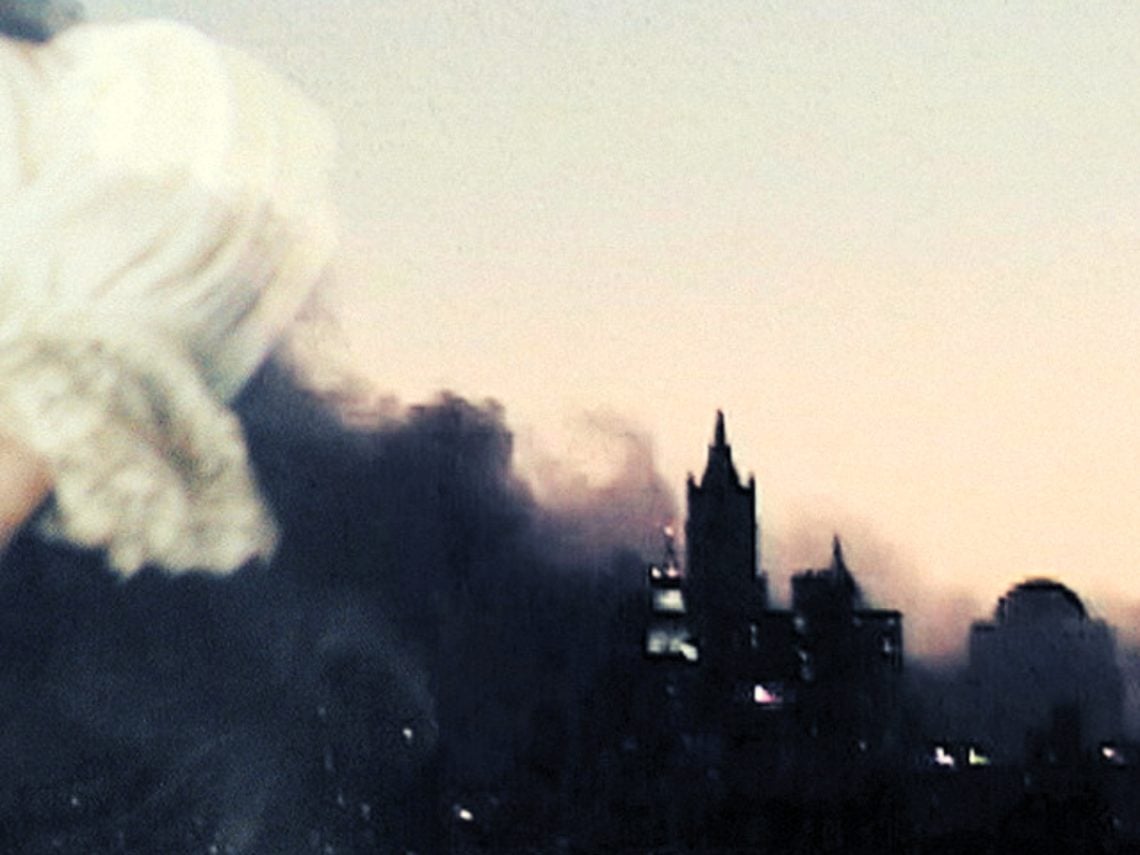
Basinski then filmed the fallout of the attack during the last hour of daylight from a roof. The following morning, he played ‘Disintegration Loop 1.1’ as a soundtrack to the aftermath when the city was suspended in a state of haunted inertia, one it would never really rebound from. Stills from Basinski’s footage were then used as the covers for the four albums, and only weeks later, he dedicated the project to the victims in a postscript contained in the liner notes. He explained that “the events gave new meaning to the musical pieces created by catastrophic decay in my studio a few weeks before”.
Speaking to Texas Monthly in 2021, Basinski revealed that on the day the planes crashed into the Twin Towers, he also recieved an eviction notice from his landlord. “I was ready to slash my wrists,” he recalled.
Basinski’s life partner, James Elaine, who at the time was working in Los Angeles, feared for William’s life. He told the publication: “I remember talking him down on the phone that day and the day after. He was definitely in bad shape, and I was wringing my hands and in tears talking with him.”
Basinski, his neighbours and friends spent the whole day on the roof, watching every angle of the nightmarish spectacle. It would be The Disintegration Loops playing loud through a pair of speakers that comforted them as the tragedy unfolded. This state was only interrupted when “the girls downstairs freaked out and asked me to turn it off”. It was then that he captured the fallout on his video camera.
Fittingly, on the tenth anniversary of 9/11, Basinski’s work was performed at New York’s Metropolitan Museum of Art as a live orchestration.
