


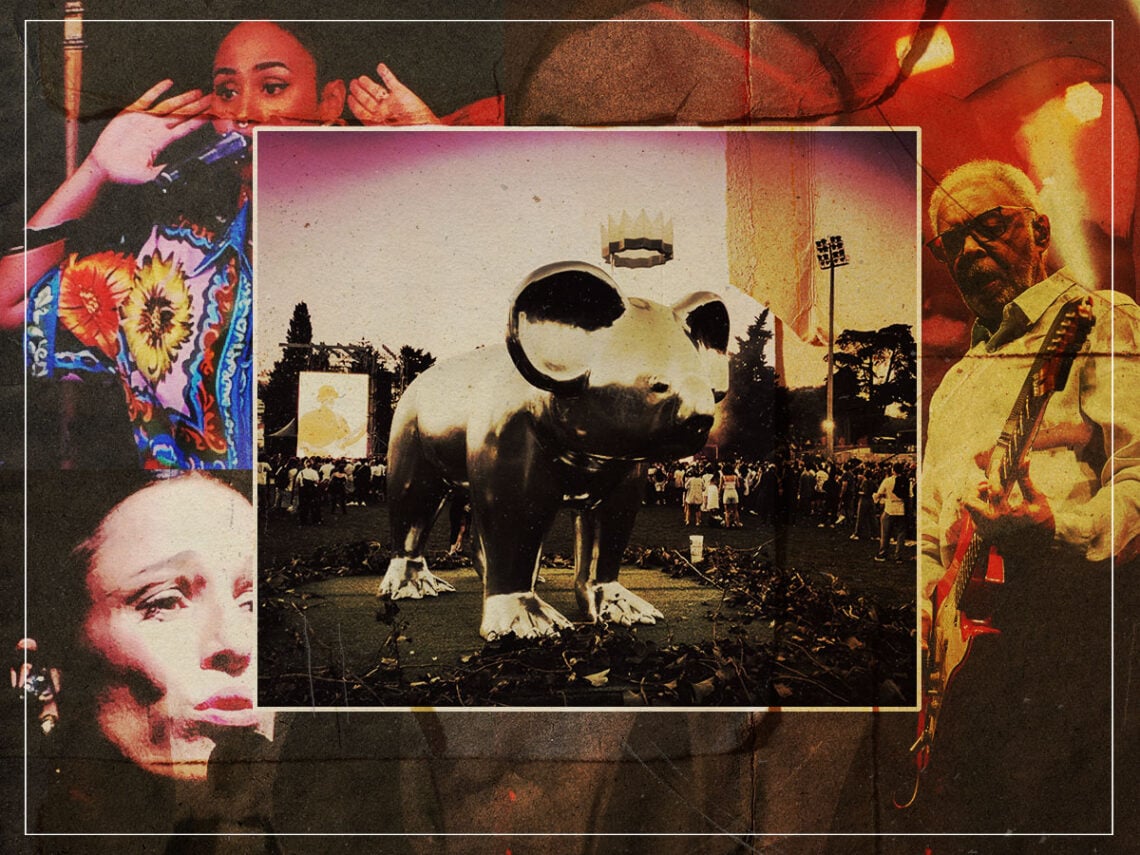
COALA Festival 2024: Brazil’s samba celebration brings the party to Europe

Portugal’s capital Lisbon was treated to a party of historic proportions this weekend. For the first time in its 10-year existence, COALA, the world’s largest celebration of Brazilian music both new and old, went on the road. And it brought some of the biggest names in Brazil’s vast musical landscape with it, along with a healthy dose of African stars and a sprinkling of Portuguese fado.
Over the course of two days 20 thousand people descended on the Hipódromo Manuel Possolo in Cascais, a short journey down the Portuguese Riviera from central Lisbon. The historic setting was transformed into an idyllic haven of bohemian paradise. Adding to the ambience was the fact most of the revellers were Brazilians living in Europe, making for a particularly special atmosphere throughout the weekend, as a homecoming hue coloured the event.
This wasn’t just any line-up of musicians, either. Topping the bill were two of the three biggest names still alive from Brazilian pop and rock’s golden age. Jorge Ben Jor and Gilberto Gil, founders of the tropicália and Música popular brasileira (MPB) genres alongside Caetano Veloso, Gal Costa and others, headlined on successive nights.
Throughout each of their sets, the thousands-strong crowd sang and danced along to every word as these two evergreen legends swaggered their way through half a century of classics. The home-from-home upswell emanated from both sides for the artists and the mass of Brazilians assembled before them. Acts and punters alike revelled in the joy and nostalgia conjured up by these most familiar of faces and voices who’d helped shape their country’s modern identity.

Sounds of a “país tropical”
Standing out as the equivalent of a Brazilian Paul McCartney at the top of the bill, Jorge Ben, well into his eighties, proved he has lost none of the reedy vocal range or boyish charm that inspired Gil and Veloso to follow in his wake. He kicked straight into his infectious disco stomper ‘Salve Simpatia’, commanding the stage as the sole guitarist in his band’s line-up.
His set lost its way a little when a female backing singer who was clearly underprepared and overawed by the occasion joined him to duet on three songs. But it returned to form with the powerfully anthemic ‘País Tropical’, now a standard of modern Brazilian music, which was belted out by the entire audience, before he blazed through several greatest hits in a reggae-infused medley.
Ben then caught his audience by surprise with an off-beat intro to arguably his greatest song, the hit that launched his career and pushed samba into music charts around the world. ‘Mas Que Nada’ proved to be the penultimate song of an incredible one-hour 40-minute set, during which he barely stopped for breath and patrolled the stage conducting his band.
The following evening, after 81-year-old Gilberto Gil skipped effortlessly onto the stage, his set proved to be a more measured affair – but no less impressive. He sent the crowd wild with popular staple ‘Andar com fé’ early in the performance, before regaling us with a superb bilingual singalong rendition of Bob Marley’s ‘No Woman, No Cry’.
After proving his Bahian reggae credentials, as if they were ever in doubt, he turned things down a little with the sublime ‘Estrela’, in one of several examples of his genre-spanning dexterity as a songwriter. No one left the Hipódromo on Sunday night in any doubt that they’d been a part of history.

Africa and fado?
Aside from two Brazilian all-time greats, Cape Verdean songstress Mayra Andrade wowed a sizable late afternoon crowd which had arrived early to see her perform. In a stripped back set accompanied by a single semi-acoustic guitar and her own guiro-playing, Andrade sat cross-legged in an armchair for almost all of her allotted 45 minutes, letting her flawless voice, natural charisma, intimately moving songs, and superhuman ability to avoid pins and needles do the talking.
Political samba-reggae hip-hop troupe, BaianaSystem, also threatened to steal the show on Saturday with an empowering set showcasing Bahian identity and its roots in African culture. Colourful slogans adorned the on-stage screen behind them as they took their audience with them, prompting loud cheers and raised fists at several points in the performance. Before them, Angolan dance artist Pongo got the freshly-arrived crowd going with a tea-time set that must have been a rarity for her, before bringing her family on stage for a mass selfie with the crowd.
The one artist who seemed oddly out of place in the line-up was Portuguese fado star Carminho. The singer has a back catalogue that crosses over into Brazilian genres, but chose to stick to the music for which she’s best-known. Dressed all in black, she interspersed her songs with emotional descriptions of what fado means to her and shed a tear as she finished her final song.
Nonetheless, she demonstrated her mastery of a traditional music genre unique to Portugal with a stunning vocal performance. And she made it, to use her word, “vital” with modern interpretations of the fado style accompanied by a blend of electric and classical instruments.
All-in-all, COALA more than achieved its aim of bringing the magic of Brazilian (and African) music to Europe. With the convivial spirit of Brazil’s world-renowned festas to boot. There’s no question that the festival will be back in Portugal for 2025 if the organisers want it to be. So, if São Paulo is too much of a stretch for you, look out for next year’s line up and get yourself over to Lisbon for the biggest celebration of Brazilian music outside of Brazil.

