


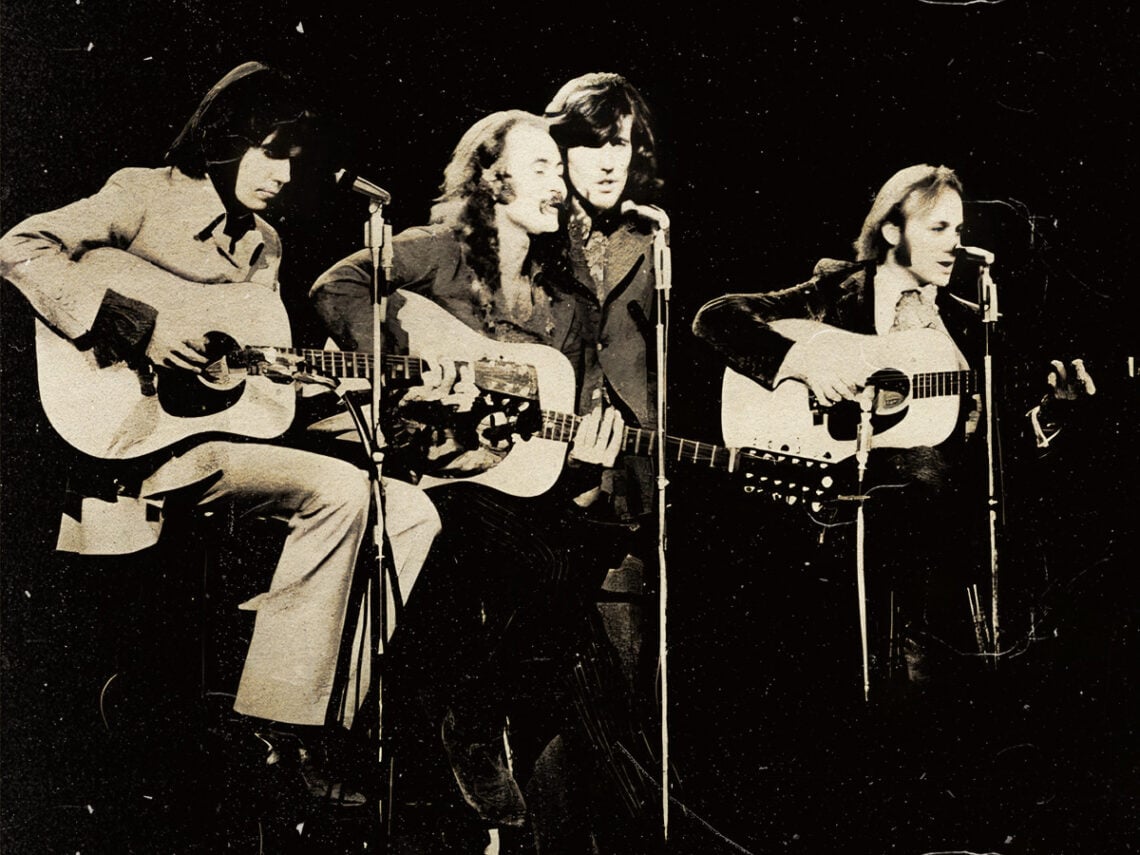
CSNY – ‘Déjà Vu’

In 1969, Neil Young joined one of rock’s first supergroups to make them an even more formidable force. Crosby, Stills and Nash had been comprised of some of the most talented songwriters and musicians of their generation, and when Young joined the fold, he offered their sound a sense of tenderness that had perhaps been lacking before. However, the typically difficult-to-work-with Young also brought along his fair share of disruption to the harmonic understanding present in the first iteration of the group.
After playing just a few live shows together, in March 1970, the expanded supergroup’s first record arrived. It was entitled Déjà Vu and featured two songs, each written solely by Stephen Stills, Graham Nash, David Crosby and Neil Young, and also a cover of Joni Mitchell’s ‘Woodstock’, as well ‘Everybody I Love You’ co-written by Young and Stills.
Pretty much every CSN fan knows that the real brains behind the band is Stephen Stills; he is certainly the most gifted instrumentalist. In fact, Graham Nash once told Music Radar, “Stephen played every instrument on that record [Déjà Vu] except for the drums and the acoustic guitars that David and I played on our songs. He played bass, he played organ, he played lead guitar, he played rhythm guitar, he played everything. Captain Many Hands we called him.”
So all the fine moments of instrumentation ought to be credited to Stills, from that opening deep acoustic guitar chord progression on ‘Carry On’ to the final note of ‘Everybody I Love You’. The album’s opener features the kind of vocal harmonies that defined CSN’s self-titled debut album towards the middle of the song. This is before things shift completely into something loose and grooving, highlighting the versatility that the band had at their disposal.
Graham Nash’s first effort on the record, ‘Teach Your Children’, is typically tender for the English member of the band. Clearly, he was very much still wrapped up in the mood for love with Joni Mitchell, and the song’s sentimental air is only matched by Side B’s ‘Our House’, which he once admitted he had written with Mitchell in mind, finally happy with the kind of bliss that a domestic life had brought him.
Yet CSNY, particularly when the spiky Neil Young joined the band, were known for moments of inter-band tension, which is largely why Déjà Vu shifts and jumps around in tone and mood rather than appearing in one cohesive whole. David Crosby’s ‘Almost Cut My Hair’ was only kept on the record in spite (Stills had not admired Crosby’s vocals), but it still represents one of the hardest-hitting, and perhaps simply best, moments on the album.
Young himself gets ample room to express his Canadian high-pitched emotive method of writing on ‘Helpless’ and ‘Country Girl’, which do not stray too far from the kind of tunes we were simultaneously recording with Crazy Horse. In fact, Young only agreed to join the band on the proviso that he could indeed continue his admittedly excellent solo work.
The themes of CSNY’s first record together are also as muddled as its sonic textures. We have modes of longing for home and the importance of family, reflections on growing older and the passing of vital cultural events. Yet the downside of that is that Déjà Vu lacks a thematic cohesiveness, leaving listeners feeling that they have been pulled from pillar to post rather than having an understanding of learning a central lesson or two.
That’s not to say that the record is not exemplary in how it handles its emotive complexity, but that the listening experience can occasionally feel like an advertisement for each of Crosby, Stills, Nash and Young’s own songwriting.
It would be amiss to say that each of the songs on Déjà Vu are not some of the best ever written by the members of CSNY, if not some of the best of all time period. However, the fact that the record largely serves as a showcase of the four folk/rock/country icons’ individual talents, rather than show what they might have been able to muster up together had ego not got in the way, takes the shine off somewhat.
Still, the record is excellent from start to finish in both songwriting and instrumentation and serves as a perfect introduction to the respective careers of its contributors.
