


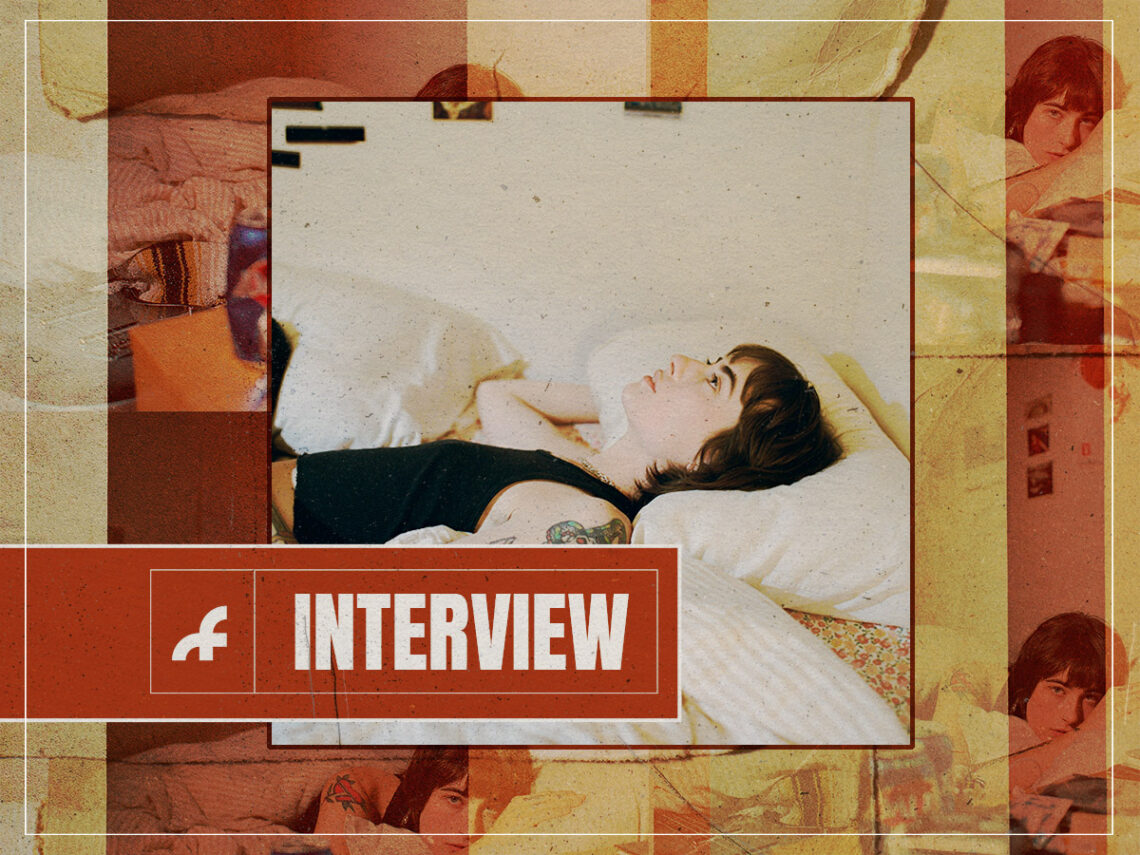
Learning how the world works: Claire Rousay on life, religion and ‘Sentiment’

The new Claire Rousay album, Sentiment, is as profound as anything you’ll hear in 2024. Written over five years in many different environments, it sees her take her unique ’emo ambient’ genre to new heights with a potent mesh of field recordings, wistful acoustic guitars, and, of course, auto-tune. Masterfully, it pulls the listener on a journey deep into the songwriter’s own experiences but doubles up as a broader commentary on the nature of life, with the intense gamut of human emotions explored.
Heartbreak, regret, love and hope are all probed in full-frontal detail, and the moment the last reverberations encircle, you’re left feeling intangibly altered, a feat that albums seldom achieve.
I spoke to Rousay over Zoom about the record. She was in a cloudless Los Angeles – a markedly different state to the maudlin London street I was staring straight out to. She was held up waiting for the bill in a coffee shop. “It’s literally so nice. I’m so sorry,” she dryly voices on the wildly differing weather situations, apologising for her present setting. It’s an innocuous remark, but I soon came to find it was indicative of a wealth of honest empathy.
Unsurprisingly, she’s feeling good about the record. It was not always the case, though. Initially, she feared people might not like it, heightened by how scathing fans can often be. However, things changed after she received some mixes back. Rousay realised just how fun the project was. She was stoked by the absurd reality that something made on her laptop in her bedroom could successfully tie her array of influences together. These include disparate forces such as Young Thug, DIIV, Town and Country and Arthur Russell, all coming together into something full-bodied and thick with life. Gradually, confidence grew as the album took shape.
Despite this, Rousay was hesitant that her new label, Thrill Jockey, would want to release it. Being on the Chicago indie has moved her into what she describes as a “new era”, with their outlook just as boundary-pushing as hers. They’re willing to take risks, she says: “They send over all these crazy ideas, and I thought I was the only one with crazy ideas.” One of these conceptions includes using a gift card to buy lottery tickets, handing them out at shows, and everyone scratching them off to see who wins money. Audience participation is something Rousay is exceptional at.
Perhaps most significantly, there’s the way she’s touring. This involves putting the bedroom she wrote much of Sentiment in onto the stage, recreating the walls to scale, a mattress, clothing on the floor and posters on the wall. It’s an artistic nuance to not only help her return to that mindset but also invite her audience into her most sacred of spaces. Pointing to what’s to come, she wryly adds: “Many of these venues are churches, and setting up in a church with a Playboy poster is always really funny.”

One distinctive aspect of Rousay’s work is the use of auto-tune, which adds an entirely different dimension to the ambience of her music. While there are many reasons for employing it, including her love of R&B and hip-hop, she thinks it’s today’s version of the cheap radio microphones formative lo-fi artists like Sparklehorse used. As well as evoking the spirit of older inspirations, its use by contemporary innovators such as Bladee and Yung Lean speaks to its deeply experimental essence as it challenges sonic convention. Naturally, it feels right at home with the other unique elements of her sound.
She explains: “The whole idea of just even making songs on a record in the place that I’m at, after making a couple of records that are pretty experimental, musique concrète and ambient, and then shifting to a song form, is already jarring for a lot of people who may have not been expecting that. Some people really don’t like it. The auto-tune is just an extension of that. I’m already going so far, I might as well just go all in with this, you know?”
While the album’s music is heady and immensely moving, one of the most arresting aspects is the opening number, ‘4PM’, a monologue that eventually fades into an astral ambient palette. Read by her friend and composer Theodore Cale Schafer, it’s a stark way to commence. Despite the crushing nature of the words lamenting losing friends, family and “what I thought was my god”, it loops in on itself. Rousay concludes that the piece is her “letter to the universe”, as she appreciates human emotions, returning from a state of numbness. “That monologue encompasses everything that I address on the record.”
“Because I wrote it over such a long period of time,” she continues, “so much can happen.” So, the album unfurls like a series of chronicles diary entries. But this isn’t the case. The lyrics might often seem like frank discussions of her feelings, but most of the time, they’re “based on improvisation.” Surprisingly, she establishes a melody first and then writes the lyrics off the cuff.
Rousay explains: “I like writing about things in a way that’s a little bit broader so people can apply their own minds to it, which is why I got interested in field recordings to begin with, because so many people hear the sounds that I use. The specific kinds of field recordings I make are based in the domestic space; everybody has their own domestic space. So, I’m like, how can I make that happen with lyrics?”
“There’s so much variety. Which, when I think about it a little bit, it’s kind of pathetic that I’ve been feeling the same way for five years. I should really do something about that,” she smiles before adding saliently, “but some things you can’t help.”
However, at least she knows where that sentiment stems from. Rousay grew up as an evangelical Christian in San Antonio, Texas. However, despite believing in her family’s religion so wholeheartedly that she would speak in Church as a teenager, her belief started to wane as other circumstances changed.
“Since I de-converted from Christianity and pretty much all religion, I haven’t filled that hole. The loneliest I’ve ever felt was that one or two years where my whole brain was broken.” She recalls that testing time further: “I literally had to learn how the world works; it’s crazy.” Realising there’s probably not an omnipresent being watching out for her was worse than any romantic heartbreak. She now considers herself agnostic, but God can be whatever someone chooses, she notes.
Her de-conversion happened at a time when “everything was changing.” Growing up in the South as an evangelical male meant that she “lost that privilege” when she started her journey to becoming the person she is today. Life changing so definitively on these two fronts meant she had to recreate social circles, community and “everything” in between.
Naturally, her sound transformed during this sea change. “I got into experimental music,” she expresses. Playing in various bands in the DIY scene since her late teens showed her a life outside of the Church. These non-believing radicals offered simple acts of kindness, such as allowing her groups to crash on their floor. She reconciled that this was a gesture her former religious friends would never have offered. She laughs: “Once I got more invested in that, I learned about so much more music that is not a Christian rip-off version of free jazz.”
Rounding it out, I wondered if Rousay feels more contented with life than when tracks like ‘4PM’ were written. She concludes: “It comes and goes. You know, self-worth is not very permanent, so it changes depending on circumstances.” Professionally, things were different then, she concedes. Still, I get the sense that now, despite the oscillating nature of life, things are in a good place. And if Sentiment is anything to go by, they’re looking up.
Listen to Sentiment below.
