


How the Civil War shaped Santa’s modern image

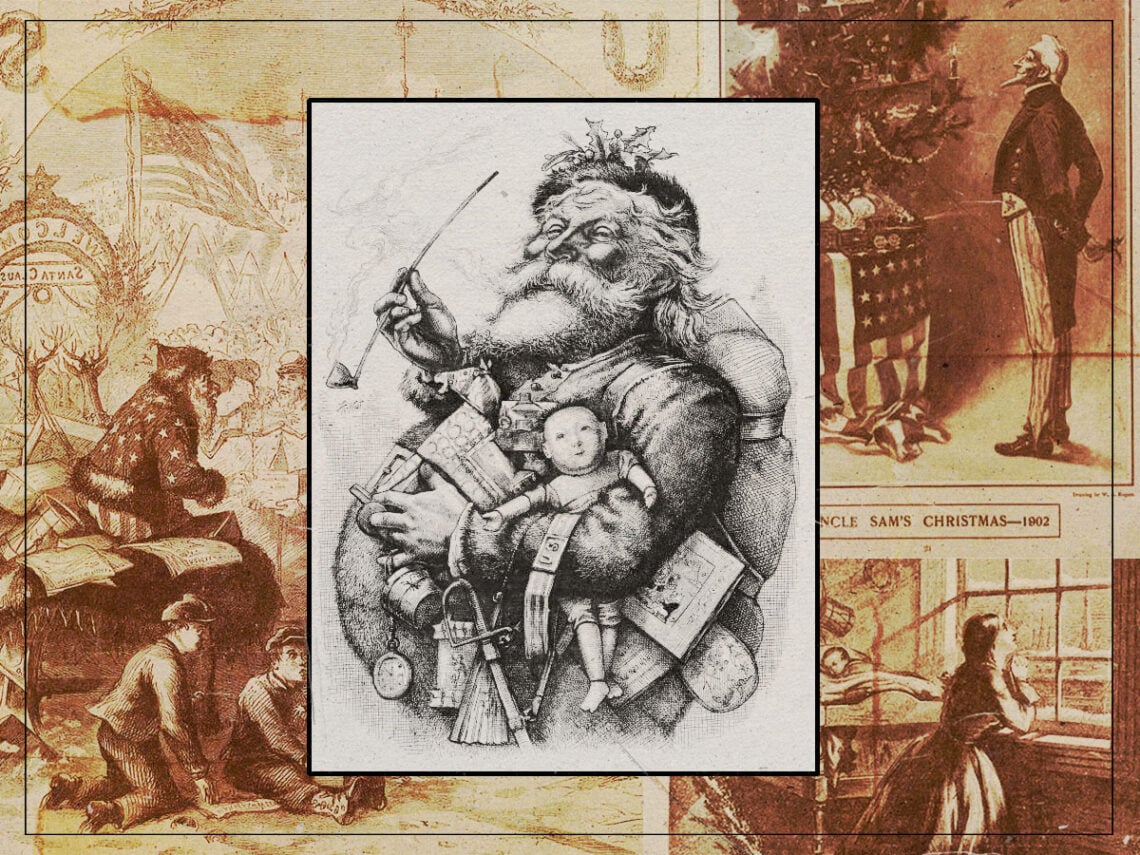
Close your eyes and imagine Santa Claus. I’m guessing the man you come up with has a mass of white hair, a red jumper and a generally jolly disposition. Continuing with this festive mental exercise, imagine him holding something. If big advertising has got to you, it might be a bottle of Coca-Cola, but more likely a present or a small child on his lap. You owe that image to Thomas Nast, the Baravarian artist who arguably pioneered the modern face of Santa. Except his version included Santa clutching a puppet of Confederate President Jefferson David, with a rope around his next. Merry Christmas!
Civil War propaganda doesn’t exactly scream happy holidays, but his illustration seems to have stuck. It first appeared in Harper’s Weekly in 1863 and was incredibly effective in raising the spirits of the Union as the war raged on. General Ulysses Grant, who went on to become the 18th President of the United States, said Nast: “Did as much as any one man to preserve the Union and bring the war to an end.”
He did this by showing Santa dishing out presents to a Union camp, naturally wearing stars and stripes instead of his typical red number. The puppet was admittedly less subtle, but it was a genius political tactic. Effectively handing the festive season to the north, and despite the noose on the puppet, gave the Union Army a homely feel by showing they cared about Christmas.
Nast spent many a December sketching for Harper’s, churning out over 30 festive Santa illustrations after finding he was a perfect vehicle for political messaging. His Merry Old Santa seems the closest to the “real” deal. All the hallmarks are there: a big old beard and a sack of presents, and in this one, Nast swapped out the stars and stripes for the typical red suit. He’s even clutching a freakish-looking baby that looks neither human nor dolllike.
Once you’ve got beyond the abject horror of the child he’s holding, like one of those optical illusions that take a while for your eyes to adjust to, you’ll find it gets even stranger. His sack isn’t bustling with gifts to deliver and isn’t actually a sack for presents at all. Created in 1881, Nast was rallying against the government lowballing military men’s pay, so he illustrated Santa with an army backpack.
You’d be forgiven the pocketwatch he wears is for timekeeping purposes related to delivering presents to children around the world in one night, but you’d be wrong. Proving that the icon of Christmas as we know him today was the perfect tool for veiled propagandised statements; it was a threat to the US government. The hands were painstakingly painted to show ten to 12, which told the Senate their time was running out to pay the army fairly.
Nast’s work had unimaginable political power. His cartoons played a significant role in the election of five successive presidents, but somehow, his contributions to Christmas imagery have stood the test of time more. However, that comes with its own complications. The sanitised image of Santa and its modern association with Nast means people quickly forget the dark bent of his other political drawings. His knack for racist portrayals of the Irish were so cruel that it’s often wrongly assumed the word “nasty” derived directly from his name, but his contributions to the visual Christmas canon seem to have eclipsed that detail.
