


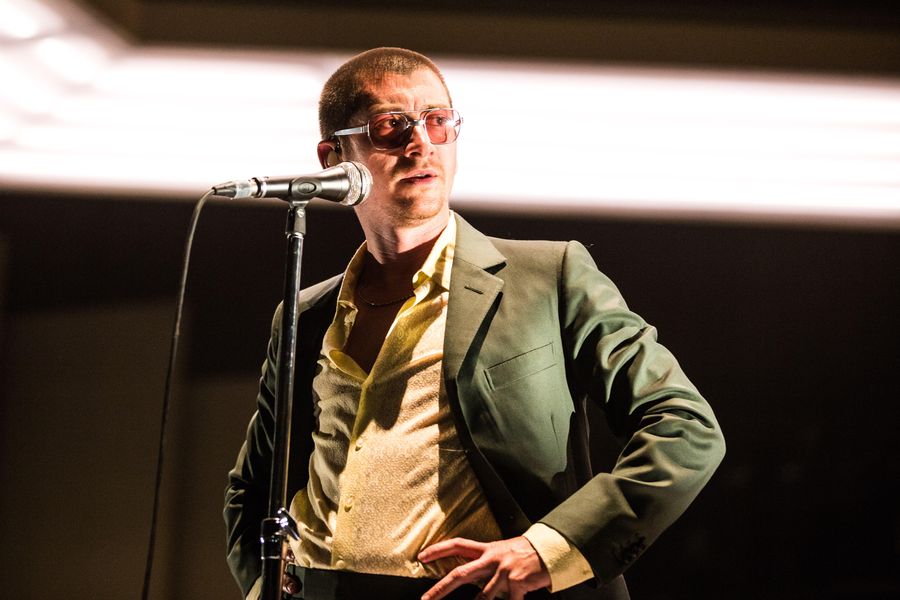
The favourite films of Arctic Monkeys’ Alex Turner

With the release of Arctic Monkeys‘ highly-anticipated seventh studio album, The Car, looming over us like the first threat of the clock ticking towards 3pm on the advent of the school summer holidays, the music world is holding its breath, wondering what sonic textures will roll into our ears this time around.
Alex Turner has recently noted the cinematic quality that much of The Car possesses; the string arrangements, for instance, or the classic grainy textures in the music videos of the thus-released singles from the album: ‘There’d Better Be A Mirrorball’ and ‘Body Paint’. In fact, the video for ‘Body Paint’ is pretty much the making of a classic film.
We know that in the past few years, Turner has revealed himself to be something of a cinephile, particularly in the years between their world-conquering fifth album, AM, and its much-misunderstood follow-up Tranquillity Base Hotel and Casino.
But what exactly are the films that Turner so loves? Fortunately, he has given several direct answers to that question (which is admittedly something of a rarity for him) and referenced them in several of his songs.
While Turner’s obsession with film seemingly developed post-AM, as early as 2005, he noted the kitchen-sink drama Saturday Night and Sunday Morning, and the novel on which the film was based, he took a line from to title Arctic Monkeys’ first album, Whatever People Say I Am, That’s What I’m Not.
Then, on Suck It and See’s ‘All My Own Stunts’, Turner claimed that he had “been watching cowboy films, on gloomy afternoons”, and when Turner says he “feels like the Sundance Kid behind a synthesiser” on ‘Black Treacle’ from the same album, we know the reference is, of course, to George Roy Hill’s 1969 cowboy flick, Butch Cassidy and the Sundance Kid, starring Robert Redford and Paul Newman.
Yet the two genres that stick out the most amongst Turner’s cinematic loves are European new wave and science fiction. Of the former, Turner is a massive fan of the works of Jean-Pierre Melville. Discussing his obsession with his films during the writing of Tranquillity Base, Turner said, “When I was writing this record, I was turned on to these three Jean-Pierre Melville films – Un Flic, Le Cercle Rouge, and Le Samourai – that all star Alain Delon and have this jazz lounge club at the centre of the story. And the clubs in these films were often very obviously film sets, which is something that interested me as well.”
As far as sci-fi goes, we know Turner asks whoever he is talking to in ‘Star Treatment’, “What do you mean, you’ve never seen Blade Runner?”. Yet discussing his method of writing, he also referred to a scene from Stanley Kubrick’s 2001: A Space Odyssey. He poetically (and perhaps sarcastically) said, “I sometimes imagine each word to be made using a three-dimensional open-top glass alphabet. Each letter built to harness and transport the mirror ball liquid marble of the melody. When the ‘substance’ fills up the syllables, they seem to shimmer and become weightless. With the addition of close harmony, I see colours swirl together, parts of the lyrics glow, and the way in which they float suggests that something like the ‘star gate’ sequence from 2001: A Space Odyssey is happening deep inside them out of view.”
Check out a list of Turner’s other favourite films below, including the works of Hal Ashby, Martin Scorsese and Rainer Werner Fassbinder.
Alex Turner’s favourite films:
- Saturday Night and Sunday Morning (Karel Reisz, 1960)
- 8 ½ (Federico Fellini, 1963)
- Blow Up (Michelangelo Antonioni, 1966)
- The Graduate (Mike Nichols, 1967)
- Le Samourai (Jean-Pierre Melville, 1967)
- 2001: A Space Odyssey (Stanley Kubrick, 1968)
- Butch Cassidy and The Sundance Kid (George Roy Hill, 1969)
- Le Cercle Rouge (Jean-Pierre Melville, 1970)
- Harold & Maude (Hal Ashby, 1971)
- Un Flic (Jean-Pierre Melville, 1972)
- Mean Streets (Martin Scorsese, 1973)
- World On a Wire (Rainer Werner Fassbinder, 1973)
- The Shining (Stanley Kubrick, 1980)
- Blade Runner (Ridley Scott, 1982)
