


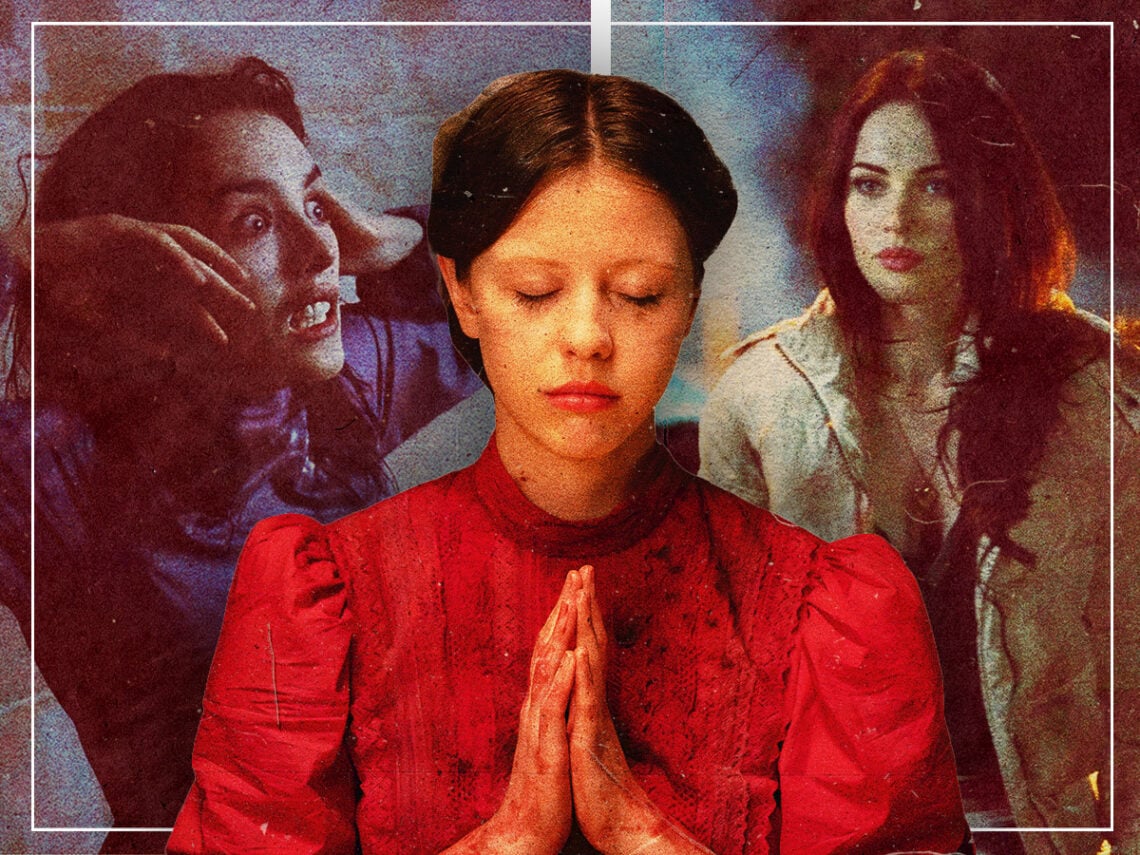
Exploring cinema’s obsession with deranged female protagonists

Log onto popular social media apps such as Pinterest and TikTok, and it won’t be long before you discover a community of young women who find solace and understanding in cinema‘s most deranged female characters. From murderous heroines to unhinged, obsessive women, many young women are drawn to these characters, regardless of whether they would act on such violent or catastrophic impulses in their own life.
It’s easy to find screenshots of characters such as Isabelle Adjani’s Anna from Possession mid-Subway freakout or Mia Goth’s axe-wielding Pearl from Ti West’s horror of the same name, captioned with statements like “She’s just like me”. Of course, the young girls and women typing these comments, reposting them or tapping ‘like’ have (hopefully) never murdered a person or manically thrown groceries at the wall of an abandoned train station before spurting white liquid from their mouths.
Yet, more than ever, it seems that women are drawn to characters that express crazed behaviour. Movies like Jennifer’s Body, The Love Witch, Black Swan, Titane, The Piano Teacher, Ginger Snaps, Carrie, Girl, Interrupted, and Gone Girl have all amassed cult followings in the internet age. Despite traversing genres, from horror to psychological thrillers, these movies all have one thing in common: a female protagonist who acts in a way that attacks societal norms.
These women, whether incredibly obsessive as seen in a film such as Black Swan, or those who morph into a werewolf at the onset of their first period as exhibited by Ginger Snaps, don’t present in a traditionally desirable way, even if they are outwardly attractive. Instead, they engage in behaviours that paint them as unstable, gross, or scary, distancing themselves from the patriarchal expectation of women to be quiet, subservient and passive. There’s nothing subtle about becoming a werewolf or causing destruction. Thus, these films disrupt the social order.
It might be easy to interpret many of these films as depicting women as monsters, but that would miss the point. Rather, these characters highlight society’s flaws and issues, such as rape culture, with films like Jennifer’s Body standing as an allegory for sexual abuse. Megan Fox’s Jennifer enacts revenge on local men after becoming the victim of a sacrifice, which clearly acts as a metaphor for rape. Women are not the true monsters in these films – issues such as sexism and male authoritarianism are the demons these women are working against.
Put simply, many young women are turning to films which feature deranged, abject female protagonists because they are offered a moment of catharsis. These on-screen women let out the rage that we are rarely afforded the space to release in real life. Of course, many of these characters take it to the extreme, channelling their hurt and distress through murder and torture, but this represents an ultimate dissatisfaction with the patriarchal social order – something that can only be amended through drastic change. While murder and violence are not the answer to these issues, these women highlight just how severe the need for change really is – and how the relentless cruelty of men, or the unfairness of our patriarchal set-up, can drive women to extreme levels of disarray.
The depiction of women acting in ways deemed gross, for example, vomiting, bleeding (including menstruation) or munching on flesh, is refreshing to watch from a female perspective, as bizarre as that sounds. Being awarded the chance to see other women presenting without regard for what a male audience will find attractive (again, think back to the Subway scene in Possession) is incredibly liberating to witness.
Watching Toni Collette’s outburst in Hereditary or Mia Goth performing her best deranged smile at the end of Pearl is strangely therapeutic. The pent-up frustrations all women have, yet are often told not to express, are delivered right in front of us. Naturally, this framework has flaws, and the canon of unhinged female characters is predominately led by white, conventionally attractive, able-bodied women. Thus, this gives a rather one-dimensional depiction of ‘deranged women’, especially when this is the subsection of women most widely accepted in society.
There is also a danger of lumping these female characters into a reductive trope, not allowing them the breadth to be anything other than a deranged, sad or murderous villain. These characters are complex women, and these films explore much more than ‘a woman being angry’ or ‘crazy’. There’s also the issue of mental illness (many of these characters clearly have mental disorders) being wielded as a weapon to convey terror, invoking fear in the audience. This only perpetuates negative stereotypes around mental illness, something cinema has significantly contributed to over the decades.
However, it’s easy to see the appeal of watching women act destructively and ‘unhinged’ on screen. The popularity of these characters isn’t necessarily a symbol of the female desire to wreak havoc or murder. Instead, it gives visibility to the scope of female emotions repressed by society and seen as ‘too much’. The kind of woman that is not accepted by society, yet one we can all relate to in some way or another, is, for once, given a chance to be (sometimes only temporarily) free.
