


Christopher Nolan’s ‘Inception’: Is Cobb awake or dreaming?

Inception is a 2010 science fiction action film written and directed by Christopher Nolan. It stars Leonardo DiCaprio, Joseph Gordan-Levitt, Sir Michael Caine, and Elliot Paige. The story follows professional thief Cobb, who steals information from his targets by entering their dreams, going so far as to layer multiple ones at a time. Saito, an immensely powerful and wealthy business magnate and the head of Proclus Global, offers to wipe Cobb’s criminal history as payment for performing Inception on his sick competitor’s son.
The film was a hit immediately upon the summer it was released. It grossed over $828 million worldwide, becoming the fourth-highest-grossing film of 2010. Considered one of the best sci-fi films of the 21st century, Inception won four Academy Awards and was globally adored by critics and film buffs
Inception exemplifies Nolan’s love for the psychological and the concept of reality versus illusion, likewise to his previous film, The Prestige. When discussing his intention for the film, the director stated he was looking to explore “the idea of people sharing a dream space… That gives you the ability to access somebody’s unconscious mind. What would that be used and abused for?”
Inception’s plot carries out mostly in interconnected dream worlds. In turn, the film’s structure orchestrates an ordered scheme where reality and illusion collide and compromise, making it difficult to distinguish between real life and a dream. These fantasies are always manufacturing and reaching new levels whenever the characters engage with them.
One sequence conveys this to such an extent that audiences are still unable to determine if its reality or an illusion; the film’s conclusion. After the other dream riders have clearly made it back to reality after the final dream heist, Cobb has an unclear fate as he is shown returning to LA to see his children and father-in-law following the suicide of his wife, Mal.
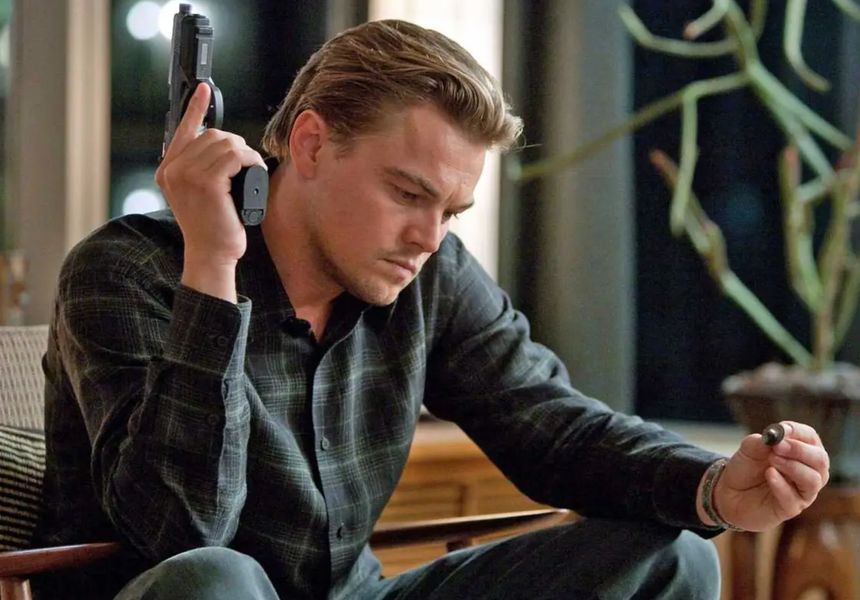
Cobb uses Mal’s “totem” – a top that spins indefinitely in a dream – to test if he is awake in the real world. However, he immediately decides that he doesn’t care as he is already too comforted and instead leaves the top spinning alone and joins his children. Thus, we, as an audience, never get confirmation.
Nolan uses his film techniques as vehicles to build the ambiguity surrounding the ending. The ending cuts to the closing credits before the top stops spinning. All we see is an ever-so-faint wobble, creating speculation about whether the final sequence actually happened or is just a deeper level of the dreams.
Nolan exemplifies the ideology and attitude fellow director David Lynch does when confronted about the unexplained meanings and realities of his multi-dimensional work, as he states the enigma was an intentional technique. He revealed, “I’ve been asked the question more times than I’ve ever been asked any other question about any other film I’ve made… What’s funny to me is that people really do expect me to answer it.”
Furthermore, Nolan has stated, “I put that cut there at the end, imposing an ambiguity from outside the film. That always felt like the right ending to me—it always felt like the appropriate ‘kick’ to me.” This illustrates the thematic value of reality and illusion blending and negotiating an objective truth for audiences to take as fact.
After spending the entire runtime playing with the confirmations between reality and illusion, why should the ending specifically state which is which?
The director then went on to layer the ambiguous ending with a heartfelt emotive underbelly in re-directing the true intentions of Cobb. “The real point of the scene—and this is what I tell people—is that Cobb isn’t looking at the top. He’s looking at his kids. He’s left it behind. That’s the emotional significance of the thing.”
In addition, actor Sir Michael Caine, who plays Professor Stephen Miles, Cobb’s mentor and father-in-law, explained his interpretation of the ending using a detail unrelated to the totem. The actor tells the audience, “If I’m there, it’s real because I’m never in the dream. I’m the guy who invented the dream.”
Following this, we as an audience can conclude the film has a happy ending that sees its protagonist reunited with his family like he always wanted. However, Nolan’s own classification that the ending should remain unknown to maintain the film’s overall framework still holds up.
Essentially, one’s own decision of what happens relies on whether one prioritises the protagonist’s subjective emotional fulfilment or the film’s objective thematic meaning. What’s most important to you, Cobb’s happiness or Nolan’s vision?
Watch Inception‘s mind twisting ending here
