


Christopher Nolan’s views on the divisive ending of ‘Memento’

Christopher Nolan is a filmmaker who, like any true cinephile, proudly wears his influences on his sleeve. He famously channelled his admiration for Michael Mann’s sprawling 1995 crime epic Heat into the world of DC Comics, crafting The Dark Knight to profound acclaim. Similarly, Nolan has acknowledged that much of his groundbreaking film Inception was inspired by his long-held dream of directing a James Bond movie, blending espionage and high-stakes action into a uniquely cinematic vision.
But among the celebrated filmography is Memento, Nolan’s dive into film noir through non-linear narrative, which, over two decades after its release, continues to provoke discussion and divide opinion, particularly of the film’s closing moments. While directors are always desperate for their work to be endlessly discussed, this scene is one that might need to be resolved.
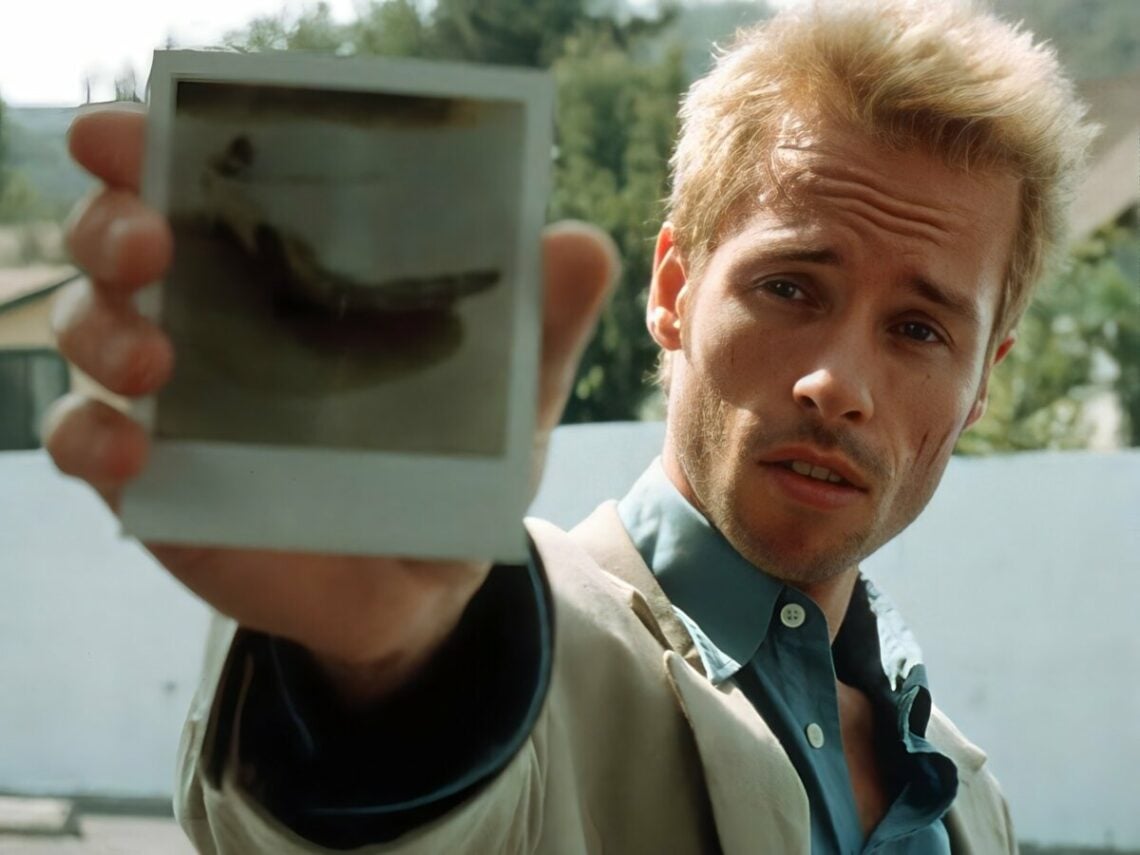
The film follows Guy Pierce’s Leonard Shelby, a police officer suffering from a specific kind of short-term amnesia that costs Shelby the ability to create new memories. Throughout the movie, he uses unorthodox methods like writing notes on Polaroid photographs and getting tattoos of different clues in an attempt to uncover both the murder of his wife and the reason for his condition.
As the film progresses, through Nolan’s non-linear narrative structure and two different temporalities (one in black and white and the other in colour), it becomes clear that Shelby is not the man the audience has been led to believe. The movie comes to a head in the final scene where the entire narrative is flipped on its head when Teddy (played by Joe Pantoliano), a man the audience has been told repeatedly through the film is not to be trusted, reveals that the killer of Shelby’s wife died a year ago and that Teddy had been using Shelby as his own contract killer.
The reaction to this moment from fans and critics upon release fascinated Nolan, who elaborated on this discussion when talking to Filmmaker Magazine, saying, “The most interesting part for me is that audiences seem very unwilling to believe the stuff that Teddy says at the end – and yet why? I think it’s because people have spent the entire film looking at Leonard’s photograph of Teddy, with the caption: ‘Don’t believe his lies.’ That image really stays in people’s heads, and they still prefer to trust that image even after we make it very clear that Leonard’s visual recollection is completely questionable.”
To question a piece of art is to enjoy it fully, so a large part of Nolan probably enjoys the fact that audiences were left scratching their heads by the end of Memento. He would get an equally bewildered crowd when his picture Tenet was given a similar reaction. However, unlike that one, Nolan claims that the idea behind the final scene in Memento was not meant to deliberately confuse those watching it.
Nolan said the response was “quite surprising, and it wasn’t planned” when asked about the polarising nature of the ending. “What was always planned was that we don’t ever step completely outside Leonard’s head and that we keep the audience in that interpretive mode of trying to analyse what they want to believe or not,” he added.
So, what does Christopher Nolan think?
Nolan nails down the real nugget of what’s going on: “For me, the crux of the movie is that the one guy who might actually be the authority on the truth of what happened is played by Joe Pantoliano, who is so untrustworthy, especially given the baggage he carries in from his other movies: he’s already seen by audiences as this character actor who’s always unreliable.”
The performance was so good that Nolan confides: “I find it very frightening, really, the level of uncertainty and malevolence Joe brings to the film”.
As the story of Memento comes to a close, Leonard is transformed from a tragic hero into something of a multi-moral persona. At this point, it’s hard to tell if Leonard is trying to get even for his wife or if he’s just sick and addicted to getting even. Nolan leaves the ending up to the audience to decide how they feel about Leonard’s ethics and the purpose of his quest, regardless of his thoughts on the matter.
As we’ve seen many times with Nolan, the plot delves into the key elements of the human condition, exploring themes such as the importance of purpose, the limitations of memory, and the lengths people would go to avoid confronting difficult truths. A tragic admission of his inability—or unwillingness—to break free from his own terrible story, Leonard’s determination to prolong his cycle of revenge appears like a victory of willpower.
Of course, it’s undeniable that Nolan makes some very ambitious cinematic choices in his movies and demands a lot of his audience: the spinning top at the end of Inception, the bookcase scene in Interstellar, and basically everything in Tenet. But once a film comes out a lot of the authorial ownership is lost and audiences are going to respond often in many different emotions and reactions, even in ways that can surprise a master like Nolan. Maybe that’s just another aspect to appreciate about the beauty of art and films as a medium.
