


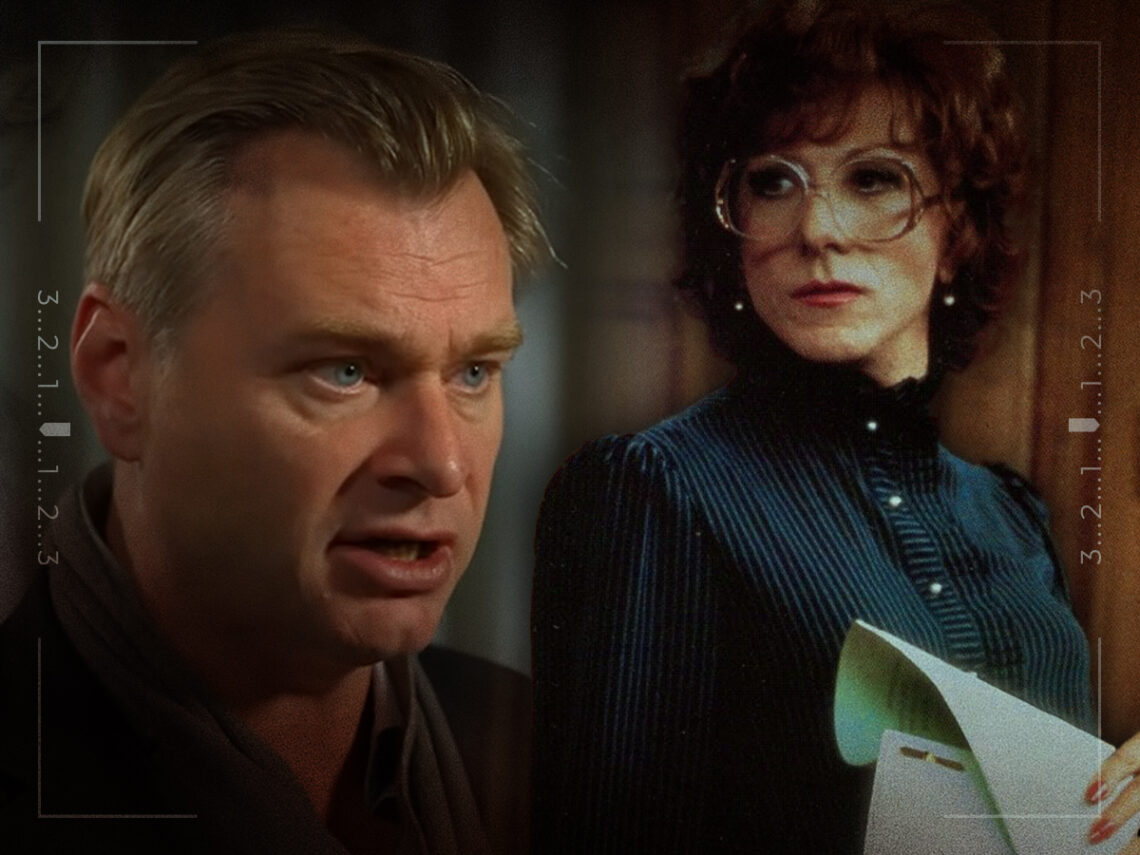
Christopher Nolan’s career-long obsession with time, as explained by ‘Tootsie’: “This is great”

What does Sydney Pollack’s Academy Award-winning Tootsie have to do with Christopher Nolan’s career-long obsession with the concept of time? If your first thought is, “What the fuck are you talking about?” that’s completely fair and totally understandable.
On one hand, you’ve got Dustin Hoffman playing a jobbing actor who impersonates a woman to reignite his failing career, and on the other hand, you’ve got one of modern cinema’s most studious auteurs, who specialises in big-budget escapism that’s guaranteed to bother awards season and put butts on seats.
From Following and Memento to Tenet and Oppenheimer, time has been the defining theme of Nolan’s work. Whether it’s nonlinear, moving in reverse, fragmented, doubling back on itself, or ticking down to a defining moment for the characters, his movies don’t feel complete without it.
Again, what the fuck does Tootsie have to do with this? After all, it’s a high-concept caper that juggles drama, comedy, romance, and satire, and it’s not as if Hoffman’s Michael Dorsey or his alter-ego, Dorothy Michaels, are giving extended monologues about temporal pincer movements and saving the world.
“The way that time is dealt with in regular films is incredibly sophisticated,” Nolan intoned. “I take the mechanism and make it visible. So, suddenly people are going, ‘Oh, there’s all this going on with time’. I actually make it simpler.'” Some viewers might disagree, but to add some weight to his point, the Tootsie experiment was conducted.
Tom Shone screened Pollack’s picture to a dozen subjects, ranging in age from 20 to 65, and when the credits rolled, he asked them a simple question: how long did it take for the narrative to unfold? The answers ranged from a month to six years, and while Tootsie never specifies its timeframe to any definitive degree, Nolan was thrilled with the results and related them to his own work.
“This is great,” he said. “I mean, you chose a good film, because it’s exactly right; it’s a great movie, but also not one for where time is a factor. That, for me, is the point. That’s the interesting thing. That’s the fun thing about the way movies work. It’s very indefinable. That’s why Tootsie was such a good choice.”
To Nolan, “It reminded me of the link that I took to dreams in Inception,” and what it has in common with Tootsie is that “the different elements of the narrative run at different times, but you accept it completely.” Conversely, if there’s an anti-Tootsie in his back catalogue, it’s Hugh Jackman’s monologue in the closing stretch of The Prestige, which is “essentially saying we create a more complicated, mysterious idea of the world because we’re disappointed by our reality.”
Little did we know that Nolan’s penchant for running several narrative strands simultaneously without definitively spelling out to the audience how long they take to unfold individually, something that applies to Memento, Inception, The Dark Knight Rises, Interstellar, and Tenet, to name a few, isn’t just entirely applicable to Tootsie, but something that the filmmaker is willing and eager to embrace.
