


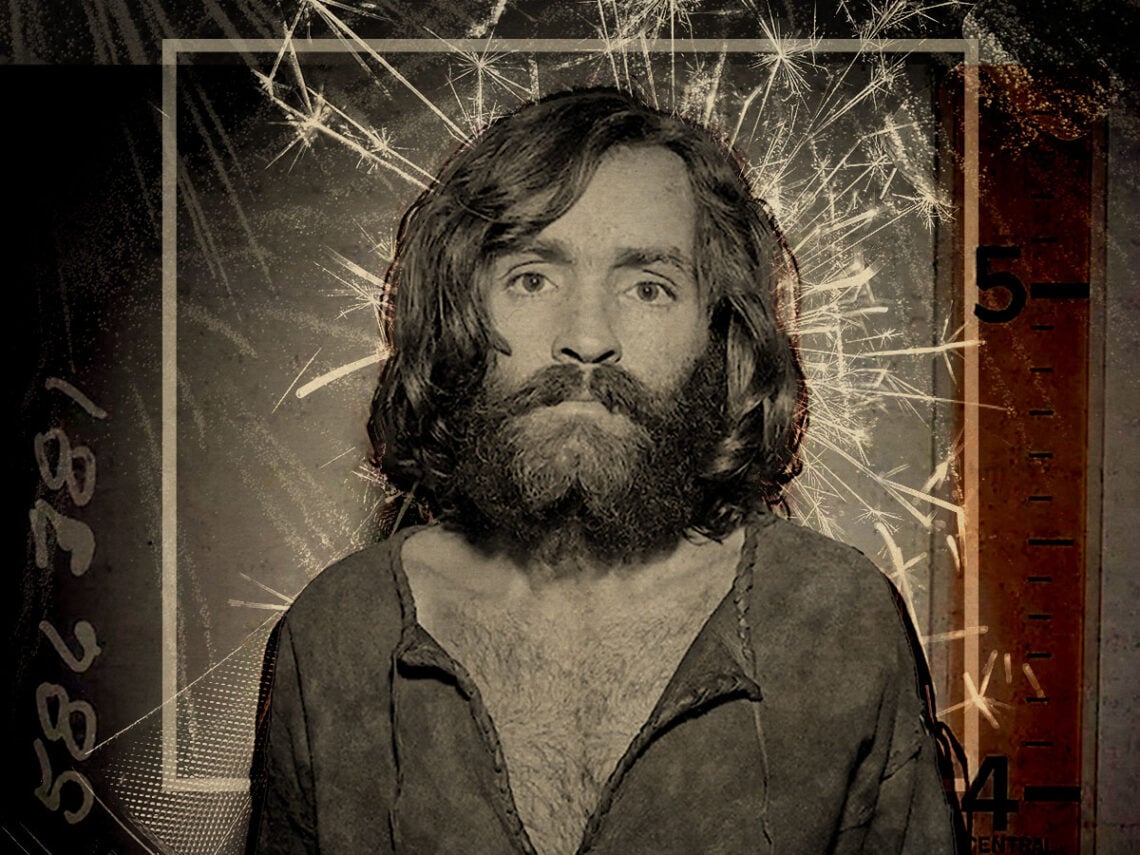
When Charles Manson threw the worst New Year’s Eve party in history

On June 15th 1970, the legal trial of Charles Manson and several of his followers began. During the nine-month proceedings, prosecutor Vincent Bugliosi pointed to a diabolical plan that was laid out on New Year’s Eve that went something like this…
On the brink of Death Valley, at Myers Ranch, a party has been rumbling on for days. Its denizens are a warped mess, consuming LSD-like candy as the sun beats down on this crooked desert spot. When the effects of the tabs fade, they turn to Bella Donna, an herbal fast track to insanity. The days become night in a procession devoid of time, but somewhere in his addled mind, Charles Manson remains sober enough to recognise the approach of New Year’s Eve.
With the clock counting down to 1968, he rises from a seated circle, all 5ft5” of him, the flickering eyes of his harem of teenage girls, hangers-on, and drug addicts vaguely connected to music, all gaze vacantly towards their favoured spiritual grifter. He’s about to make an announcement that would finally grant him fame: he’s about to slay some piggies.
He was once a wayward child whom nobody cared too much about. His crime record was vast but ‘lone wolf’ enough for the authorities to continually conclude that the diminutive crook was suffering from little more than a sense of misdirection and disengagement. Then, as the 1960s roared towards a revolution, Manson saw a chance to break this lowly malaise: the fame and fortune of international rock stardom would be his salvation.
In music, he saw the presentiment of the American Dream, the ultimate engine of social mobility whereby a drifter could learn a handful of chords, dole out some ‘truth’, and rise from their wallowing ranks to become true architects of social influence. Charles Manson, who should have garnered great social influence. The issue was he found it all too easy to enamour people. He was bold and daring enough to be different, and in the mid-1960s, folks were lapping up ‘difference’ like a hungry stray cat over a bowl of Jersey cream.

So, he soon found himself rubbing shoulders with the likes of Dennis Wilson, Frank Zappa and Neil Young. The main chance had never loomed larger for the young vagabond. The problem was, he’d soon learn that in order to make four chords and the truth sound convincing, you have to have musical chops that stretch far beyond that.
Manson didn’t. The main chance was never anything more than another pipe dream for him. He was a mere cling-on to the talent of international esteem that he had managed to infiltrate. These people were happy to partake in the free sex and drugs that he could offer, but dismissed his demented dream.
When a failed recording session coincided with a whirlwind of substance abuse, this message was hammered home with a sense of frenzied disassociation. And that all culminated in one diabolical New Year’s Eve party, where he laid out his snapped vision of revenge. If those that had led him to the hill that he was dying on were deemed revolutionary for growing their hair, strumming a guitar and being vaguely anti-establishmentarian while smoking grass, then he’d show them what a real revolutionary was.
All the same, he knew the importance of association. Without snaring the likes of Dennis Wilson under his thumb, would he really have been able to attract a fledging cult? With that same thought in mind, he pinned his own agenda on something bigger – the biggest thing of all at the time: The Beatles. So, as he rose to give his rousing toast to 1968’s end of times, he enlisted ‘The Helter Skelter’ scenario as his stupid basis.
Ranting and raving as the Summer of Love’s final hours ticked away, he claimed that the White Album was coded with the same messages he had foreseen – an impending apocalyptic race war – and he was the Christ figure who was going to do something about it, his family, now swaying in flitting consciousness like Blackpool palm trees, were his disciples.
To him, it was clear, or so he said, ‘Revolution 9’ was adjacent to the Book of Revelations. The reckoning for the world that had rejected him would come in a brutal battle perpetuated by pigmentation, a war that would sound something a little like the chaos of ‘Helter Skelter’, which in actual fact was simply Paul McCartney’s bid to out-metal The Who.
This race war would act as a cleansing that made him King. He and his Family would be the only white survivors stationed in an underground ranch while it all went to hell in the festering lands above, only to emerge and rule over the new utopia once the racket of Helter Skelter had died out. All they had to do in the meantime was kickstart this with a series of brutal slayings, ostensibly targeting the white rich who would surely seek revenge.
This was all apparently espoused in one manic speech as midnight approached on the final day of 1967. Those gathered around him were too far gone to reconcile the true horror of his vision. They were too far gone to question its credulity. They seemed alone and isolated on their little ranch on the outskirts of existence.
Now, they were embracing the wrath of an angry little man as he dropped his twisted final acid tab on their tongue and set them loose in a world of warped reality. On a New Year’s Eve party that had started a few days before the countdown, he lay out a demented vision before his addled followers, drifters like him before them, that would take down counterculture, and grant him nothing more than infamy and a freaky trial.
Every new year offers a chance for resolutions. Manson’s was an act of revenge that would land him in the history books. And his slayings, in truth, would be the death knell of the 1960s. If such evil thrived in the midst of peace and love, then was the whole damn thing a sham?
…Now, does that whole thing really sound believable? Well, Vincent Bugliosi cunningly had that obvious ‘no’ covered. His narrative decreed that it didn’t matter whether you and I found it believable. You and I will toast the New Year with loved ones in homes, pubs, and nightclubs. All that mattered was whether a swathe of unwashed stragglers, bringing in the New Year by listening to a tiny criminal, out of their mind on Bella Donna and LSD on some god-forsaken ranch in the desert, found it believable.
That was the question – a question far more gaudy and dazzling than any NYE fireworks display ever conducted – that outshone any procedural mishaps, evidence gaps, or greater consipracies. And it’s conclusion brought down the revolution of counterculture. It shouldn’t have. And with nothing more than the shaky testimonies of the addled folks present, what happened that NYE and in the months that followed remains shrouded in the towering madness of it all
