


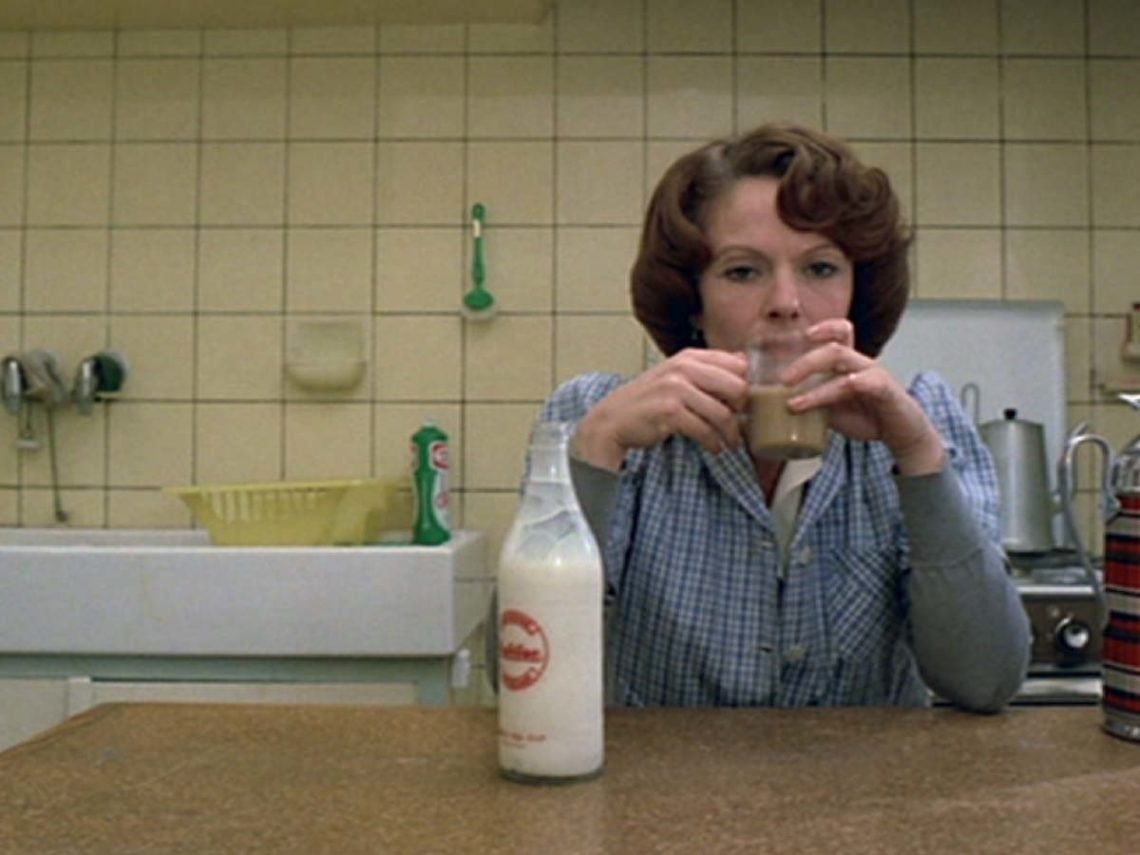
Chantal Akerman discusses the inspiration behind ‘Jeanne Dielman’

The late Belgian filmmaker Chantal Akerman is recognised as one of the most influential creatives of 20th-century cinema, as well as one of the most important female filmmakers of all time, releasing such classics as Je Tu Il Elle, News from Home and Les rendez-vous d’Anna throughout the 1970s. Her impact on feminist cinema and the European arthouse scene cannot be understated, inspiring later directors Gus van Sant, Todd Haynes and Michael Haneke.
Her greatest contribution to cinema came in 1975 with the release of Jeanne Dielman, 23 quai du Commerce, 1080 Bruxelles, a feminist masterpiece that follows the life of a lonely widowed housewife who goes about her daily life whilst living with her teenage son. Making ends meet through completing arduous tasks, at one point, the protagonist Jeanne Dielman (Delphine Seyrig), makes a decision to change her routine and outlook on life.
Appreciated by a select few upon its release, Jeanne Dielman has only recently received the respect it deserves, taking the number one spot on Sight and Sound’s list of the top 100 greatest movies of all time, released in December 2022. Beating out Alfred Hitchcock’s Vertigo and Orson Welles’ Citizen Kane to take the top spot, Akerman has become the first-ever female filmmaker to hold number one on the decennial poll.
Such has inevitably magnetised far more attention towards Akerman and her 1975 movie, leading many to consider her inspiration behind the curious three-and-a-half-hour experimentation.
Akerman spoke about the movie in an exclusive interview with Nicole Brenez, stating, “While I was writing it, I didn’t understand Jeanne Dielman. I didn’t understand it until many years later: it was also a film on lost Jewish rituals, not just about an obsessive woman”. Continuing, she adds, “If she’s so obsessive, it’s to avoid leaving an hour open to anxiety. And when that extra hour arrives, all her anxiety surfaces”.
Anxiety and ritual run riot in Jeanne Dielman, with the recurrence of the same activities keeping her in a loop of sanity that distracts her from her own fragile mental health. A deeply personal account, drawn from her own experience of Jewish rituals, Akerman’s film is a fascinating piece of arthouse cinema.
“I understood it after the mental crisis and analysis,” the director added, explaining, “I wanted my mother to keep the Sabbath, to light the candles; it came from the death of my father’s father…the man who had accepted me as a girl. At his death, I was still little; they took me out of Jewish school overnight, and it was a shock, since it broke off another connection to my grandfather. To keep the Sabbath, for me, meant reviving my ties with this man who had accepted me as a girl”.
Regarding the importance of ritual in her own life and for the character of Jeanne Dielman, Akerman explains, “The idea of the ritual has to do with the passage from animal to human”.
Check out the trailer for the revolutionary 1975 movie below.
