


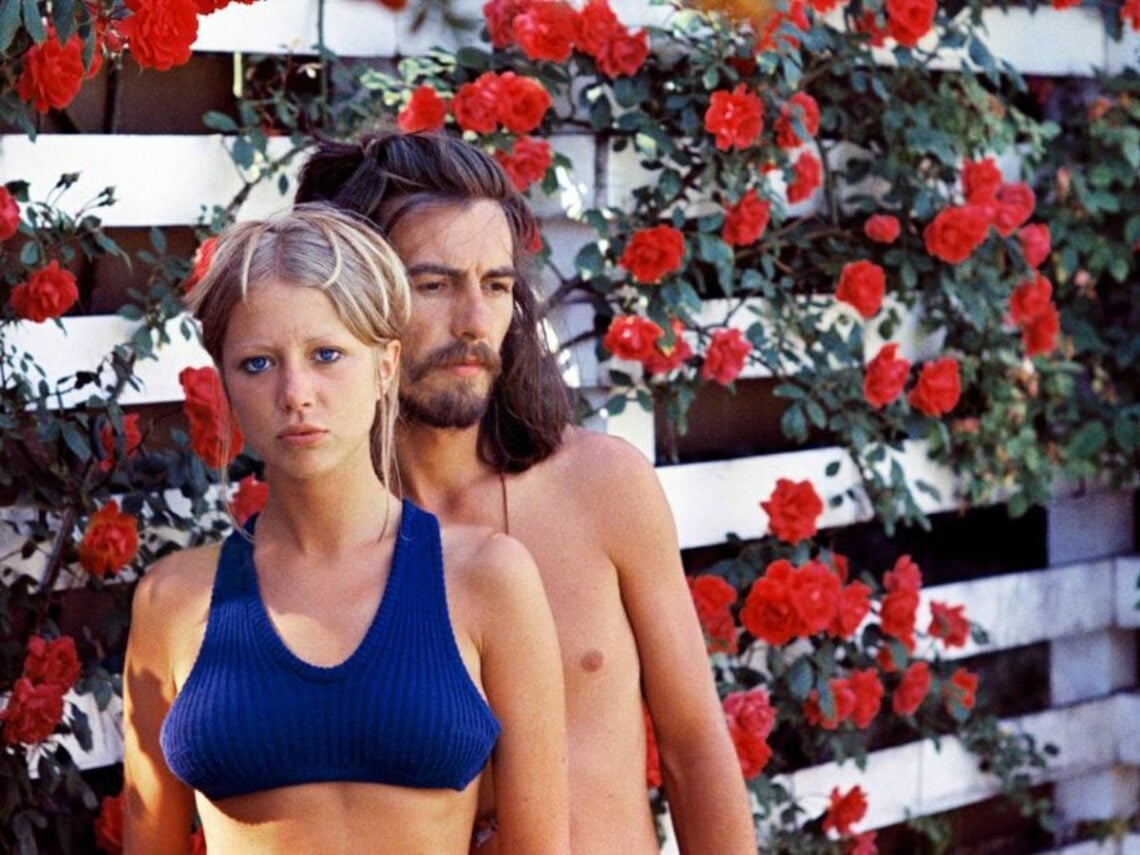
Celebrating the achievements of 1960s icon Pattie Boyd

The swinging sixties was a revolutionary period of British history which welcomed a new era of fashion, music, art and attitudes. Post-war malaise inspired British youths to embrace a new outlook, prioritising playfulness and optimism. Bands such as The Beatles, The Kinks, The Rolling Stones and The Who became hugely popular, eventually making their way across the pond as part of the ‘British Invasion’.
Although youthful guitar-led music was a sizeable defining factor of the period, fashion was utterly transformed during the swinging sixties. Many young people in London typically shopped at stylish boutiques, mixing vintage pieces with burgeoning independent designers. Mary Quant’s mini skirt became a staple of the London look, as did distinctive eye makeup, knee-high boots, bright colours and shift dresses. Music and fashion went hand-in-hand, with many famous musicians shopping from the fashionable boutiques down Chelsea’s King’s Road or vintage markets, inspiring their fans to emulate their style.
One of the most iconic figures of the era was Pattie Boyd, whose influence on both music and fashion was immeasurable. Best known for marrying George Harrison before becoming the wife of Eric Clapton, Boyd inspired some beautiful love songs, including ‘Something’ by The Beatles and Clapton’s ‘Layla’. However, Boyd did so much more than inspire a few love songs. Her immense influence over culture, helping to shape the new direction of popular fashion and music, deserves to be celebrated.
Born in 1944 in Somerset, Boyd lived a somewhat sheltered life, although she travelled around as a child thanks to her father’s job. After living in Kenya for a few years, Boyd returned home and moved to London, where she began working in an Elizabeth Arden salon as a shampoo girl. She was quickly snapped up by a modelling agency, leading her to appear in editorials for prestigious publications such as Vogue and Elle. According to Tom Hibbert, Boyd embodied the “British female ‘look’ – mini-skirt, long, straight hair and wide-eyed loveliness.” As The Beatles began to take over the world, international audiences became interested in the styles popularised by young British girls, and Boyd was the perfect example.
During an interview with Forbes, Boyd discussed this period, stating: “Previously fashion had been really rather severe and sophisticated as far as magazines like Vogue and Harper’s, etc. They really only showed very sophisticated models, probably aristocratic models, and it was so completely different. And then the ’60s girls, when we came in, we did completely different makeup, we liked black underneath our eyes as well as on top. Our hair was completely different. It was more ruffled, it wasn’t so neat. I feel that it was all part of a rebellious movement in a creative way.”
“This trickled out and spread out to Paris and New York. London was the centre at one point in time of that creative boom,” she continued. Thus, Boyd’s pioneering style marked a journey towards greater freedom and expression, which has been hugely influential towards designers and fashion icons in the following decades. The model actively pioneered these new looks, stating, “We all inspired each other. We had the look, and they designed the clothes to match our look.”
After Boyd starred in an advertisement for Smith’s crisps, helmed by Richard Lester, she reunited with the filmmaker for a small part in The Beatles’ A Hard Day’s Night, playing a schoolgirl fan of the Liverpool lads. Here she met Harrison, and the pair quickly began dating. By the beginning of 1966, they were married, and she became one of the most iconic ‘Beatle wives’. Although Boyd inspired Harrison’s love songs, it is a little-known fact that she was the catalyst for The Beatles’ interest in India, which, as we know, hugely influenced their music.
Boyd told The Independent: “I suppose it was the establishment of the hippy trail, though we didn’t realise that at the time. I was the first in our circle to start meditating. I guess I just knew that there had to be a more spiritual aspect to life, and I saw a little ad for meditation classes in the back of The Times. That’s how it started. To me, it’s about plugging into my essence, and calming myself down.”
She continued: “And then India was a real third-eye-opener. It was the opposite to England at the time, a real spiritual society.”
Spurred on by Boyd’s interest, Harrison began incorporating Indian instruments into The Beatles’ music, eventually leading the group to a Transcendental Meditation retreat in India led by the Maharishi Mahesh Yogi. The band experienced a spiritual awakening during their trip, writing many songs that ended up on The White Album. According to Paul Oliver’s book, Hinduism and the 1960s, “The relationship between the Beatles and the Maharishi brought about an enormous interest in the West in Indian clothing, meditation, yoga and the playing of the sitar.”
Sadly, Boyd’s relationship with Harrison ended when she realised he was not faithful. She ended up marrying Clapton, Harrison’s best friend, in 1979, who had pined over the model for years, although Boyd divorced him in 1989 due to his issues with infidelity and alcoholism. Since then, Boyd has found happiness with her husband, Rod Weston, whom she married in 2015 after many years of dating.
Boyd is now a professional photographer, an art form she began experimenting with during her travels with The Beatles, snapping candid shots of the musicians or self-portraits with Harrison. She told The Independent, “When Eric and I split up, I knew that I had to do something to make some money, so I did a serious photography course and actively tried to find work. Today, I shoot for magazines and I’m commissioned to do portraits for friends.”
Boyd’s snaps of the 1960s offer behind-the-scenes access to some of the period’s most influential stars, and she has carried her eye for effortlessly capturing icons into an established career as a photographer. She has exhibited her photos in various galleries over the years, and she released a photo book in 2022, Pattie Boyd: My Life in Pictures.
Although Boyd was a muse to Harrison and Clapton, it is essential to remember the contributions that she made to popular culture in her own right. As one of the faces of the swinging sixties, Boyd helped to create stylistic trends that have become staples of modern fashion. Moreover, she was responsible for inspiring an interest in Eastern culture in the minds of four British boys, who helped to popularise its incorporation into the West, which has influenced generations of artists, designers and musicians.

Never Miss A Beat
The Far Out Beatles Newsletter
All the latest stories about The Beatles from the independent voice of culture.
Straight to your inbox.