


Hear Me Out: ‘Cape Fear’ is the greatest revenge movie ever made

Revenge is a dish often served cinematically. It’s a thematic motivator that has given us iconic films like Kill Bill: Volume 1 & 2, Gladiator, and Oldboy. However, when it comes to the greatest revenge movie ever made, one that often gets overlooked is Martin Scorsese’s 1991 film Cape Fear.
A movie that is a thrilling exploration of the depths that the quest for revenge can take someone to, Cape Fear examines the moral consequences of revenge and moves beyond the typical violence and action, instead focusing on a complex story of guilt and desperation.
The movie sees Taxi Driver and Raging Bull’s winning combination of Scorsese and Robert De Niro once again partner up to give us a compelling and haunting character in the form of Max Cady, a man who feels he is justified in his pursuit of revenge against the lawyer who hid evidence that could have awarded Cady a shortened sentence for his crimes of rape and battery. De Niro does not play Cady as a hero—far from it, in fact. He is wholly a villain, intelligent and single-minded in his approach to his perceived rightful vengeance.
Cady is calculating, his approach to justice not merely physical, but psychological. Hell bent on dismantling the life of lawyer Sam Bowden (Nick Nolte), exploiting legal loopholes and taking advantage of the weaknesses in Bowden’s family to wage psychological warfare. Scorsese’s film relies on suffocating tension, instead of overt violence, to display Cady’s victim’s helplessness, showcasing a methodical approach to revenge until a climatic moment of primal confrontation in the film’s final act on a houseboat in the middle of a storm, an analogue for the simmering build-up we see in Cady throughout the film.
Cape Fear doesn’t condone or disavow Cady’s actions, instead leaving the moral ambiguity of revenge itself on full display, asking the audience to consider for themselves whether Bowden deserves the torment being dealt to him, or if there’s a twisted logic to Cady’s unrelenting rage. The film chooses not to give easy answers, instead asking more questions surrounding guilt, and the morality of revenge and whether it’s ever justified.
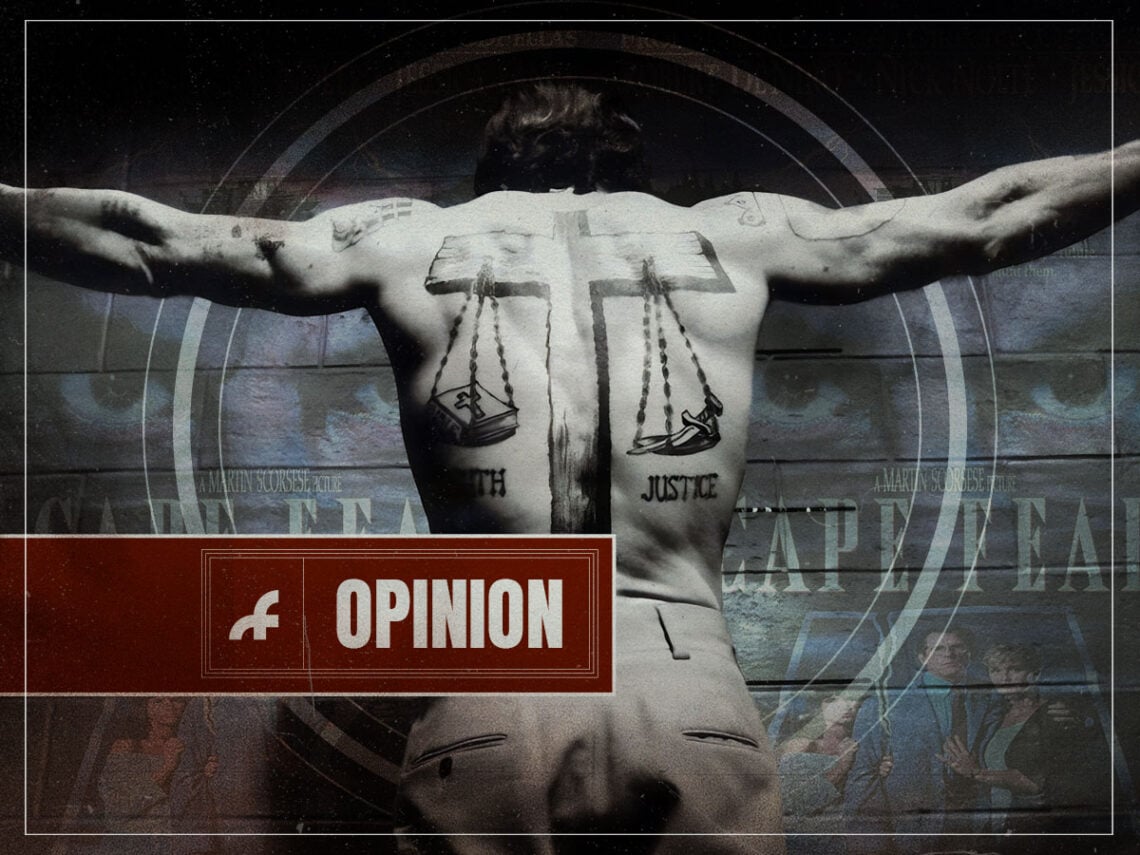
De Niro shines as Max Cady, delivering one of the more haunted performances of his career, transforming himself into a personification of revenge and physically losing himself to the role, bulked up, tattooed and imposing, making his more psychological approach that much more terrifying. Cady is a man who could easily use violence to achieve his ends but instead chooses to use a patient, methodical dismantling of a man’s life, tapping into a relentlessness that furthers his embodiment of the consequences of the actions we decide to make.
Scorsese’s mastery over direction is on full display in Cape Fear, with the tension-driven, slower pace of the film building until it’s almost unbearable, mirroring the experience of Bowden. With tight, claustrophobic camera choices and unsettling sound design, the direction of the film creates an air of paranoia, making the audience almost another victim of Max Cady’s tirade. Aesthetically, the roiling stormy skies and ominous, churning river reflect the inner workings of De Niro’s dread-inducing villain.
Like all good revenge films, the final act is a cathartic release, relieving the audience of the expertly built-up tension and suspense preceding the stormy culmination. The violence that is finally on display is almost additional relief as we begin to see the brutal villainy at the core of Cady.
The mix of psychological thriller, twisting morality, and a standout performance from De Niro make Cape Fear an iconic example of a revenge film. It was also an unconventional one at the time of release that has helped redefine what the genre can look and feel like. It is a foreboding, haunting, and powerful dissection of the human condition and a visual treat.
