


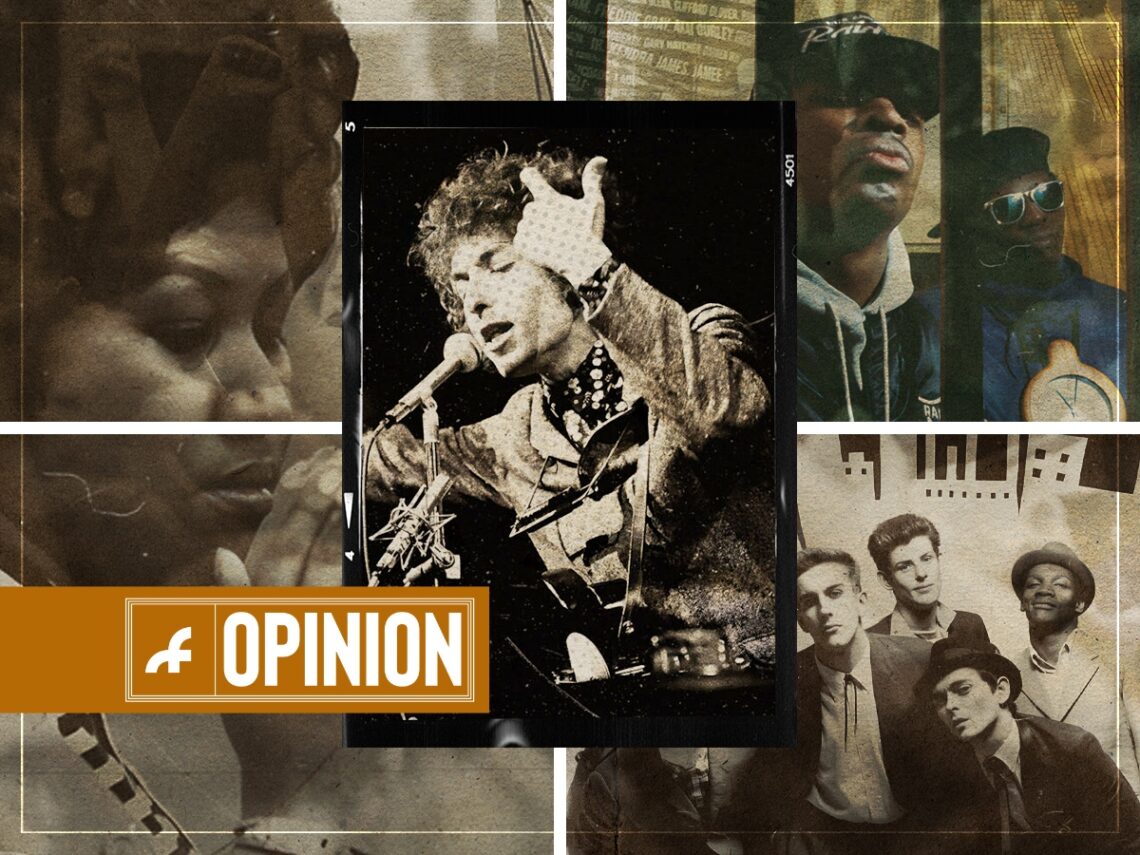
Can protest music influence real change?

Throughout history, there have been many instances of musicians channelling emotional reactions caused by societal or cultural events through music. It’s easy to see why: music is an outlet, a conduit for personal expression. Some of the greatest songs in history are those deeply rooted in politics, but when does a song become a protest song? Moreover, can protest music actually influence change? Or is it just performative activism at its best?
In the 1960s, Bob Dylan was seen as a master of intersecting real-world issues into music and making it sound great. His ability to thread social themes into his poetic writing style is a characteristic that people still admire today – but there were artists who demonstrated the same sentiment long before Dylan rose to prominence.
Woody Guthrie had a profound influence on Dylan during his ascent to fame and stood as an emblematic figure among protest singers of his time. His compositions predominantly centred on anti-fascism and socialism within the United States. Guthrie’s approach to conveying pivotal political and societal messages through music left a deep impression on many, including Dylan.
The surge of protest-oriented music in the ’60s dovetailed seamlessly with the eruption of the youthful counterculture embodied by the hippie movement. Throughout the 1960s and ’70s, a considerable portion of popular music pointed an accusatory finger at the government, often rallying against the American involvement in the Vietnam War or addressing the deep-seated issues of racial inequality amid the ongoing Civil Rights Movement. While the spectre of war intermittently surfaced in music, it became evident that other pressing matters were ascending to the forefront following the culmination of the Vietnam War.
For instance, the 1980s witnessed a resurgence of music advocating for the release of South African anti-apartheid leader Nelson Mandela, who had been incarcerated since 1962 for his activism against segregation. Simultaneously, the emergence of initiatives like Live Aid and comparable organisations steered music’s focus toward raising awareness for those afflicted by poverty and famine on a global scale.
In contemporary times, protest music frequently channels its energy toward the persistent fight for societal equality. Artists routinely draw inspiration from issues encompassing racism, gender disparity, and LGBTQ+ rights. These themes are often complemented by broader political commentary, reflecting the increasing disillusionment with government leadership in both the US and the UK over recent years, coupled with the protracted debates stemming from the UK’s EU referendum.
While hip-hop appears to have claimed the mantle of the most politically engaged genre in our present era, the legacy of protest music spans decades and genres. Jazz, folk, funk, and rock music, each in their own distinct way, have all contributed to the rich tapestry of the most remarkable protest songs of all time.
So, can protest songs actually stimulate change for good, or do they only extend as far as fleeting ideas of a better world? In short, yes, protest music can actually change the world, but it’s not quite as easy as that. Take Aretha Franklin’s ‘Respect’, for instance: the song didn’t solely take down discriminatory barriers during the feminist movements, but it did contribute to community mentality and allow people an anthem to chant loudly and proudly while they fought for change.
Equally, ‘Free Nelson Mandela’ by The Specials served as a powerful protest anthem against the apartheid regime in South Africa and the imprisonment of Mandela. The song became a rallying cry for anti-apartheid activists around the world and contributed to raising international awareness about Mandela’s plight and the broader struggle against apartheid. It was a major hit in the United Kingdom and reached the top ten of the UK singles chart. The song’s success helped amplify the pressure on the South African government and garnered support for sanctions against the apartheid regime.
The track is remembered not only as a musical hit but as a cultural touchstone for the movement as a whole. The song was played at various protests, rallies, and events advocating for Mandela’s release. Mandela was eventually freed in 1990, and he went on to become the President of South Africa, marking a significant victory and a monumental moment in history.
Public Enemy also saw protest music follow a similar pattern with ‘Fight The Power’ in 1989 – the song became not only a hit but also a cultural rallying cry, addressing issues of racial inequality, oppression, and social justice. Its profound impact on both music and culture is undeniable: it emerged as a powerful anthem for marginalised communities and activists advocating for social change.
Whether or not music can bring change on its own is a question that almost always points to ‘no’ as its answer, but music can and does bring together communities, and communities are what’s needed to take the first steps towards acceptance and liberation. It becomes challenging when musicians and songs become nothing more than sentiment without any real indication of intent to change the course of history, but even in some of those circumstances, it’s difficult to challenge the impact they’ve had on the collective consciousness.
Ultimately, it’s always better for voices to speak loudly about the world’s wrongdoings than to stay silent, but if it’s followed up with genuine, tangible efforts, that’s a bonus.

Never Miss A Tale
The Far Out Bob Dylan Newsletter
All the latest stories about Bob Dylan from the independent voice of culture.
Straight to your inbox.