


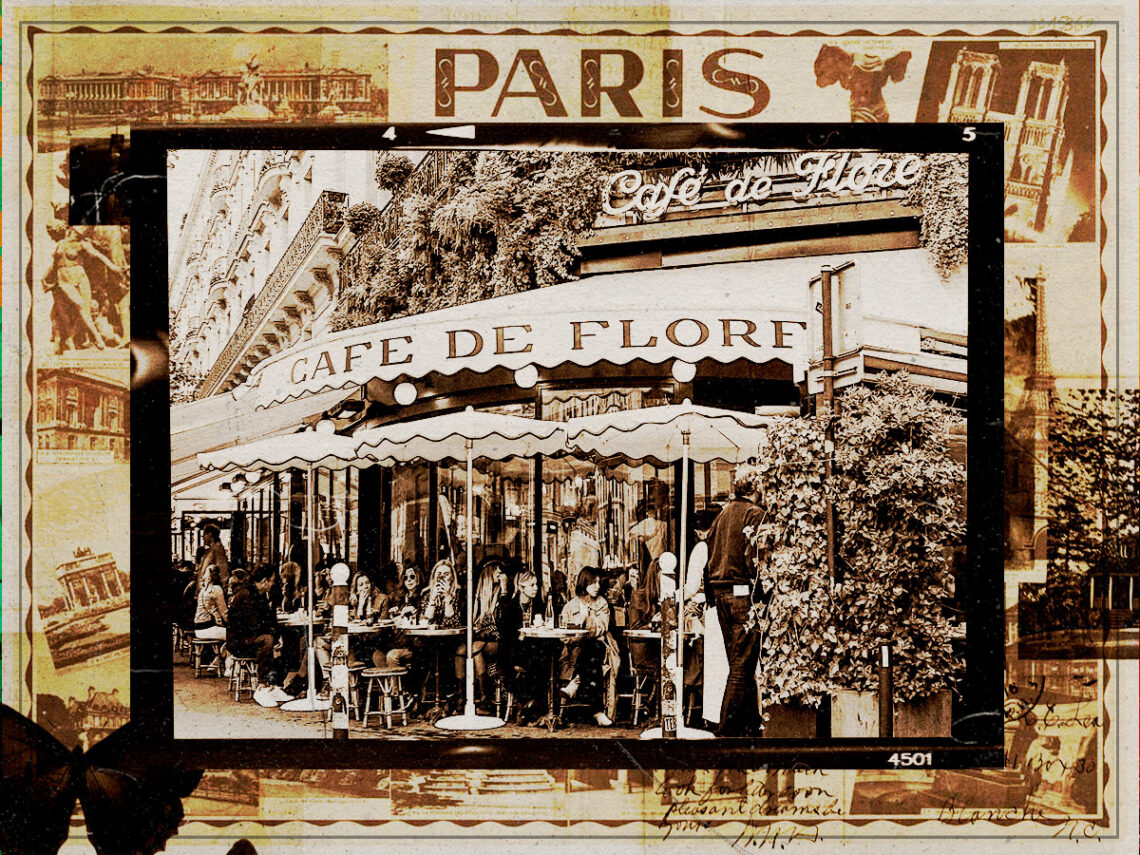
Café de Flore: the Parisian haunt for hordes of great artists

There are a lot of bold claims surrounding the Café de Flore. Like the fact, when he’s in town, Robert De Niro is said to have their coffee sent to his hotel room. But the iconic café’s more significant claim to fame comes from its association with artists far before De Niro’s time. Since 1887, its art deco walls have housed some of the world’s foremost thinkers, cementing it as a must-see travel spot in France to this day.
Sat on the left bank of the Seine, part of its pull is the picturesque location, as dutifully noted by the Emily in Paris team, who filmed a scene there. As one of the most eagerly flocked to cafés in Paris, it’s fittingly chic, adorned with greenery and an overflow of dainty wicker chairs that spill out onto the street. To that end, in the summer, it becomes a popular apéro spot, and in colder months, their Chantilly cream-topped hot chocolates replace the booze.
But it’s not just the drinks menu that keeps it appearing in guidebooks as a must-visit place in France. It’s an alluring place for fans of literature, art, and fashion. The café, which is adorned with works of the artists who used to spot by there, lays claims to a star-studded list of former regulars.
The first two were authors Remy de Gourmont and Joris-Karl Huysmans, and as the 19th century approached, poet, politician, and critic Charles Maurras took to writing his book, Au signe de Flore, on the first floor of the café – where in 1899, the Revue d’Action Française far-right monarchist political movement was founded. A rival bubbled up between the Café de Flore and Les Deux Magots, Jean-Paul Sartre and the others had to avoid it like the plague, amplified by its association with far-right thought.
That said, its mahogany leather interior still saw the likes of Pablo Picasso, Léon-Paul Fargue, Georges Bataille, Robert Desnos, and Raymond Queneau often, and although its clientele has shifted from writers and philosophers as it became a tourist attraction, its art deco red appearance has barely changed since the Second World War.
In the A Tale of Two Cafés essay, and even more in-depth in his book, Paris to the Moon, writer Adam Goptnik contemplated the rival between the two cafés, both ostensibly attended by French intellectuals, but both always vying to be the best. Despite Les Deux Magot’s list of famous faces – the likes of Oscar Wilde and Sartre somehow, the Café de Flore seemed to emerge as the victor.
As he wrote in a 1996 edition of his Paris Journals: “The relationship between the modishness of the Flore and the unmodishness of the Deux Magots isn’t just possibly arbitrary. It’s necessarily arbitrary. If you place any two things side by side, one will become fashionable and the other will not. It’s a necessity determined by the entire idea of fashion.”
