


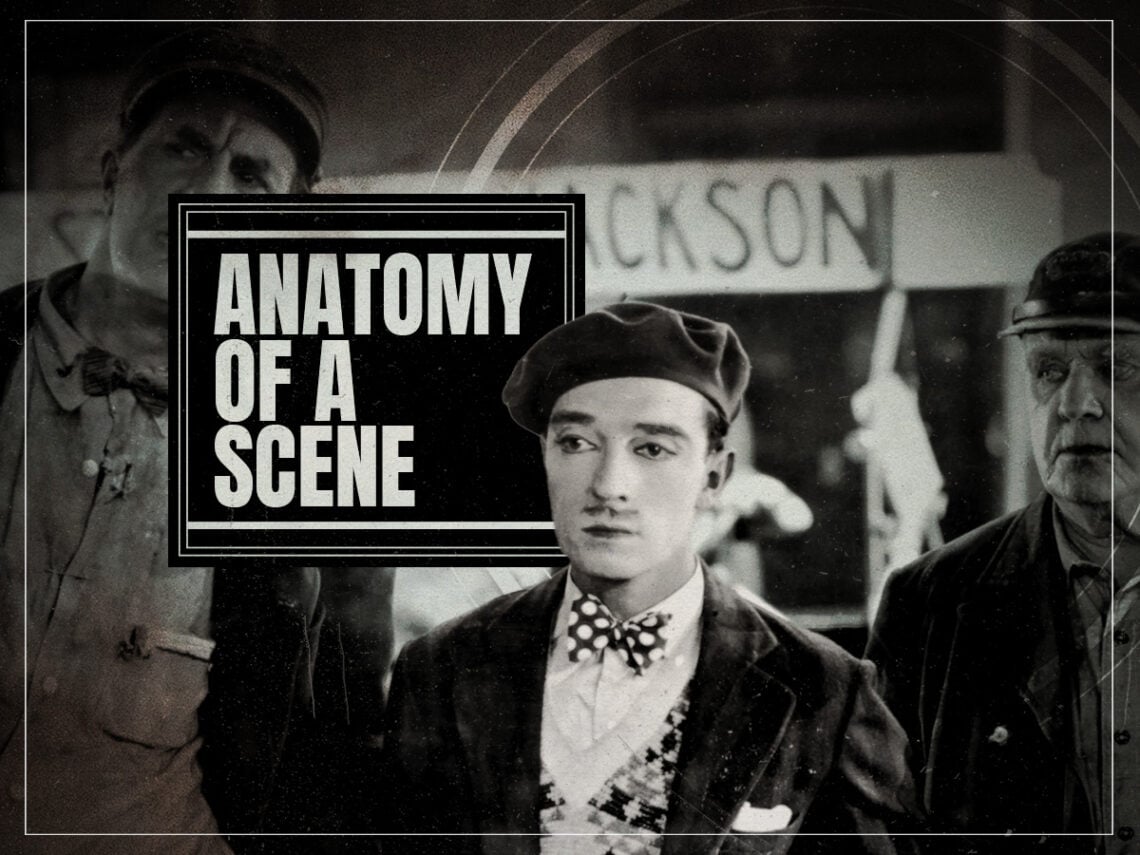
Anatomy of a Scene: Buster Keaton’s narrow escape in ‘Steamboat Bill, Jr’

It’s an image you’ve likely seen time and time again. Someone is standing on the ground when the front of a building falls towards them, only for the intended victim to be spared by standing in just the right spot that they actually pass through a window or some such hole in the facade. This sort of gag is so ingrained in culture that it’s easy to forget where it actually came from or who did it first. Not this one, though. This is the calling card of one of the greatest movie stunt performers of all time – Buster Keaton.
The falling house trick, one of Keaton’s endless array of mind-blowing set pieces, comes from a 1928 film called Steamboat Bill Jr You might think that director Charles Reisner nicked this title from Mickey Mouse’s cartoon debut Steamboat Willie, when in fact, his creation came first. Keaton stars as the eponymous young man who, after many years of not seeing him, visits his father, a steamboat captain. Various hijinks ensue, including a freak storm that is responsible for the famous housefront stunt.
This wasn’t the first time something like this had happened during a Keaton film. In the 1919 short Back Stage, a similar stunt featured Roscoe ‘Fatty’ Arbuckle avoiding a falling piece of set. Then, one year later, in Keaton’s first independently released movie, One Week, a section of wall falls around his character during a sequence of him building a house. The gags are identical, but the props are very different. The first two were thin and flimsy; they would have hurt if they’d hit their actors but probably wouldn’t have killed them. By the time Steamboat Bill Jr came around, however, Keaton had moved on to the proper stuff.
The front of the house that fell around Keaton was genuine and weighed about two tonnes. The window through which Keaton would pass was also much smaller and much higher up, making it even harder to calculate the exact spot the silent star would need to stand in to avoid getting flattened. Legend has it that Keaton had just two inches of leeway on either side and that his shoes were nailed in place to stop him from moving out of position.
Fred ‘Gabe’ Gaourie had been Keaton’s technical director for a number of years before this film. He worked with the maverick actor to bring his insane ideas to life, figuring out how to achieve the desired effect safely without shattering any of the cinematic magic. It was his idea to use a series of concealed ropes to hold the housefront in place, positioning three men on the roof of the structure to cut them just as the cameras started rolling. Keaton himself recalled the tense atmosphere on set ahead of the big moment. “Cameramen, electricians and extras prayed as we shot that scene,” he said (via the San Francisco Silent Film Festival). “I don’t mind saying I did a little praying myself.”
There might be a very sad reason as to why Keaton was prepared to take such a big risk. He was at a low point in his life, struggling with alcoholism and the collapse of his first marriage. To top it all off, his producer, Joseph M. Schenk, had told him that he was shutting down his production company. This meant that Keaton could no longer make films independently. He would have to go back to working for a studio, which would severely reduce his creative influence on any future projects. Some theorise that Keaton didn’t care what happened to him anymore, hence the possibility of being crushed by a falling house.
Regardless of what drove Keaton to attempt this stunt, the point is that he did it. With very little trickery, the slapstick icon cheated death and gave cinema an image that would endure for the best part of 100 years. Simple, terrifying, and utterly engrossing, Steamboat Bill Jr is the perfect example of why the era of silent film should not be slept on.
