


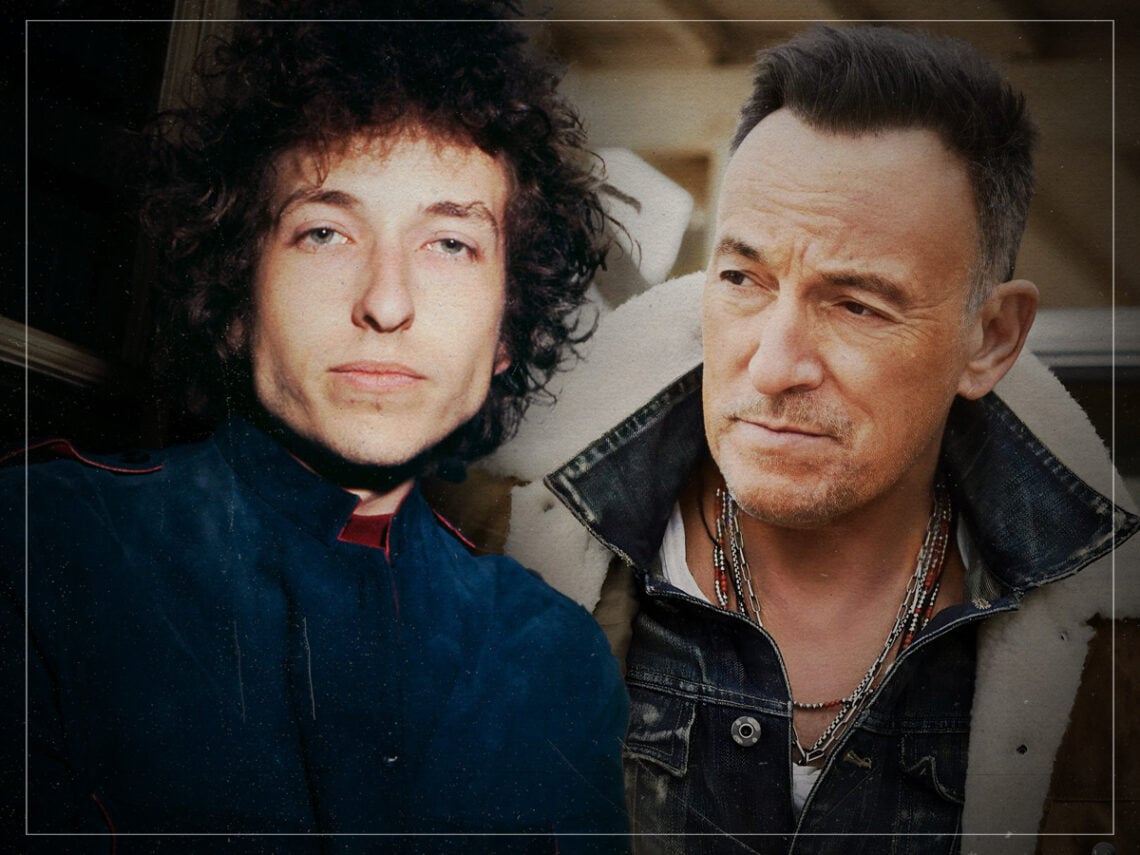
“Part of history”: The moment in 1975 when Bruce Springsteen stopped being ‘the next Bob Dylan’

You would be forgiven for assuming that being repeatedly compared to your hero, and one of the greatest songwriters of all time, would be rather flattering. During the early days of Bruce Springsteen, though, the constant comparisons drawn between himself and Bob Dylan gave the New Jersey songwriter an almost impossible task to pull off.
After all, by the time that Newark’s favourite son began his recording career, with 1973’s Greetings from Asbury Park, N.J., Bob Dylan was already a pretty untouchable figure, having both defined and eclipsed the folk landscape of the previous decade. His work was inherently incomparable, which didn’t exactly aid the young Springsteen when his early work was almost immediately compared to Dylan.
Admittedly, though, it is easy to hear the influence of the folk hero in Springsteen’s early recordings, which were far more folk-oriented than the heartland rock that would define his output in later years. Nevertheless, ‘The Boss’ recognised, even early on, that he would have to break free from those music press comparisons sooner rather than later, or risk being written off as little more than another Dylan copycat.
“Well, I love Bob Dylan,” Springsteen shared in a 1978 interview. “Highway 61, Blonde On Blonde, that’s part of the book, you know. That’s part of history.” However, Springsteen was quick to downplay any similarities between himself and that part of history: “I always loved him but it’s different, we play a lot differently.”
“It happens to everybody when they come out,” the songwriter continued, criticising the laziness of the music press. “First thing when somebody new comes out, they try to compare them to the next guy, or the last guy, make him the new ‘this’ or the old ‘that’.” Luckily, Springsteen managed to wriggle free of those restrictive comparisons back in 1975, with his breakout record Born To Run.
Unlike his previous records, in which you could quite clearly hear the influence of artists like Dylan, that 1975 album was completely unique in its offerings. Crucially, too, it was nothing like anything that had been achieved by the curly-haired folk singer.
It is no surprise, then, that Born To Run marked the death of most comparisons between Springsteen and Dylan, marking out ‘The Boss’ as an entirely separate songwriting identity, albeit one with an equally visionary artistic mind.

Although Springsteen, throughout the course of his extensive and illustrious discography, has consistently reinvented his sound, going from the pop-rock excellence of Born in the USA to the emotive acoustic nature of Nebraska in the space of only a few months. However, it was with Born To Run in 1975 that he first established his own sound; it was – and still is – a record that could not be confused for anybody else.
So, if the songwriter’s aim for the album was to escape the pressure and limitation of being billed as ‘the next Bob Dylan’, then he certainly succeeded.

Never Miss A Tale
The Far Out Bob Dylan Newsletter
All the latest stories about Bob Dylan from the independent voice of culture.
Straight to your inbox.