


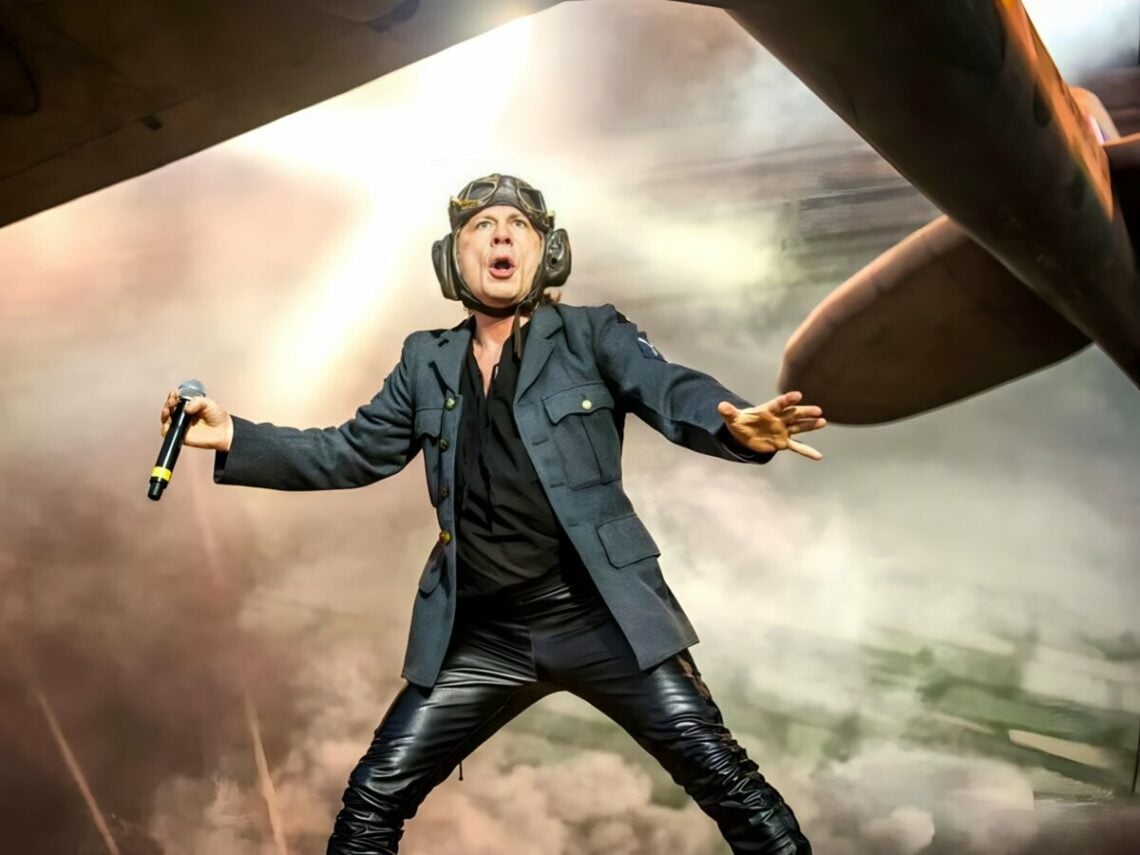
Bruce Dickinson believed he’d leave Iron Maiden due to cancer battle

Iron Maiden frontman Bruce Dickinson has revealed that he was ready to find the British metal pioneers a new vocalist when he was battling throat cancer a decade ago.
Dickinson, who is best known as the wailing lead of the ‘Run to the Hills’ group, as well as his extra-musical career as a commercial pilot, was diagnosed with throat and tongue cancer in 2014, seriously bringing into doubt his career.
The following year, he underwent seven strenuous weeks of chemotherapy and radiation therapy to work on the cancerous tumour found at the back of his tongue. It was said to be the size of a “golf ball”. Fortunately, the cancer was discovered in the early stages, and on May 15th, 2015, he was given the all-clear by doctors. He then began getting his career back on track.
In a new interview on the Rich Roll podcast, Dickinson reflected on that tough time and revealed that he was prepared to leave Iron Maiden so they could find a replacement and continue their careers. He recalled: “When I had throat cancer, the last thing on my mind was, ‘Would I ever sing again?’ The first thing on my mind is, ‘Am I gonna get through this and be alive?’ And the last thing on my mind was would I ever sing again? And I thought, ‘Well, we’ll get to that stage when I’m done and we start trying to sing.’
The frontman continued: “And I was quite prepared to accept that I might not be able to sing with Iron Maiden again. I might be able to sing, I might be able to vocalise, I might be able to sing in a different way, but if I couldn’t sing the way I have to sing with Iron Maiden, I’ll help them find a great replacement. Because the music is sacrosanct.”
Iron Maiden released their most recent album, Senjutsu, on September 3rd, 2021.
Who did Bruce Dickinson replace in Iron Maiden?
As is well known, Bruce Dickinson is not the original Iron Maiden frontman. The band was formed in 1975 by bassist Steve Harris after he left his previous group, Smiler. They debuted at St. Nicks Hall, Poplar, on May 1st the following year, with a brief line-up that featured vocalist Paul Day. However, he soon left as, according to Harris, he lacked “energy” and “charisma on stage”. He was replaced by Dennis Wilcock, who wore Kiss-esque makeup and used fake blood during performances.
In 1978, amid changing lineups and disputes over the band’s sound, Wilcock left to form his own group, V1. Luckily, for Iron Maiden, a chance meeting at the Red Lion pub in Leytonstone in November 1978 led to Paul Di’Anno successfully auditioning. He was the missing piece of the puzzle and had the edge they had been looking for. Iron Maiden released their self-titled debut in 1980, a tremendous success. It featured the early classic ‘Phantom of the Opera’.
However, in 1981, Di’Anno’s increasingly difficult behaviour due to his drug use was getting too much. He was fired after the Killer World Tour, and the band had already selected his replacement: former Samson frontman, Bruce Dickinson. His first album with them was 1982’s The Number of the Beast, which produced the title track and ‘Run to the Hills’, kicking off a majorly successful run. He played with the band until 1993, when he left to pursue a solo career and was replaced by Blaze Bayley before rejoining in 1999.
Di’Anno, who had been struggling with health problems for many years, forcing him to use a wheelchair, passed away in October this year. Iron Maiden wrote in tribute to their late frontman: “We are all deeply saddened to learn about the passing of Paul Di’Anno earlier today. Paul’s contribution to Iron Maiden was immense and helped set us on the path we have been travelling as a band for almost five decades. His pioneering presence as a frontman and vocalist, both on stage and on our first two albums, will be very fondly remembered not just by us, but by fans around the world.”

Never Miss A Beat
The Far Out Music Newsletter
All the latest music news from the independent voice of culture.
Straight to your inbox.