


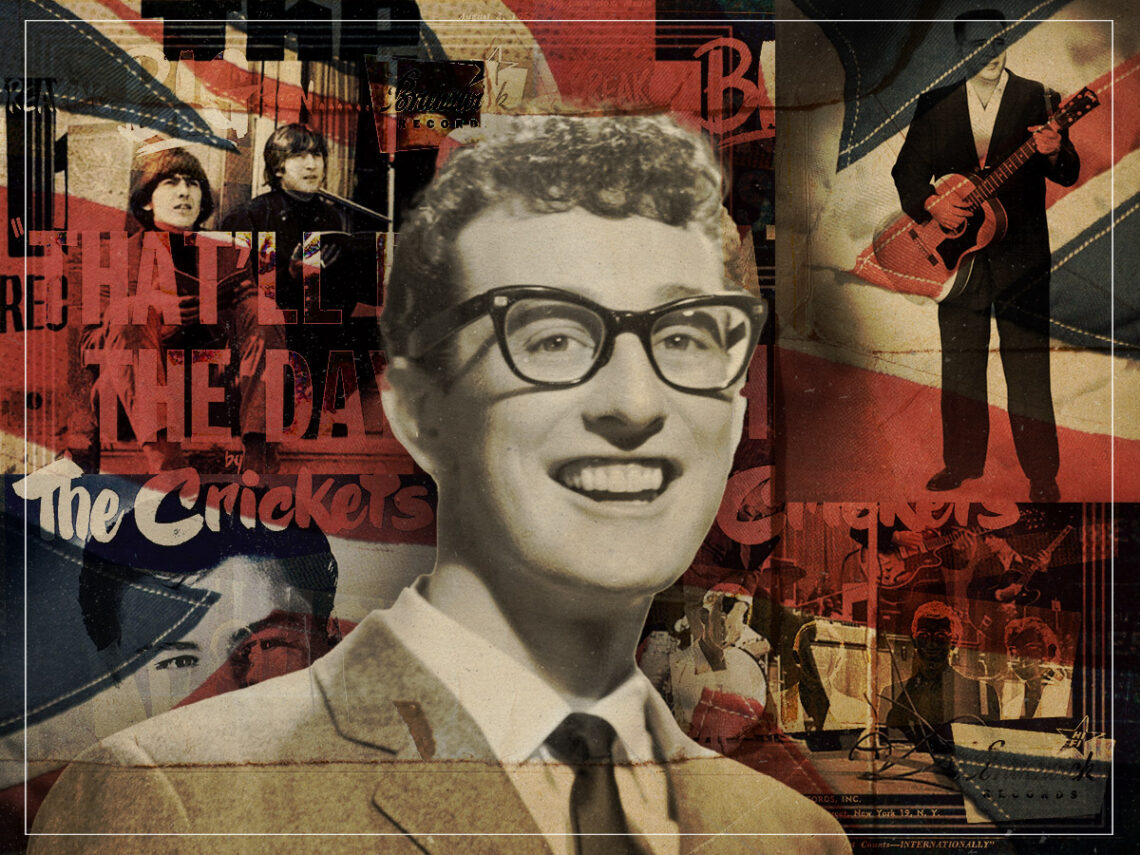
Would the ‘British Invasion’ have happened even without ‘The Day the Music Died’?

So, here’s how the story goes: on February 3rd, 1959, shortly after take-off, Roger Peterson, a young and inexperienced pilot, lost control of a light aircraft on a dark, cold, cloudy evening and crashed into an Iowan field at 170mph. The catastrophic impact took his life and those of his three passengers: Buddy Holly, Richie Valens and The Big Bopper. In one night, three of America’s biggest pop stars perished. This created a void that bands like The Beatles, The Rolling Stones, and The Animals flooded into, and so the British invasion began.
These two events, ‘The Day the Music Died’ and ‘The British Invasion’, have always been inextricably linked in cultural discourse, with widespread claims that one led to the other. But is this just an angle drummed up by theorists, or does it actually hold any weight? Well, they say history belongs to those who write it, and those who write it require an angle. In truth, linking the two separate sets of circumstances arises from the desire for a succinct historical narrative more so than any analysis with a great deal of depth.
Logistically, the links were obvious. Prior to the arrival of The Beatles, very few UK acts had any success in the US. Cliff Richard was a commercial phenomenon in the UK in the early part of the 1960s, but by 1964, only ‘Living Doll’ had charted in the US. Thus, British labels were wary of expensive tours and marketing on the far side of the pond, and American venues were unsure about booking them. With the competition thinning out, suddenly dabbling in a bit of transatlanticism seemed more viable for both parties.
But mere viability following the deaths of three prominent pop stars does not equate to a full-scale invasion that had irrevocable impacts on global culture, not just the two countries involved. No, the furore that fuelled the flood of acts was not caused by a group of young girls getting excited about sudden logistical viability thanks to a tragic gap in the market. Regardless of what may have become of Buddy Holly, there’s no chance he would’ve been cooing ‘Sympathy for the Devil’ in a few years.
British invasion bands were, very simply put, different from their US counterparts, and the youth that lapped them up were praying for something different at the time. The presentiment of sweet and cheery peace and love played out by personable young lads and lasses at a point when president’s heads were being blown off, after a childhood where nuclear air raid drills were a routine part of classroom life, was ineffably appealing on a surface level alone.

But delving deeper, there was more than merely ‘difference’ at play. On a more subconscious level, there was something beautifully “everyday” about The Beatles, as opposed to the bombastic individualism of Elvis Presley, which played into their appeal. Arriving on a plane that touched down on February 7th, 1964, there is a lot to be said for the fact that the band were reminiscent – for the screaming mass of young girls that awaited them – of their brothers that were being shipped off in the other direction in the US’ own invasion of Vietnam.
Amid this unrest and turmoil, they didn’t want rock ‘n’ roll idols but rather a relatable collective of friends. The bands of Britain suited this socio-political climate far better than the solo stars of the States. That collectivism also galvanised the bands and made them less manageable and more liberated in their own way, revolutionising the music that they produced. They offered a daring alternative to the norm, hence ‘counterculture’.
So, to say the likes of The Beatles with ‘A Day in the Life’ only flourished because Buddy Holly with ‘Peggy Sue’ was out of the picture is reductive of both acts and the wider societal climate around them. There is no doubting the brilliance and pivotal importance of Holly, Richie Valens and The Big Bopper in their day, but their day had all but been and gone. The British invasion was a British inevitability, and The Stones would have rolled over the three stars who were lost in the same way they rolled over the King, Bobby Darin and everyone else of that era had they hypothetically survived.
These things are cyclical, and that inevitability is supported by the fact that exactly 20 years on from the British invasion of 1964, in 1984, The Smiths, David Bowie and Duran Duran began to usurp their American counterparts who had all succumbed to commercialism. Then young acts like Nirvana heeded the same call for sincerity to return to music up until 2004 when British indie bands began to wash ashore, and so on and so on. If these subsequent cycles weren’t prompted by any plane crashes, then what’s to say that the first had much bearing on what followed?
