


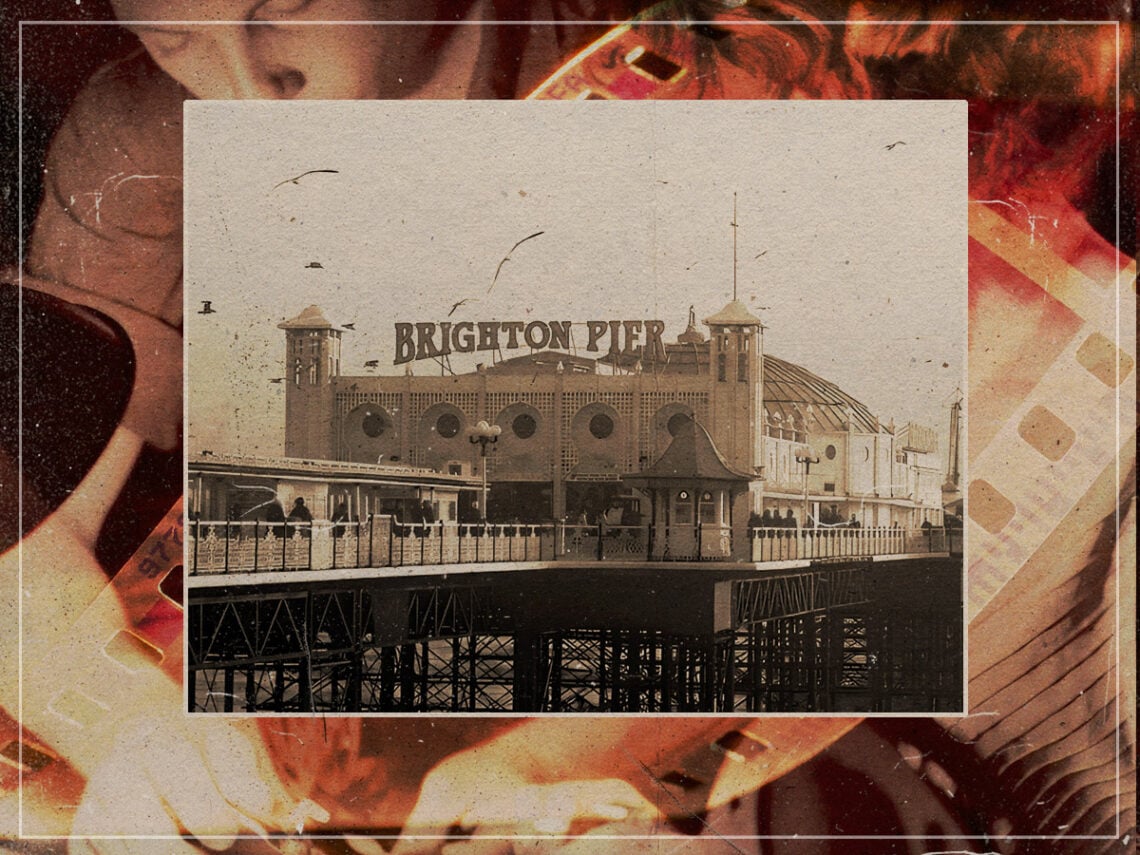
The crucial role Brighton played in the birth of cinema

In the 18th century, Brighton stood distinct from its neighbour, a small fishing village named Hove. The isolated settlements depended on the bounty of the sea and a handful of burley fishermen to sustain their local economies. However, all this began to change in 1787, when George, the Prince Regent, erected the Taj Mahal-inspired Royal Pavilion in Brighton.
The cordial, if famously unhinged, Prince would invite his aristocratic acquaintances from London to his seaside retreat and gradually, Brighton transformed into a cultural hub. As it remains in the modern day, Brighton became an epicurean extension of London, with a finger on the pulse of the latest fashion trends.
Throughout the 19th century, many of these aristocrats decided that a seasonal second residence on the coast might be a good idea. With property developer visionaries like Charles Busby, who designed the affluent homesteads of Sussex Square, and Thomas Read Kemp of Kemptown, these prayers were answered, and money began to flood Brighton and Hove.
While this social succession took hold, just over 5,000 miles away, Hollywood, a dusty suburb of Los Angeles, was still waiting to be named. While Hollywood was put on the map in 1987 by ranch owner Harvey H. Wilcox, it wouldn’t be placed on the proverbial map of global cinema until 1911, when Al Christie for David Horsley opened the neighbourhood’s first movie studio, Nestor Studios.
Hollywood may take the glory for popularising cinema as an artistic medium, but Brighton had laid some crucial foundations over a decade prior. At the very end of Queen Victoria’s reign, Brightonian and early filmmaker George Albert Smith was credited with trailblazing reverse film effects for the first time. In his groundbreaking 1900 work, The House That Jack Built, Smith depicted a house that rebuilds itself as if by magic.
As a hub of artistic innovation, Brighton subsequently bore witness to a series of film firsts that we may take for granted today, such as the first close-up, the first editing for narrative, the first cutaways and dissolves, the first on-screen kiss and the first chase scene. As the medium’s prime progenitor in the UK, Smith also developed the first commercial colour film system between 1903 and 1908.
In the modern day, Brighton prides itself on progressive values and sexual liberation. Hence, it’s only fitting that the city should host the first-ever erotic movie. The gentleman responsible, Arthur Albert ‘Esmé’ Collings, formed an associated group of pioneering filmmakers dubbed Brighton School alongside Smith, James Williamson and Alfred Darling.
Titled Woman Undressing, Collings’ salacious short of 1987 was bland by modern standards but a daring move in the shadow of Queen Victoria’s well-clad bosom. In light of this, the film was marketed strictly for discrete viewings in “gentleman’s smoking rooms”.
As the global hub for cinematic innovation in the late Victorian era, Brighton and Hove was the birthplace of at least 167 films between 1896 and 1900. While these were silent, grainy and exceedingly short by modern standards, Smith’s 1903 work Mary Jane’s Mishap was deemed “the first modern film” by cinema historian John Barnes. This complex narrative combined several techniques in one package, including distance shots, close-ups, stop-motion and super-imposition.
With the so-called Brighton School filmmakers in town, Brighton and Hove also became a technological centre for photographic research and invention. Notably, Smith converted the Pump Room at Hove’s St Ann’s Well Gardens into a film factory. Here, he pioneered double-exposure effects in his glass-walled studio and laboratory, as seen in his 1898 works The Corsican Brothers and Photographing a Ghost. Nearby, on Cambridge Grove, Williamson’s Kinematographic Company followed suit, opening a similar glasshouse film studio.
Although the first official cinema, or Kinetoscope, was opened in New York City in 1894 by the Holland Brothers, Brighton’s staggering cinematic output was showcased in Mutoscope parlours. Here, viewers could bring their change for the coin-operated viewing machines.
Watch Esmé Collings’ Woman Undressing below.
