


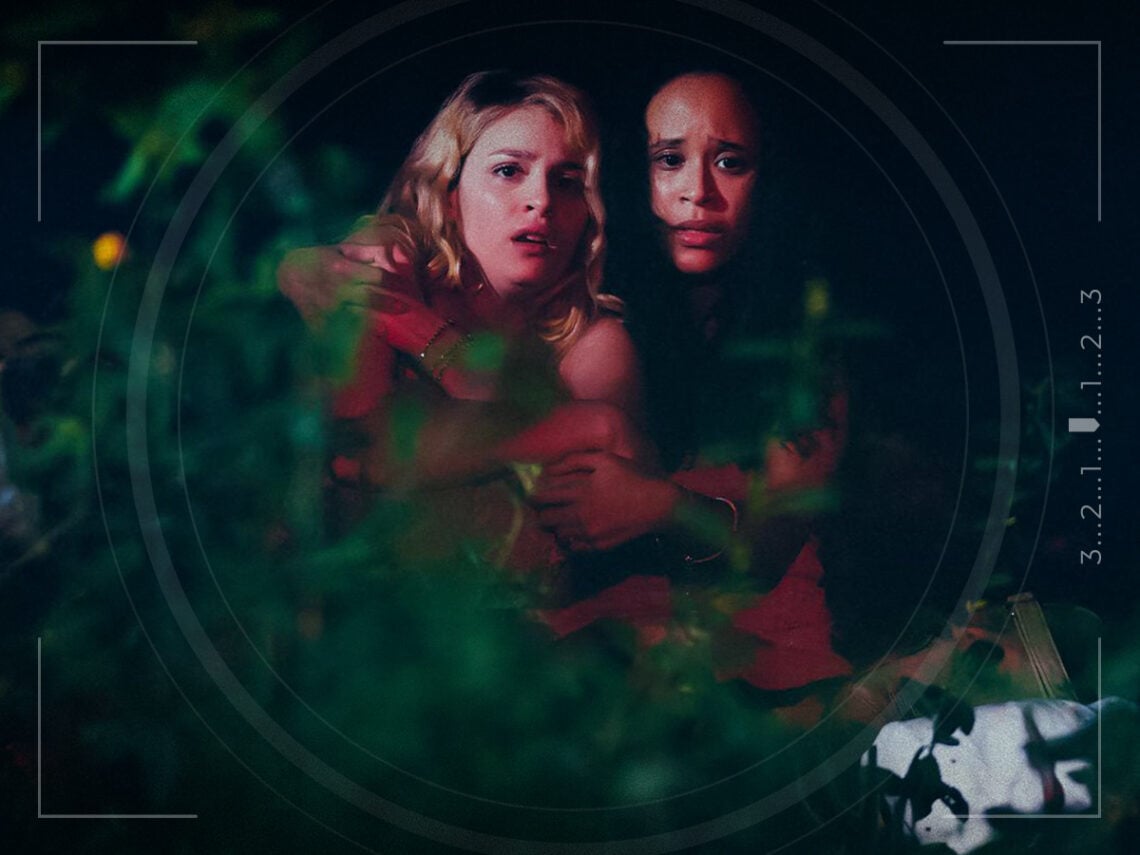
‘Medusa’: the Brazilian horror movie taking on Christian authoritarianism and internalised misogyny

There is a special place in hell for women who don’t support women, or so the saying goes. In Anita Rocha da Silveira’s 2021 horror movie Medusa, however, the relationship between female solidarity and the fiery pits of eternal damnation is twisted. Set in an unnamed city in Southeastern Brazil, the story follows a group of young Christian women who stalk the streets at night in masks and attack women who they deem to be promiscuous and ‘worldly’.
There have been plenty of movies about misogyny and even more movies that are outright misogynistic, but a story that takes direct aim at the internalised sexism that women enforce upon each other is largely untrodden territory. Silveira, a Rio native whose first feature, Kill Me Please, centred on a teenage girl who becomes obsessed with a spate of murders, was inspired by current events rather than personal ones when writing Medusa.
The rise of Jair Bolsonaro’s government in Brazil stoked the flames of a new kind of far-right Christian movement in which ultra-conservative misogyny is peddled by smiling YouTubers who make makeup tutorials and hip pastors who look like they walked straight off the set of a reality TV dating show. Medusa contains all of these elements, touching on how women can subjugate themselves and each other and make it all look like harmony.
Evangelical extremism is not unique to Brazil, of course. One need only see the sea of female anti-abortion protestors in the US or the baffling rise of trad wives and girl math on TikTok. If anything, Silveira’s film has only become more relevant in the years since it was released. As its title suggests, however, it is also a topic as old as time.
While developing the script, the director began to see parallels between the stories in the news and the Greek myth of Medusa, which centres on a young woman who had sex with Poseidon and was turned into a monster with snakes instead of hair by the goddess Athena as punishment for her supposed promiscuity. In the film, serpents feature heavily, painted on city walls and buildings like an omen.
Silveira threw everything at the wall narratively and stylistically, leaning heavily on cinematic inspirations like Brian De Palma’s Carrie, Dario Argento’s Suspiria, and Amy Heckerling’s Clueless. The religious extremism and cruelty of young women towards each other is an obvious throwback to Carrie, while the more comedic elements of cliquey in-fighting and pink-drenched decor are clear references to Clueless. But the nods to Suspiria are the most prevalent, right down to the soundtrack, which was composed specifically to mimic the prog rock bombast of Goblin. The director drenches the film in moody neon lighting as well, turning her characters green, blue, and red depending on the tone of the scene.
The main character, Mari, is a devoted Christian and member of the ‘slut’ hunting gang, but when one of their victims lashes back and slices her face with a broken bottle, she learns first-hand how fickle that supposed solidarity with her fellow vigilantes can be. Fired from her job at an aesthetics clinic, she becomes more and more obsessed with a woman who was attacked with gasoline and a lighter several years before and disappeared.
A long-time fan of David Lynch (she watched Blue Velvet for the first time at age nine), Silveira descends into surrealism as Mari starts searching for the missing woman. Blending the hallucinatory Lynchian sequences with Argento’s dramatic use of colour and music makes for a psychedelic and bewildering experience, and the third act feels more like a loose end than an ambiguously thought-provoking message.
Whatever its foibles, Medusa is a stylistically captivating film with a central conceit that feels frustratingly unexplored in other movies. As Carrie and Coralie Fargeat’s The Substance have proven so well, horror, and body horror in particular, is the perfect genre for highlighting the dark sides of being a woman in the modern world. While Silveira’s film might not be as prominent as those films, it addresses an aspect of the female experience that deserves greater examination.
