


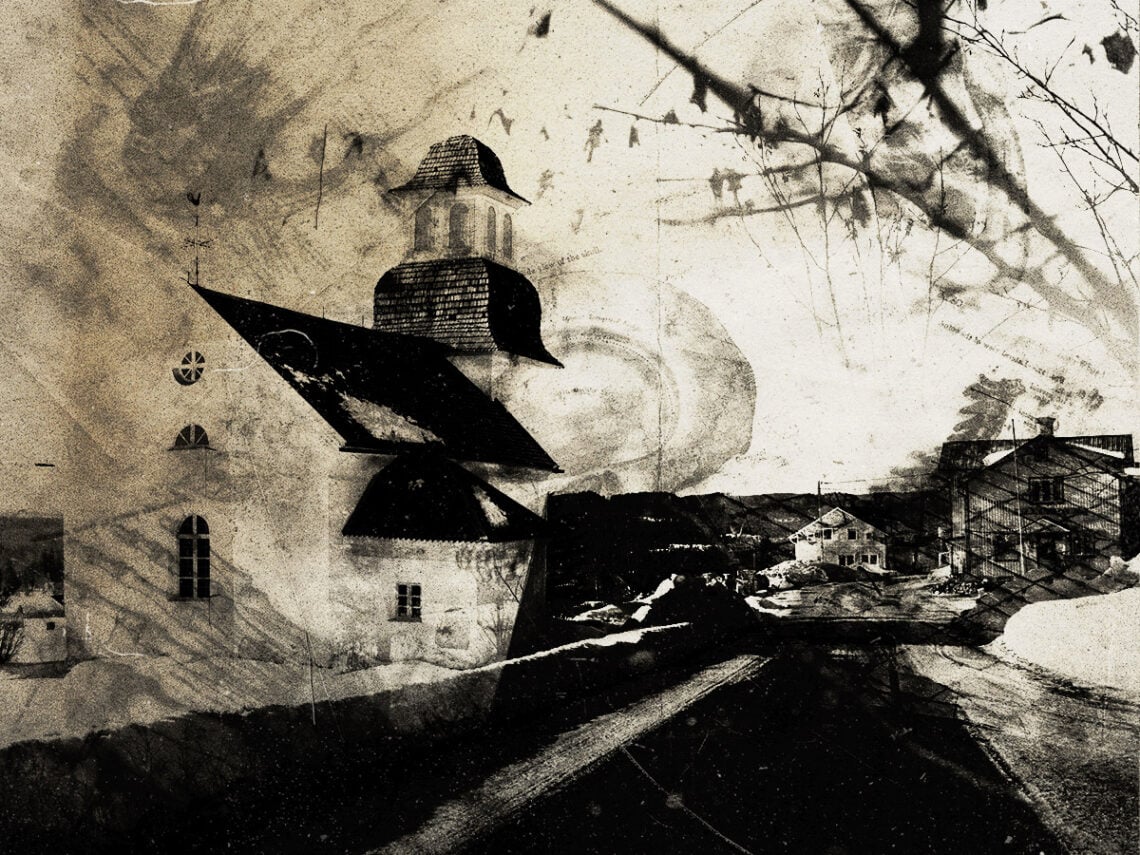
Exploring Borgvattnet: Sweden’s most haunted village

Home to just 50 or so residents, Borgvattnet is one of Sweden‘s smallest villages. It’s also home to perhaps the most haunted residence in the whole country. Borgvattnet Vicarage is so haunted, in fact, that it once attracted a renegade exorcist priest who spent a year trying to rid it of its many ghouls.
Located in an isolated corner of northeast Jämtland, Borgvattnet Vicarage was built in 1876. The first hauntings were reported in 1927 when the resident vicar revealed (prepare yourselves) that his laundry had been torn from the line. To be fair, that wasn’t all. Writing about his experiences in a personal letter, vicar Nils Hedlund explained that his mother, Marta, had died in the house’s pink room back in 1907. Overcome with grief, his father had decided to bury Marta in the garden rather than give her a Christian burial. When the local community discovered this, they demanded that her body be reburied in the churchyard. He agreed, but the next day the entire Hedlund family disappeared, taking Marta’s body with them. Nils eventually returned following his father’s death. The day his bedsheets were torn from the line, there hadn’t been a breath of wind all morning.
When Hedlund left Borgvattnet Vicarage, he was replaced by Vicar Rudolf Tängdén, who, in 1930, saw a grey lady walking slowly towards him from the far side of the main hall. Keen to learn more about the spirit, Tängdén approached the lady only for her to take a turn into the Expedition Room. When he reached the room for himself, he found it empty and still. Six years later, a man called Otto Lindgren moved in with his wife. While they never saw Tängdén’s grey lady, they heard footsteps going up and down the stairs and doors opening and closing at odd hours. Mrs Lindgren had perhaps the strangest experience of all. She was alone in the house one day when she heard music coming from behind the kitchen door. When she thrust it open, the music stopped abruptly. When Otto returned that evening, they heard the music again, and again it stopped as soon as they opened the door.
Things got even weirder in 1941 when Inga Flodin, the diocese secretary, stayed the night at Borgvattnet Vicarage and awoke at 3am to see three ladies gazing at her from the couch opposite her bed. Even when she turned the bedside light on, they were still there, gazing at her curiously. Flodin reported that one of the ladies was dressed in black, one in purple, and one in grey. They all wore sad expressions, but the most melancholy of the lot was the grey lady, who held a pile of knitting in her lap. When vicar Erik Lindgren moved in in 1945, he too began experiencing paranormal activity. On his very first night, he heard furniture being dragged across the floor of the room above his head. This wouldn’t have been so frightening were it not for the fact that his belongings had not yet arrived. When they were, he placed a rocking chair in the corner of a room. The next night he sat down to read but was thrust from the chair so violently that he fell to the ground. He never sat in the rocking chair again. From its constant rocking, he knew that to do so would be to insult whatever spirit had adopted it.
In the late 1940s, the hauntings at Borgvattnet Vicarage went national. In 1947, Erik was discussing his experiences with some fellow vicars when a journalist decided to pick up the story. The interview he subsequently conducted with Erik was published in the national newspapers and made Borgvattnet famous. In the 1970s, local entrepreneur Erik Brännholms spotted an opportunity and transformed the house into a bed and breakfast. A decade later, outsider priest Tore Forslund, having heard the many stories surrounding the vicarage, decided to put an end to what Borgvattnet locals had already commodified. Known as the ghost priest, the exorcist offered to rid Borgvattnet of its ghost problem once and for all. He felt strongly that the villages’ ghouls were a dangerous symptom of provincial occultism but failed to convince the locals that they had been banished. After a year, he left both Borgvattnet and the Church of Sweden for good.
Today the vicarage still operates as a bed and breakfast for curious tourists looking to test their mettle. Those who make it through the night receive a certificate to mark their bravery. You can rent a single room or, if you’re feeling up to it, the entire house.
You can browse booking options on the vicarage’s dedicated website. Reviews range from “cosy” to “I thought a door would melt”. Make of that what you will.
