


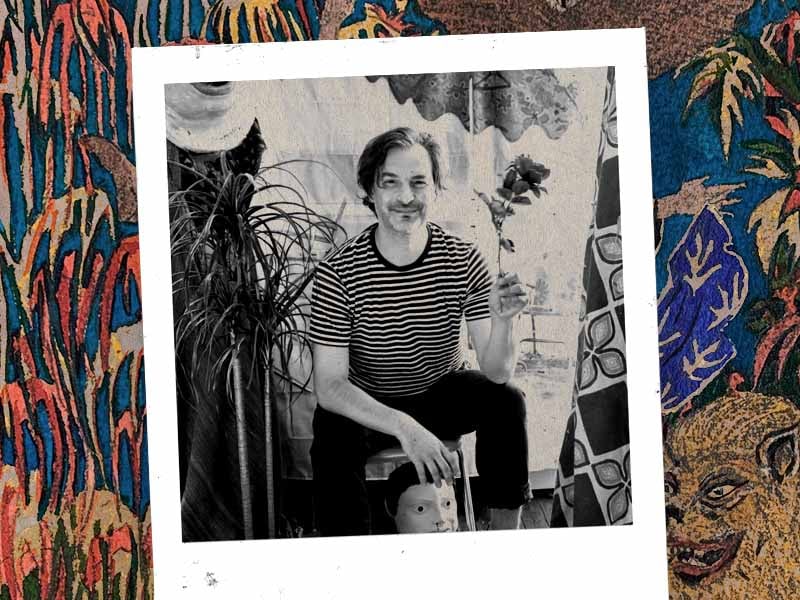
Book Club: Step into the dizzying world of Marcel Dzama’s ‘Pink Moon’

The moon has held sway over us for millennia. At its brightest, its milk-white glow can alter our very dreams, shaping the rhythm of our slumber with its strange, mercurial power. There’s something about its proximity to our planet, the sense that we could almost reach out and grasp it, that has led us to portray the moon not merely as a lump of space rock but as a guardian, a familiar presence with the hollow-eyed face of a benevolent grandparent. No matter where we are in the world, we see the same wrinkled brow and sunken eyes, the same wry grin. In this way, we are united by the moon, which is perhaps why our lunar neighbour is an ever-present spectator in Pink Moon, Marcel Dzama’s new collection of artworks inspired by his travels in Morocco and Mexico, available from Rough Trade Books.
In the 17th-century, an educator called Charles Morton decided to put an end to a mystery that had been plaguing European naturalists for centuries: the yearly disappearance of swallows. In his Compendium Physicae, he claimed that the migrational birds spent their winters not, as had been proposed, at the bottom of the ocean but nesting in the moon’s craters. For Morton, the astral body served as a screen onto which he was able to project his wildest imaginings. His since-debunked theory is a reminder that for as long as the moon has dangled above us, it has served as a mirror to our dreams and fears. It is perhaps for this reason that some ancient Greek philosophers indulged the possibility that the moon might be little more than a reflection of the earth.
As you would expect, Aristotle was unconvinced by this explanation and proposed that it was as flat as a warrior’s shield and only a stone’s throw from our world. Together with Pliny the Elder, he maintained that the brain’s high water content made it susceptible to the planetoid’s tidal influences, an assertion that reflects the folkloric belief that the moon’s phases can influence human behaviour, a belief shared by Marcel Dzama. For the artist, the moon is something with agency and power: “It’s like a restlessness. A weird energy, almost like a caffeine fix,” he says of the new moon. “I always have strange nightmares. Or dreams, not even nightmares, but absurd dreams if I do sleep deeply.”
But it isn’t just our mood the moon is said to hold mastery over. From selkies to werewolves, folklore abounds with stories of physical transformation under lunar light. Dzama plays with this idea to great effect. His swirling world is overrun with animal-human hybrids: dancers with the heads of bears, toddler-esque cats, and besuited rabbits are all residents of his nocturnal landscapes. The division between human and animal is just one of the many partitions Dzama delights in erasing. In the world of Pink Moon, the boundary between urban clubland and rural idyll is similarly blurred, allowing for a selection of chimaeric landscapes that throb with burnt oranges, cerulean blues and emerald greens.
The intensity of Dzama’s colour scheme in this collection stands in stark contrast to that of his early works, many of which boast the snow-white backdrops of his native Winnipeg. This sensitivity to landscape and environment is a common thread running through the breadth of Dzama’s artwork. When the artist relocated to New York, his characters were also invited into the hustle and bustle. Suddenly, his paintings became a “claustrophobic ballet”, a swirl of human life once populated by woodland animals. It’s unsurprising, then, that when he stepped into the unfamiliar cultures of Mexico and Morocco, the intensity of these new environments was reflected in his art. It was a “Matisse moment” in which he found himself fascinated by “patterns and textiles. Turquoise and yellow and gold I never would have touched before. Now I’m drawn to it. Even after the travel, the colour stayed with me”.
Dzama started working on the Pink Moon collection at the height of the first lockdown when the skies were empty of their usual aerial traffic. Spotting a pink moon from his studio, he was reminded of a trip to Morocco two years earlier, where he’d witnessed an equally intoxicating lunar spectacle. He began to wonder if he was being followed. It’s a preoccupation that permeates the collection. Midnight bathers, cigarette-smoking cayotes, jazz musicians in mid-romp: almost all of them are caught in the impenetrable gaze of a low-slung orb. The majority of these inhabitants are women. Exquisitely painted, they wear the sleek bobs of jazz-age cabaret dancers, oscillating between the maternal, fraternal and seductive. It is under the light of the moon that they seem the most candid, shedding their skins to reveal previously hidden forms. They remind us that, astrologically, the moon has frequently been considered matriarchal, probably because it was said to be responsible for controlling all things related to water, whether tidal or amniotic.
We see the maternal quality of the moon in one of the earliest vestiges of lunar worship: the Venus of Laussel, a 44-centimetre limestone relief sculpture from the Upper Palaeolithic period. In her right hand, she holds the crescent horn of a bovid, into which 13 notches (perhaps to indicate the 13 phases of the moon) have been meticulously carved. Her left hand, meanwhile, is placed upon her belly, suggesting that the once-ochre statuette may have been used in fertility rituals or had some association with menstruation. Dzama’s moons, in contrast, cannot be pinned down to one purpose or personality. While some are cantankerous, others are melancholy – their groove-laden faces betraying something akin to loneliness. Other times, they are puppeteer tricksters, staring down on stages set with props and players. “He has control of everyone’s destiny,” Dzama says of his protagonist. “He’s watching his mad work unfold. Or maybe it’s me. It’s my representation. It’s the artist making this drawing.”
Pink Moon is published by Rough Trade Books. Featuring an introduction by fashion designer Duro Olowu and an interview by Craig Taylor, the collection seeks to visualise the experience of travel and cultural immersion in a way that brings the subconscious realm bubbling to the surface. The book is available in a regular edition and in a new special limited edition, which includes an EP featuring covers of Nick Drake’s ‘Pink Moon’ by Sufjan Stevens and Hannah Peel. Pressed onto a vinyl decorated with Marcel Dzama’s Pink Moon artwork, the disc is as much a work of art as anything within the pale rose pages of this expertly curated collection.
Photos were provided courtesy of David Zwirner Gallery.
