


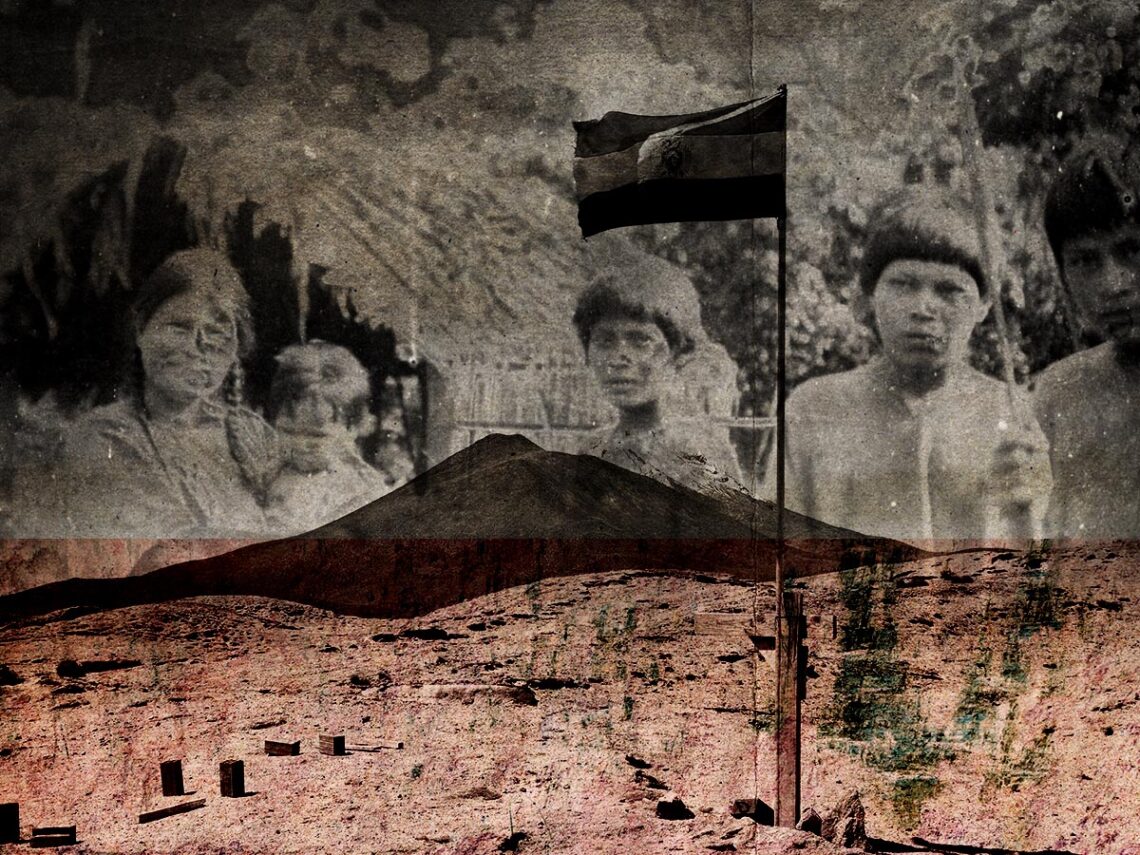
Off The Beaten Track: The incredibly singular music of the Bolivian Tsimane tribe that defies harmony as we know it

Not to put too fine a point on it, but music is a weird phenomenon. It can make us weep, bring back memories, and mimic the feelings of fear, ecstasy, and everything in between. It can also conjure the seasons, and storms, follow societal trends and revolutionise hairdos. It knows no bounds, seems as natural as the wind, and yet we can define and study this seeming magic like maths. When you venture off the beaten track to the Tsimane tribe in Bolivia, the oddities of its strange constitution really do come to the fore.
Penetrating through the cacophonous hum of the lowland Bolivian rainforest comes the caterwauling screech of a singing Tsimane tribe member. It’s a dissonant and wildly out-of-tune ramble that couples plate-scratching tones with the rolling clamour of a toddler with pots and pans at their chaotic disposal. Sat around the singer are local tribe members basking in its beauty. What seems like a vocalised scrap metal facility to the western ear sounds to them like a harmonious musical soliloquy. This caterwauling is, in fact, the rainforest’s equivalent of an acapella campfire performance by Etta James.
Why does it sound so different to the Western ear? This is a question with profound implications that we don’t often think about. You don’t have to think too much about Jeff Buckley’s ‘Hallelujah’ to know that you’re listening to the cry of a lovelorn fellow—even a babbling baby could somehow tell you that. However, such patently obvious musicology is lost when you visit a community that largely lives in isolation and has little or no exposure to the west.
So, why does music sound so different to them? Well, music is noise, that goes without saying, but it also has multifaceted implications when you view the simple statement from a cultural standpoint. The natural landscape of Europe created a quieter environment, with the soft hush of flowing rivers, genteel bird songs and quiet mammals. The pleasantry of early classical music mimicked this. However, in the Amazon, the natural environment is a wild racket of screaming primates, the background buzz of insects, hisses pops, and battering storms.
Also, keeping a close ear to hearing this is also essential for tribes. That means that their music had to be different. It had to cut through that cacophony in some way while also being inspired to capture its own strange beauty. On the surface, that’s the reason why their music is so different, but why is it also so atonal? Why does it defy what we perceive to be the mathematical rules of music?
Well, a recent study by MIT and the Max Planck Institute for Empirical Aesthetics in Germany looked into this dissonant disparity. Immediately, they found no biological difference. The Tsimane’s hearing was the exact same as ours. So, with this in mind, they wanted to figure out whether octave pitches were routed in universal maths or culturally learnt.
The findings showed that our musical language of octaves is a purely learnt one. It might seem natural to us to match the same notes on an octave scale, but to the Tsimane tribe, this was a foreign language. In essence, this proved that while music might be a universal communicator, we speak in different tongues within it.
Octaves aren’t important in the clamour of the jungle. They are, however, in the quieter world of the west, resulting in pitched nuance for greater harmonic resonance. In other words, we wanted our music to sound pretty like meadows, not riotous like a jungle, so we fine-tuned harmonics and came up with octaves so that we could variate notes. However, in the jungle, noise is noise and being ‘in tune’ simply isn’t all that important.
Perhaps most fascinatingly of all, when our worlds, in turn, became a cacophonous roar through the rise of industry, even we questioned the importance of octaves in genres like heavy metal, industrial music and other avant-garde forms. All the while, the Tsimane tribe had been doing something similar with their primitive folk stylings.
