


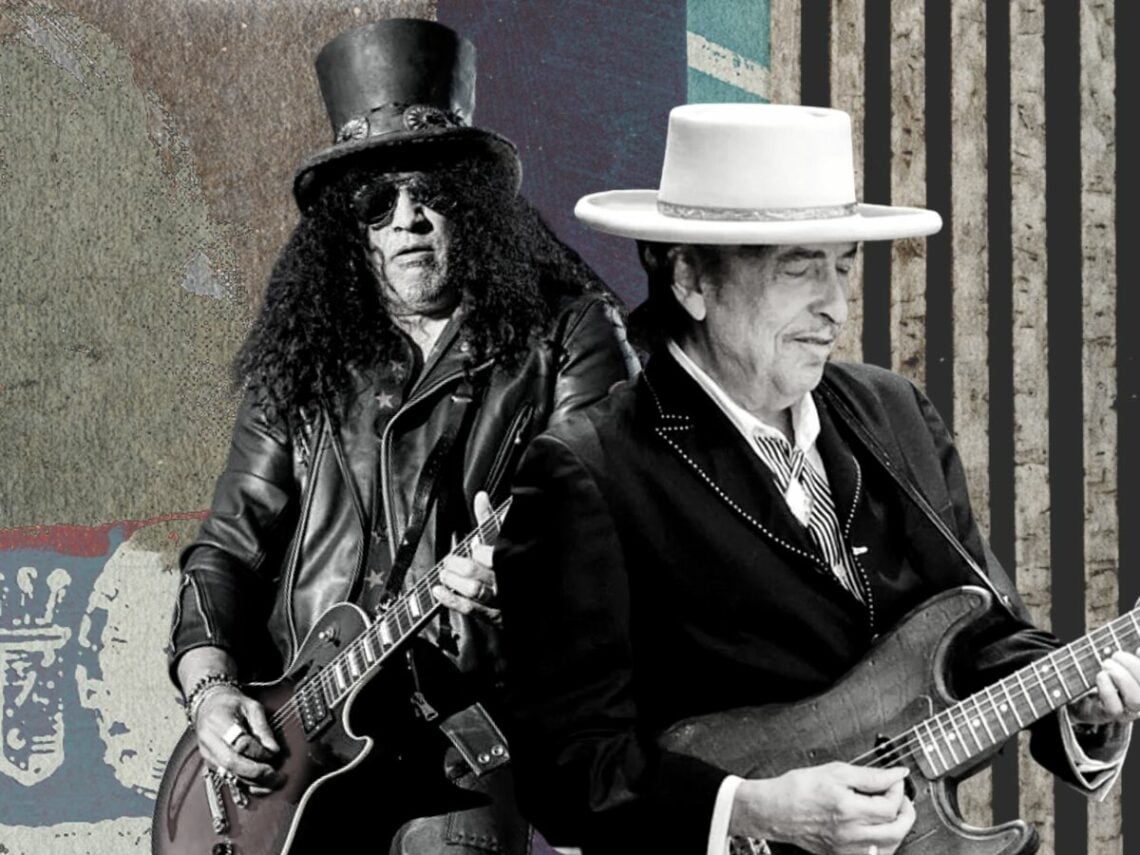
When Bob Dylan refused to use one of Slash’s guitar solos

I often hear the phrase, “you can’t have everything.” These words carry a lot of truth, but when it comes to Bob Dylan: he very nearly did. As the greatest songwriter in living memory, he inspired a ripple of generations to pick up their pen and begin writing their own music, and while his vocal talents aren’t conventionally mellifluous, he gave a unique voice to eternally impactful words that don’t sound right coming from any other mouth.
As a musician, Dylan has never been regarded as a virtuoso, either on the piano or guitar, but he’s been able to comfortably shepherd sound to suit his words for six illustrious decades. Of course, Dylan hasn’t worked in isolation all this time. His material has frequently benefitted from various collaborations, especially those with silky guitar skills, such as Mark Knopfler and Mick Taylor, who contributed to Infidels and Empire Burlesque.
Despite collaborating with guitarists of such fame and calibre, Dylan once asserted that of all the stringmen he’s worked with, Mike Bloomfield awed him the most. The lesser-known virtuoso was one of the most gifted guitarists of the 1960s. After Dylan’s meteoric rise early in the decade, he had no question in his mind when picking out the guitarist he wanted to play alongside when recording his classic 1965 album, Highway 61 Revisited.
Reflecting on his time working with Bloomfield on the 2005 documentary, No Direction Home, Dylan said: “Mike Bloomfield said he’d heard my first record, and he said he wanted to show me how the blues were played. And I didn’t feel much competitive with him. He could outplay anybody, even at that point. When it was time to bring in a guitar player on my record, I couldn’t think of anybody but him. I mean, he just was the best guitar player I’d ever heard.”
Following Dylan’s successful collaborations with Knopfler and Taylor in the 1980s, he looked to scour pastures new for his next guitar collaborations. While working on his 1990 album, Under the Red Sky, Dylan’s producer Don Was brought in Slash of Guns N’ Roses to contribute guitar parts for ‘Wiggle Wiggle’, a song not many fans would pick out as a highlight.
“I put what I thought was one of my better one-off solos on there,” Slash told CBS Radio of the collaboration. “Then I took off home, and I said: ‘Send me a rough mix whenever you get one.’ So, Don had the tape messengered over a couple days later, and I’m listening to it. It’s the song ‘Wiggle Wiggle’, and it’s a very sort of innocuous song in the first place [giggles], and so here comes the solo section — and it’s just acoustic. There’s a pointless acoustic section, then the song kicked back in.”
Slash then revealed that he called Was to ask what had happened to his original solo. “He goes: ‘Well, Bob thought it sounded too much like Guns N’ Roses’ — which, for me, was the ultimate compliment,” Slash opined. “All things considered, at least I was a part of a band that had an identifiable sound, and the guitar playing was recognisable for Bob to notice that. It was a drag because I thought the solo was pretty good. But, you know, live and learn. For me, it was one of those classic sessions stories that I adore.”
While Slash’s solo was omitted from the track, his rhythm section prevails. Joining the Guns N’ Roses guitarist on the album’s credits was Dylan’s Traveling Wilburys bandmate George Harrison, who played slide guitar in the title track, Stevie Ray Vaughan, who played on ‘10,000 Men’, Elton John and Bruce Hornsby.
Listen to Bob Dylan’s ‘Wiggle Wiggle’ below.

Never Miss A Tale
The Far Out Bob Dylan Newsletter
All the latest stories about Bob Dylan from the independent voice of culture.
Straight to your inbox.